Fence-running is the repetitive, high-arousal behavior of a dog sprinting back and forth along a fence line – usually barking, lunging, or spinning at the corners – in response to stimuli on the other side. It is not exercise. It is not play. It is a self-reinforcing stress behavior that escalates over time and, left unchecked, progresses to fence-fighting, barrier aggression, and escape attempts.
The worn dirt path along your fence line is the evidence. Every lap the dog runs deepens the habit, increases the arousal, and makes the next lap more likely. A dog that fence-runs for 30 minutes a day is not getting a workout – it is practicing a pattern that raises its baseline stress level, damages its relationship with neighbors, and puts it one triggered sprint away from going over, under, or through the fence.
This guide identifies the four root causes of fence-running, provides a matched training and management fix for each, explains how fence-running escalates into more dangerous behaviors, and introduces the “inner boundary” concept – a GPS virtual fence set inside the physical fence that keeps the dog away from the trigger zone entirely.
What Is Fence-Running and Why Is It a Problem?
Fence-running is a repetitive locomotor behavior in which a dog runs, trots, or paces along a fence line in response to a visual, auditory, or olfactory trigger on the other side of the barrier. The behavior is typically accompanied by barking, whining, or growling, and the dog often spins or bounces at the end of the fence before reversing direction.
Fence-running is a problem for four reasons:
- It increases the dog’s stress level. Each run raises arousal without providing a satisfying resolution – the trigger (another dog, a person, a squirrel) is always visible but never reachable. The dog finishes each session more frustrated than it started.
- It is self-reinforcing. The trigger passes by (the person walks away, the neighbor’s dog goes inside), and the dog interprets its own behavior as the cause: “I barked and ran, and the threat left.” The dog is rewarded for the behavior by the trigger’s departure, even though the two events are unrelated.
- It damages the fence and the yard. Repetitive running wears a dirt path along the fence line, kills grass, loosens fence posts, and creates weak points the dog may eventually exploit to escape.
- It escalates. Fence-running that starts as pacing progresses to barking, then lunging, then fence-fighting with a neighbor’s dog, and eventually to digging, climbing, or jumping – a full escape sequence that began as a “harmless” habit.
“This is the part owners underestimate completely. They see the mailman leave and think the episode is over. From the dog’s perspective, it just won. It charged, it barked, it patrolled—and the intruder retreated. That’s a successful outcome, reinforced twice a day, six days a week. By month three, you don’t have a dog with a habit. You have a dog with a job it’s extremely good at and deeply committed to. Unwinding that reinforcement history takes structured work—you’re competing against hundreds of successful repetitions.”
– Arianna MelendezHalo Trainer Expert (Dog Psychology & Behavior Modification)
Why Do Dogs Run the Fence Line?
Fence-running looks the same regardless of cause, but the underlying motivation determines which fix will work. Four root causes account for the majority of cases.
Territorial Reactivity
The dog is patrolling its boundary and reacting to perceived intruders – other dogs, pedestrians, delivery drivers, joggers, cyclists. The behavior intensifies when the trigger is close to the fence and decreases when the trigger is far away or absent.
Diagnosis: The dog runs only when a specific type of trigger is present. No trigger, no running. The dog’s body language is forward – ears up, tail high, weight on the front legs, hackles possibly raised.
Fix: Block visual access to the trigger (privacy fence slats, solid panels, landscaping). Desensitize by practicing calm behavior at progressively closer distances to the fence while triggers pass. Reward the dog for noticing the trigger and turning toward you instead of charging the fence.
Barrier Frustration
The dog wants to reach what is on the other side – not to attack it, but to greet it, play with it, or investigate it. The fence prevents the dog from doing what it wants, and the resulting frustration manifests as frantic running, whining, and spinning.
Diagnosis: The body language is different from territorial reactivity. The dog’s tail is wagging (though rapidly), the dog may play-bow at the fence, and the vocalizations are higher-pitched. This dog would be friendly if the fence were removed – the fence itself is creating the problem.
Fix: Arrange supervised, controlled greetings with the neighbor’s dog outside the fence context. Provide off-property socialization through walks, parks, or playdates so the dog’s social needs are met. Once the frustration source is addressed, the fence-running decreases because the underlying need is being fulfilled elsewhere.
Boredom and Under-Stimulation
The dog runs the fence because there is nothing else to do. The yard offers no enrichment, no toys, no company, and no structured activity. The stimulation on the other side of the fence – any stimulation – becomes the default entertainment.
Diagnosis: The dog fence-runs even when no specific trigger is present. Passing cars, distant voices, birds – anything prompts a run. The dog also shows other boredom-related behaviors: digging holes in the middle of the yard, chewing on deck furniture, or barking at nothing.
Fix: Increase daily exercise to meet the dog’s breed requirements. Add enrichment to the yard: puzzle feeders, snuffle mats, frozen treat toys, digging zones. Limit unsupervised yard time – the yard should be a place for structured play and relaxation, not an all-day holding pen. For breed-specific exercise targets, see how much exercise.
Compulsive Behavior
In severe cases, fence-running becomes a compulsive behavior – the dog cannot stop even when the trigger is removed, the owner calls, or the environment changes. The dog runs the same path, at the same speed, with the same vocalizations, in a loop that looks mechanical rather than reactive.
Diagnosis: The behavior continues when no trigger is present. The dog appears to be in a trance-like state. Interruption is difficult – the dog may briefly stop when called but returns to the fence within seconds. The dirt path along the fence line is deeply worn.
Fix: Compulsive fence-running requires veterinary behavioral support. A board-certified veterinary behaviorist can determine whether medication (typically an SSRI) is appropriate alongside behavior modification. Management is essential: the dog should not have unsupervised access to the fence until the compulsive cycle is broken. Enrichment, exercise, and structured training alone are usually insufficient for true compulsive cases.
How Does Fence-Running Escalate?
Fence-running that is not addressed follows a predictable escalation pathway:
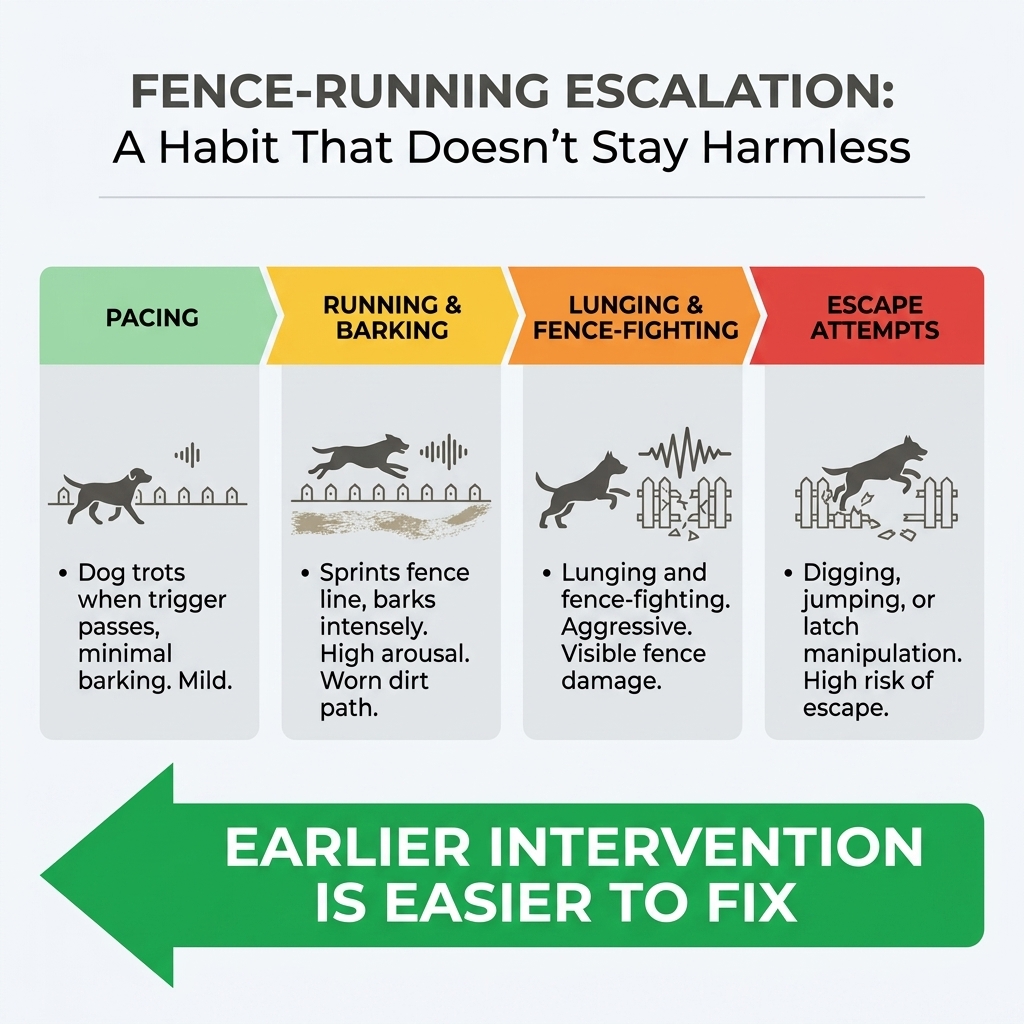
- Pacing. The dog trots along the fence when a trigger passes. Minimal barking. The behavior is mild and may seem harmless.
- Running and barking. The dog sprints the fence line and barks intensely. Arousal is high. The worn path appears.
- Lunging and fence-fighting. If a neighbor’s dog is on the other side, the running becomes aggressive: snarling, snapping at the fence, body-slamming the panels. Fence damage begins.
- Escape attempts. The dog begins testing the fence for weaknesses. Digging at the base, jumping at weak sections, working gate latches. The arousal from weeks of fence-running has primed the dog to take the next step: getting through.
The earlier you intervene in this sequence, the easier the fix. Pacing is a training problem. Compulsive fence-fighting with escape attempts is a behavioral emergency. For dogs already at the escape stage, see escape artist dog.
How Do You Train a Dog to Stop Fence-Running?
Effective training addresses fence-running from three angles simultaneously: reduce the trigger’s power, teach an alternative behavior, and manage the environment so the dog cannot rehearse the habit.
Block Visual Triggers
If the dog is reacting to stimuli it can see, reducing visibility is the fastest intervention. Install privacy slats in chain-link fencing, add solid panels to sections where fence-running is worst, or plant dense shrubs 3 to 5 feet inside the fence line to create a natural visual barrier. For many dogs, blocking the visual trigger reduces fence-running by 50% or more immediately.
Teach a Redirect Command
The goal is to teach the dog that hearing a cue word (“away,” “leave it,” or the dog’s name) means “turn away from the fence and come to me for something better.”
- Start inside with no distractions. Say the cue, deliver a high-value treat when the dog turns to you.
- Move to the yard, far from the fence. Practice the redirect 10 to 15 times per session.
- Gradually move practice closer to the fence, with no triggers present.
- Add controlled triggers: have someone walk past the fence while you practice the redirect.
- Build reliability until the dog turns away from the fence at the cue in 8 out of 10 attempts with triggers present.
The redirect must happen BEFORE the dog reaches full arousal. Once the dog is in a fence-running sprint, verbal cues are unlikely to penetrate. Intervene at the ear-perk stage, not the full-sprint stage. For building a strong recall that supports this redirect, see reliable recall.
Increase Exercise and Enrichment
A dog that has met its daily exercise requirement and has been mentally stimulated through training, nose work, or puzzle toys has less residual energy to pour into fence-running. For most breeds, this means 30 minutes to 2 hours of structured exercise before the dog is left in the yard. The yard should supplement exercise, not replace it.
Use a Long Line for Management
During the training period, attach a 15-to-25-foot lightweight long line to a body harness (not a neck collar) when the dog is in the yard. If the dog begins running the fence, step on the line to interrupt the behavior, then redirect. The long line prevents the dog from rehearsing the habit while the redirect command is being established.
How Can a GPS Fence Help Stop Fence-Running?
A GPS fence collar introduces a tool no physical barrier can provide: an inner boundary that keeps the dog away from the fence line entirely.
The concept works like this: your physical fence defines the property line. You draw a GPS virtual fence boundary 10 to 15 feet inside the physical fence, creating a buffer zone between the dog’s allowed area and the trigger zone along the fence.
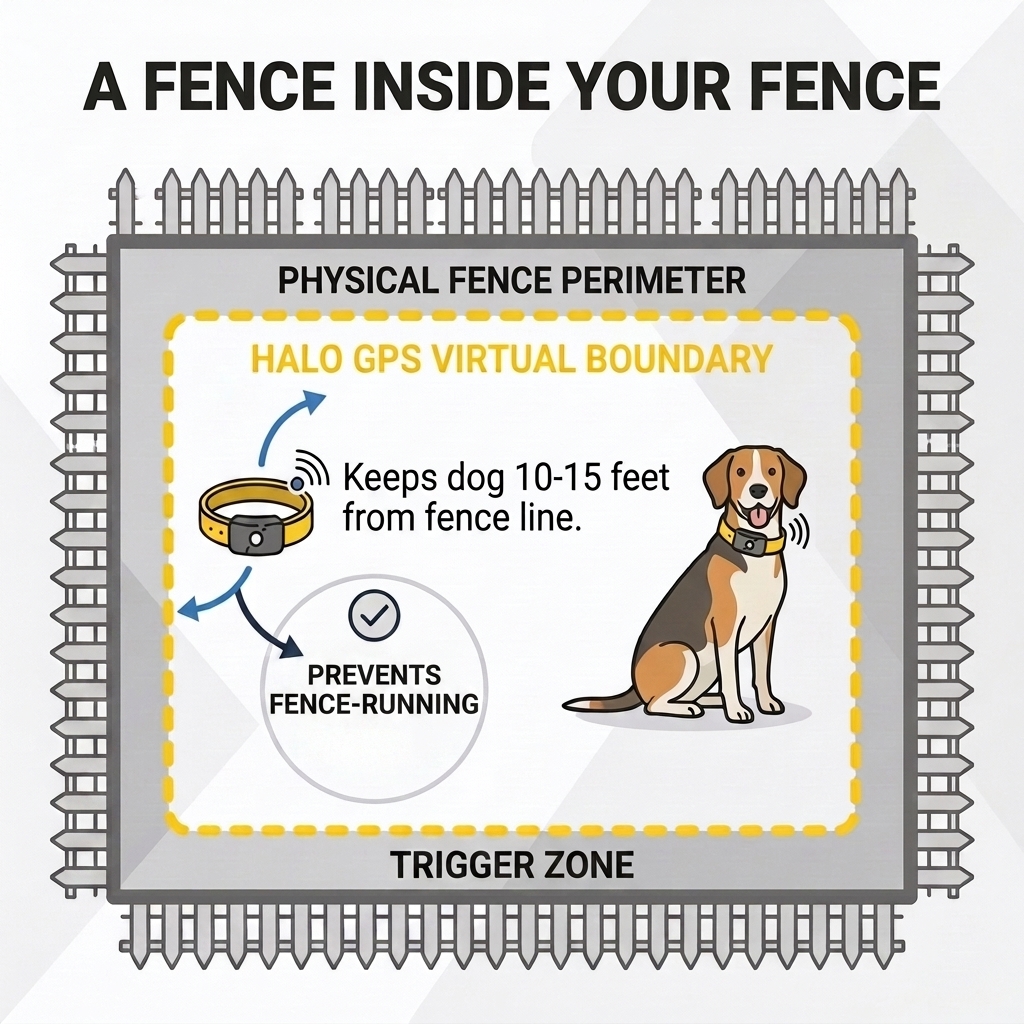
When the dog approaches this inner boundary, the collar delivers graduated feedback – a warning tone, then vibration – that redirects the dog before it reaches the physical fence and the stimuli that trigger the running.
The Halo Collar’s patented Direction-Based Feedback adds precision: the collar detects not just where the dog is, but which direction it is heading. A dog trotting casually near the inner boundary receives a gentle warning. A dog sprinting toward the fence at full speed receives a more immediate escalation. The feedback matches the intensity of the approach, creating a proportional response the dog can understand.
When the dog turns away from the inner boundary and moves back toward the center of the yard, the collar delivers encouragement feedback – a positive tone that rewards the correct decision. Over 2 to 4 weeks of consistent use, the dog learns that the interior of the yard is the comfortable, rewarding zone, and the fence line is not worth approaching.
The inner boundary concept works because it changes the dog’s relationship with the fence line from “a place where exciting things happen” to “a place I never go.” The physical fence remains as the safety barrier. The GPS fence creates the behavioral barrier that makes the physical fence irrelevant to the dog’s daily experience.
The Halo Collar supports unlimited virtual GPS fences with <2-foot accuracy, so the inner boundary can be precisely positioned – close enough to the physical fence to preserve usable yard space, but far enough to eliminate the dog’s access to the trigger zone.
Which Breeds Are Most Prone to Fence-Running?
Breed predisposition to fence-running is rooted in the drives each breed was developed to express.
- Herding breeds (Border Collies, Australian Shepherds, German Shepherds): The patrol instinct is hardwired. These dogs naturally circuit a perimeter and react to movement with chasing behavior. Fence-running is the herding drive without livestock – the dog is “herding” the triggers on the other side of the fence. They need structured jobs (agility, nose work, obedience drills) to redirect the drive.
- Terriers (Jack Russells, Bull Terriers, Fox Terriers): High prey drive combined with tenacity. A terrier that spots a squirrel on the fence will run that section of fence line for an hour without tiring. Environmental management (blocking visual access) is essential for these breeds.
- Guard breeds (Rottweilers, Dobermans, Cane Corsos): Territorial drive makes fence-running an expression of property protection. These dogs are guarding, not playing. The behavior can escalate to genuine aggression toward anything that approaches the fence. Desensitization to common triggers (pedestrians, delivery vehicles) is critical.
- High-energy working breeds (Huskies, Malinois, Weimaraners): These breeds fence-run from under-stimulation. They have more energy than the yard can absorb, and the fence line is the only stimulus available. The fix is exercise volume – 60 to 120 minutes of vigorous daily activity, not more yard time.
Can Fence-Running Be Completely Eliminated?
Yes, for most dogs. Fence-running driven by boredom, barrier frustration, or territorial reactivity responds well to a combination of environmental management (blocking triggers, inner boundary GPS fence), training (redirect command, impulse control), and adequate exercise.
For dogs with compulsive fence-running, the behavior can be managed to the point where it no longer dominates the dog’s outdoor time, but complete elimination may require ongoing behavioral support and medication. The key distinction is whether the dog can be interrupted and redirected (not compulsive – training will work) or whether the dog continues running regardless of intervention (potentially compulsive – seek veterinary behavioral evaluation).
The most reliable long-term solution for any fence-running dog combines three elements: reduced access to triggers (privacy modifications or inner boundary GPS fence), a trained redirect command, and daily exercise that meets the dog’s breed requirements. When all three are in place, most dogs stop fence-running within 3 to 6 weeks.
Fence-Running FAQs
Is fence-running a sign of aggression?
Not always. Fence-running can be driven by territorial reactivity (which looks aggressive), barrier frustration (which looks aggressive but is actually social), boredom (which involves no aggression at all), or compulsive behavior (which is neurological, not emotional). The body language during the behavior is the diagnostic key: forward posture with hackles and snarling suggests aggression; wagging tail with play-bows suggests frustration; mechanical pacing without clear arousal suggests compulsion.
Should I punish my dog for fence-running?
No. Punishment after fence-running increases the dog’s stress level, which makes the underlying cause (reactivity, frustration, boredom, compulsion) worse. Interruption and redirection are effective. Punishment is not. If you cannot interrupt the behavior verbally, use a long line to guide the dog away from the fence, reward the redirection, and reduce access to the trigger zone.
Will a privacy fence stop fence-running?
A privacy fence reduces visually triggered fence-running but does not eliminate it entirely. Dogs that fence-run in response to sounds (voices, footsteps, other dogs barking) or smells (other animals marking nearby) will continue running along a solid fence. Privacy modifications are most effective when combined with redirect training and exercise increases, or with a GPS inner boundary that keeps the dog away from the fence regardless of what is on the other side.
How long does it take to stop fence-running?
Boredom-driven fence-running often resolves within 1 to 2 weeks of increased exercise and enrichment. Territorial and frustration-driven fence-running typically takes 3 to 6 weeks of consistent redirect training combined with environmental management. Compulsive fence-running may take 2 to 6 months of behavioral modification, sometimes with veterinary-prescribed medication. The longer the dog has been practicing the behavior, the longer the resolution takes.