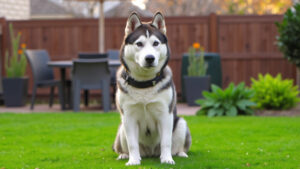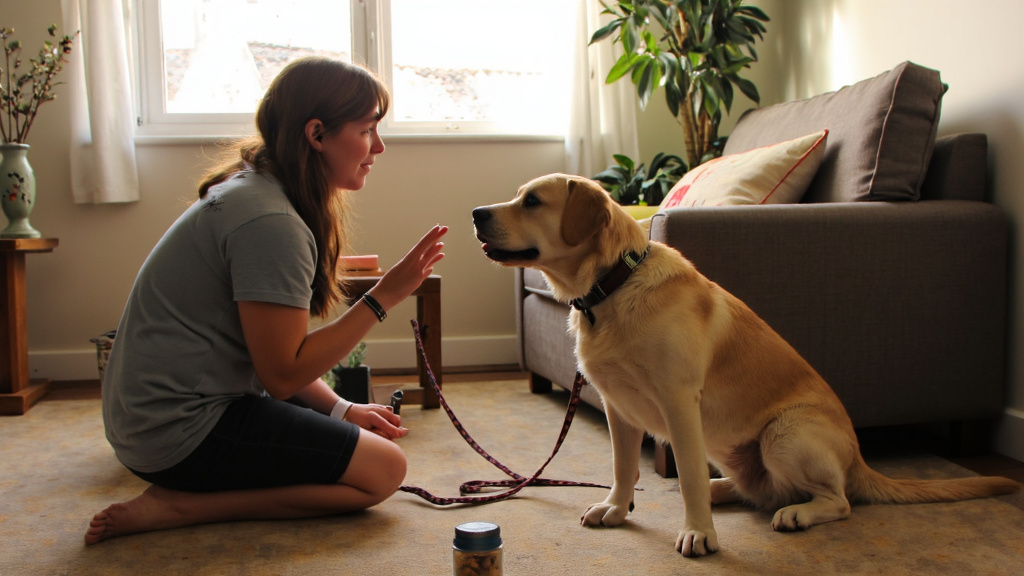
A reliable recall means your dog turns and runs back to you the instant it hears your cue – regardless of what it was doing, what it was chasing, or how far away it is. This is not the same as a dog that comes when called sometimes, when it feels like it, or when nothing more interesting is happening. Reliable recall means every time, first cue, no negotiation.
Recall is the single most important safety command any dog can learn. A dog with reliable recall can enjoy off-leash hikes, off-leash yard time, and the kind of freedom that makes a dog’s life richer and more fulfilling. A dog without reliable recall is a liability – one open gate, one squirrel, one loud noise away from a dangerous situation that you cannot control from a distance.
This guide provides a phased recall training program with specific weekly timelines, measurable benchmarks at each stage, games that make training enjoyable for both dog and handler, and an emergency recall protocol that could save your dog’s life. Whether you are starting with a puppy or rebuilding recall with an adult dog, the methodology is the same – the timeline simply adjusts.
Why Is Recall the Most Important Command?
Recall is the only command that works at a distance, in any direction, against competing motivations, in a situation you may not have anticipated. “Sit” requires proximity. “Stay” requires the dog to already be stationary. “Leave it” requires the dog to be within hearing range and relatively calm. Recall is the one command that brings a running dog back from any direction, at any distance, under any level of arousal.
Dogs with reliable recall live bigger lives. They can hike off-leash, explore large properties, play in open spaces, and experience the sensory richness of the outdoor world without being tethered to a six-foot leash. For owners, reliable recall transforms every outing from a management exercise into a shared experience.
For dogs that spend time in unfenced yards or travel to unfenced locations, recall is also the foundation of GPS fence training. The same principles that build recall – cue, response, reward – are the same principles that teach a dog to respond to a boundary warning tone and return to the safe zone. For a deeper look at why dogs leave in the first place, see why dogs run away.
What Do You Need Before You Start Recall Training?
Gather these tools and make these decisions before your first training session:
- A consistent recall cue. Choose one word (“come,” “here,” or a whistle) and use it exclusively. Every person in the household must use the same cue. Mixing “come” and “here” and “get over here” confuses the dog and weakens every version.
- High-value treats. Recall rewards must be exceptional – not kibble, not regular training treats. Use small pieces of chicken, cheese, freeze-dried liver, or whatever your dog considers the highest-value food. The recall treat should be something the dog never gets during any other activity.
- A long training line. A lightweight 15-to-30-foot leash that allows the dog to move freely while giving you a safety handle. Do not use a retractable leash – the tension mechanism teaches the dog to pull, which is the opposite of what recall requires.
- Collar grab practice. Before training recall, teach your dog that having its collar grabbed is a positive experience. Reach for the collar, touch it, deliver a treat. Repeat until the dog leans into the collar grab. This prevents the common problem of a dog that comes close but dances out of reach.
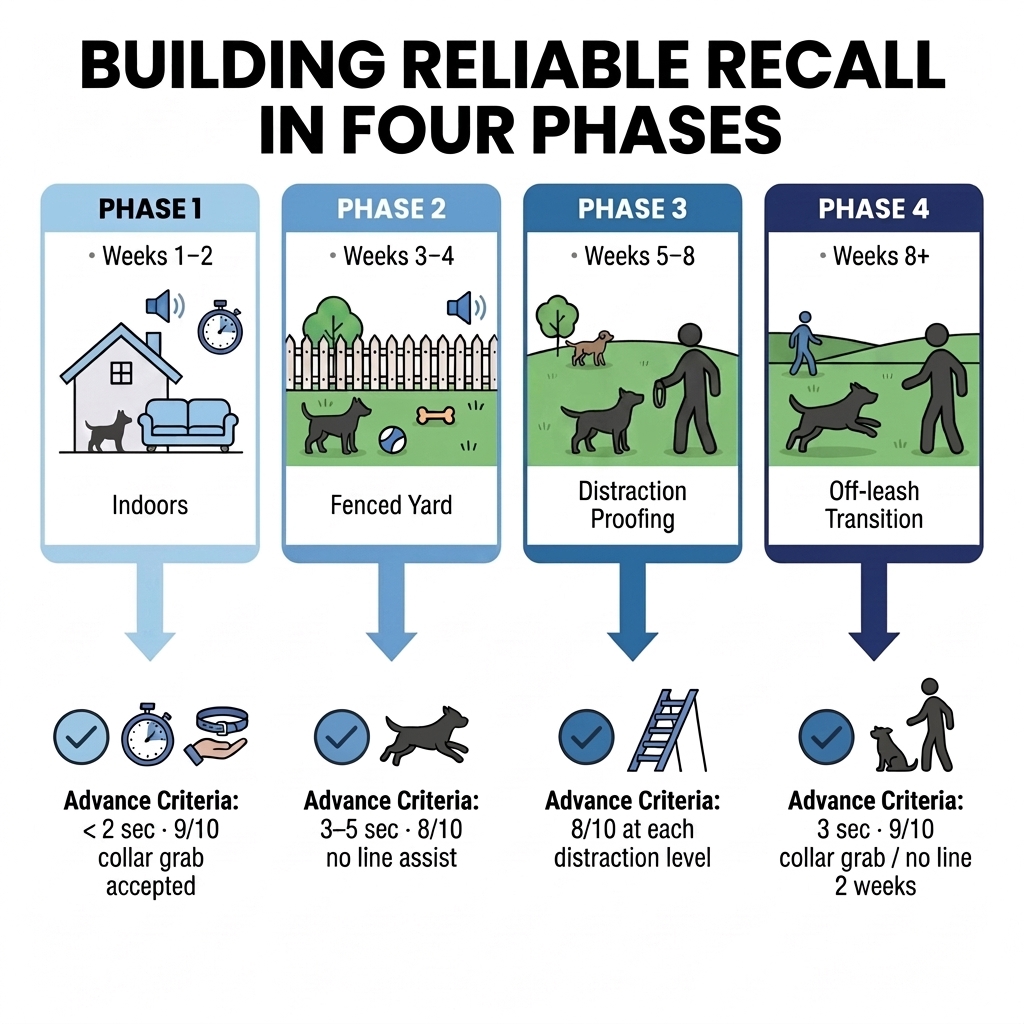
Phase 1 – Building the Recall Foundation (Weeks 1–2)
Phase 1 happens entirely indoors or in a small, enclosed, low-distraction area. The goal is to create an automatic association: cue word = turn toward handler = high-value reward.
The Name Game
Before teaching recall, the dog must learn that its name means “look at me.”
- Wait until the dog is looking at something other than you.
- Say the dog’s name in an upbeat tone.
- The instant the dog looks at you, mark the moment with a clicker or a verbal marker (“yes”) and deliver a treat.
- Repeat 10 to 15 times per session, 2 to 3 sessions per day. Within 3 to 5 days, the dog should orient to you immediately upon hearing its name.
Indoor Recall with Treats
- With the dog a few feet away, say the recall cue (“come”) in a clear, happy tone.
- As the dog moves toward you, praise continuously (“good, good, good”).
- When the dog arrives, grab the collar gently, mark (“yes”), and deliver the high-value treat.
- Release the dog and let it wander away before repeating.
Practice 5 to 10 repetitions per session, 3 sessions per day. Keep sessions under 5 minutes – short, intense, and always ending on a successful recall.
The Collar Grab
Every recall must end with the handler touching or holding the collar. A dog that comes close but stays out of arm’s reach has not completed a recall – it has performed a drive-by. Practice reaching for the collar, holding it for 2 to 3 seconds, then delivering the treat. The dog learns: come + collar grab = jackpot reward.
Move to Phase 2 when: The dog responds to the recall cue within 2 seconds in 9 out of 10 repetitions indoors, with the collar grab accepted calmly.
Phase 2 – Adding Distance and Environment (Weeks 3–4)
Phase 2 moves recall outdoors to a controlled environment – a fenced yard, a quiet field, or a low-traffic park – with the dog on a long training line.
Long-Line Recall in the Yard
Attach the 15-to-30-foot training line to a flat collar (not the training collar). Let the dog explore and sniff. When the dog is looking away from you or engaged with something on the ground, give the recall cue.
If the dog turns and comes, praise continuously as it approaches, grab the collar, mark, and deliver a jackpot reward (3 to 5 treats in rapid succession, not just one). If the dog does not respond, gently use the line to guide it toward you – do not drag or yank. When the dog arrives, still reward. Then reduce the distance for the next repetition and rebuild.
Recall Games
Games build recall speed and enthusiasm. Integrate these into Phase 2 sessions:
- Round Robin. Two or more family members stand 20 to 40 feet apart, each with treats. Take turns calling the dog between you. The dog sprints between handlers, getting rewarded each time. This builds speed, directional changes, and multi-handler response.
- Find Me. Hide in another room or behind a tree and call the dog. The dog uses its nose and ears to locate you, which engages tracking instincts alongside recall compliance. Reward with enthusiastic praise and treats when the dog finds you.
- Catch Me. Get the dog’s attention, then turn and run away. Most dogs will chase instinctively. When the dog catches up, turn, grab the collar, and reward. This builds the habit of running TOWARD the handler.
Move to Phase 3 when: The dog responds to the recall cue within 3 to 5 seconds in 8 out of 10 repetitions outdoors on the long line, without the line being used to guide.
Phase 3 – Distraction Proofing (Weeks 5–8)
Phase 3 tests whether the recall holds when something more interesting is happening. This is the phase where most owners rush and most recalls fall apart.
Low Distractions to High Distractions
Introduce distractions in a deliberate progression, not all at once:
- Recall while another person walks past at 30 feet.
- Recall while a toy is on the ground 10 feet from the dog.
- Recall while another dog is visible at 50 feet (on leash, controlled).
- Recall while another dog is playing at 30 feet.
- Recall at a park entrance with multiple dogs, people, and environmental noise.
At each level, the dog must respond to the recall cue in 8 out of 10 attempts before advancing to the next level. If the dog fails at a level, drop back one step and practice there for another 3 to 5 days before reattempting.
Recall Around Other Dogs
Recalling a dog away from another dog is the hardest recall scenario. The social drive is powerful, and pulling the dog away from a playmate feels punitive unless you make yourself more rewarding than the other dog.
The technique: call the recall cue, deliver a jackpot reward when the dog arrives, then immediately release the dog back to play. The dog learns that recall does not end the fun – it interrupts briefly, pays well, and returns the dog to exactly what it was doing. After 5 to 10 successful recall-and-release repetitions, one of those recalls can be the real one where the leash clips on.
Phase 4 – Off-Leash Transition (Weeks 8+)
Drag Line to Off-Leash
Replace the long training line with a 6-to-10-foot drag line – a lightweight cord that trails on the ground and gives you an emergency handle without restricting the dog’s movement. Practice for 1 to 2 weeks with the drag line. If the dog’s recall remains reliable, remove the line.
The first off-leash sessions should be in a securely fenced area. If the recall fails, you can retrieve the dog without a chase. Gradually move to larger, less enclosed spaces as confidence builds.
When Is Recall Reliable Enough for Off-Leash?
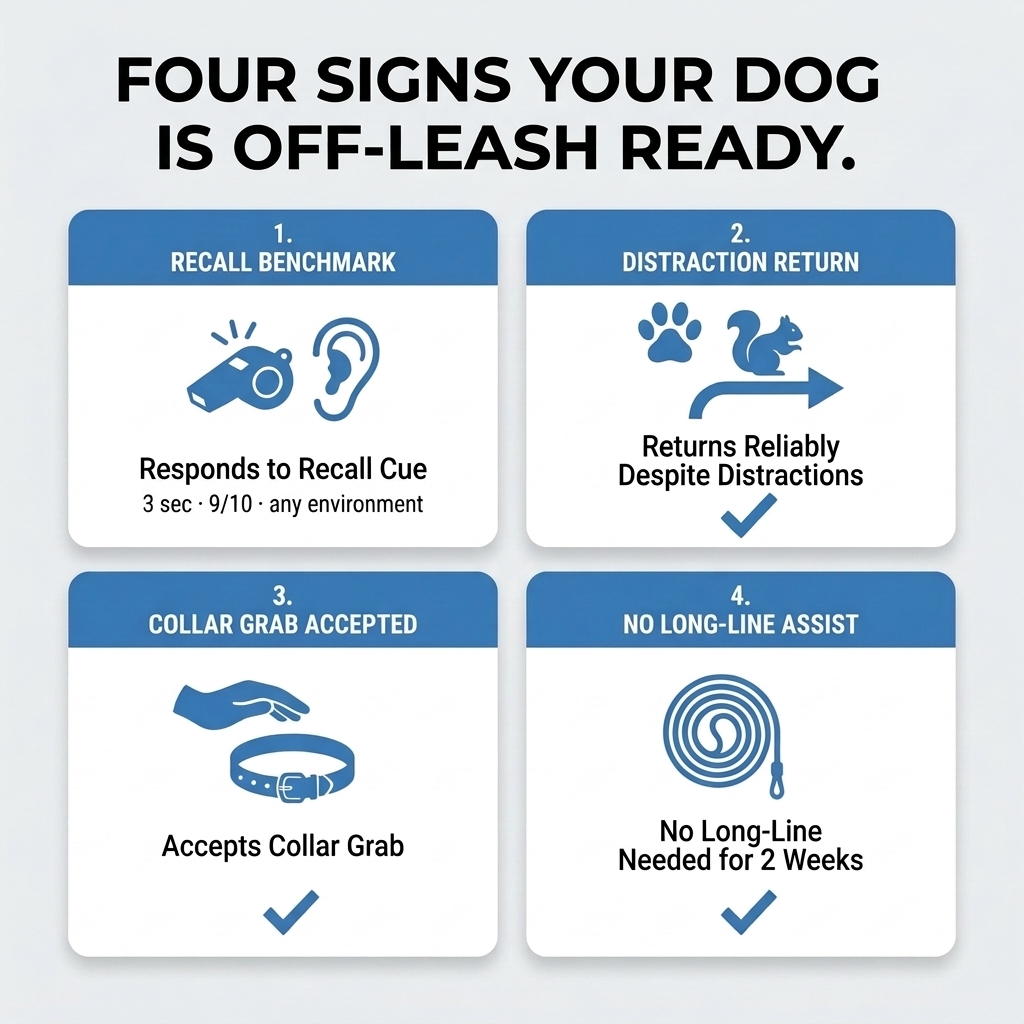
Your dog’s recall is off-leash ready when it meets all four benchmarks:
- The dog responds to the recall cue within 3 seconds in 9 out of 10 attempts across multiple environments.
- The dog returns reliably despite moderate distractions (other dogs at a distance, wildlife sounds, people walking).
- The dog accepts the collar grab calmly every time.
- You have not needed to use the long line to guide the dog back in the past 2 weeks of practice.
Even with all four benchmarks met, no recall is 100% reliable in every possible scenario. Off-leash freedom always carries residual risk from unpredictable events – a sudden thunderstorm, a deer sprinting across the path, a dog fight at the park. This is where technology provides a safety net.
How Do You Train an Emergency Recall?
An emergency recall is a separate, distinct cue reserved exclusively for life-threatening situations – the dog running toward a road, a dangerous animal, or an open gate onto a busy street.
The emergency recall uses a different word than your daily recall cue. If your daily cue is “come,” your emergency cue might be a sharp whistle blast, “HERE,” or any distinctive sound the dog does not hear in any other context.
Training the emergency recall:
- Start indoors with zero distractions. Give the emergency cue and immediately produce a jackpot reward – an entire handful of the highest-value treats the dog has ever received, delivered with maximum excitement.
- Practice once per day for 2 weeks. The jackpot must be extraordinary every single time. The dog should associate this cue with the single best thing that has ever happened.
- After 2 weeks, practice in the yard, then in public environments, always with the jackpot. Never use this cue casually. Never use it without delivering the jackpot.
- Maintain the emergency recall by practicing it once every 1 to 2 weeks in a controlled setting. If you use it in a real emergency, retrain it for a week afterward to restore the cue’s power.
The emergency recall is your last line of defense. It works because the dog has never heard the cue without receiving an extraordinary reward – the association is pure and unpolluted by casual use.
What Are the Biggest Recall Training Mistakes?
Three specific mistakes destroy recall reliability faster than anything else:
- Using recall to end fun. If the only time you say “come” is when it’s time to leave the park, clip the leash, or go inside, the dog learns that recall predicts the end of freedom. The fix: recall the dog 10 to 15 times during every outing, reward each one, and release the dog back to play. Only one of those recalls is the real one.
- Repeating the cue. Saying “come, come, COME, come here, COME!” teaches the dog that the first four repetitions are irrelevant. Give the cue once. If the dog does not respond, go get the dog (using the long line or walking to it). Reset and make the next attempt easier. One cue, one response.
- Punishing after recall. If the dog comes to you and then gets scolded, bathed, crated, or has its nails trimmed, the dog learns that coming to you leads to unpleasant outcomes. Recall must always end with a reward – even if the dog took three minutes to respond and you are frustrated. Punishing a dog for coming, even indirectly, poisons the cue permanently.
“I can spot a broken recall in about 30 seconds. I watch the owner call the dog at the end of a session and the dog does this wide arcing loop – comes close enough to make eye contact, then veers away at the last second. That dog has done the math. ‘Come’ means the leash goes on and the fun stops. It’s not disobedience. It’s a perfectly rational cost-benefit analysis, and the dog is right – coming back has never once been worth it. We have to rebuild the entire meaning around that recall before anything else works.”
– Charlie Angel Chun Expert Trainer & Consultant (Behavioral Rehabilitation & Society Acclimation)
Which Breeds Are Hardest to Recall Train?
Breed affects recall difficulty because it determines which competing motivations the dog experiences most intensely.
- Scent hounds (Beagles, Bloodhounds, Basset Hounds): Follow their nose into a tracking state that overrides auditory cues. The dog is not ignoring you – it literally cannot process your voice while in full scent-tracking mode. Use a whistle (louder, more piercing than voice) and train recall interruptions during scent exercises.
- Sight hounds (Greyhounds, Whippets, Salukis): Chase anything that moves fast. The prey drive activates before conscious thought. Once the chase begins, recall is extremely difficult. Focus on preventing the trigger (management) rather than recalling mid-chase.
- Independent working breeds (Huskies, Akitas, Shiba Inus): Bred to make decisions without human input. These dogs hear the recall cue and evaluate whether compliance is worthwhile. Training requires higher-value rewards and more repetitions than handler-oriented breeds. Reliable off-leash recall may take 4 to 6 months rather than 2.
- Handler-oriented breeds (Labs, Goldens, Border Collies, Poodles): Fastest recall learners. These breeds are genetically predisposed to work with and return to their handler. Most achieve reliable recall within 6 to 8 weeks of consistent training.
What Happens When Recall Fails?
Even with months of training, a perfect cue history, and a handler-oriented breed, no recall is 100% reliable under every possible condition. A thunderclap, a deer at full sprint, a dog fight erupting nearby – these are events that can override even the strongest trained response.
This is where technology provides what training alone cannot: an automated safety net that operates independently of the handler’s voice, timing, and proximity.
A GPS fence collar like the Halo Collar creates virtual GPS fences that deliver graduated boundary feedback (warning tone → vibration → optional static) when the dog approaches the property line. The collar’s patented Direction-Based Feedback detects the dog’s trajectory and responds before the dog reaches the boundary – even if the owner is inside, asleep, or simply not fast enough to call the recall cue.
Recall training and GPS fence containment are not competing strategies. They are complementary layers. Training handles 95 to 98% of situations. The collar catches the 2 to 5% where training alone would fail. Together, they create a safety system that is more reliable than either one alone.
For the complete GPS fence training methodology, see GPS fence training.
Recall Training FAQs
How long does it take to train reliable recall?
Most dogs develop reliable recall in low-distraction environments within 2 to 4 weeks of daily practice. Reliable recall under moderate distractions takes 6 to 8 weeks. High-distraction reliability (other dogs, wildlife, busy environments) typically takes 8 to 12 weeks for handler-oriented breeds and 4 to 6 months for independent or high-drive breeds. The timeline depends on consistency more than anything else – daily practice produces results; weekend-only practice does not.
Can you train recall in an older dog?
Yes. Older dogs can learn recall at any age. Dogs with no prior recall training may take longer (8 to 12 weeks) because they have years of reinforced habits (ignoring the owner’s voice, self-rewarding by running to interesting things). The methodology is identical to puppy recall training – the sessions may simply need to be shorter and the rewards higher to compete with established patterns.
What if my dog’s recall cue is already poisoned?
If your dog has learned to ignore “come” because the word has been used inconsistently, used to end fun, or followed by punishment, the most effective fix is to start over with a completely new cue word. Pick a word the dog has never heard (“here,” “close,” or a whistle pattern) and train it from scratch using the Phase 1 protocol. Do not attempt to rehabilitate the poisoned cue – it carries too much negative association. Retire it permanently and build a clean one.
Is off-leash recall ever 100% reliable?
No. No recall is 100% reliable under every conceivable condition. Extreme triggers – a prey animal at close range, a thunderclap, a dog fight – can override even the strongest trained recall. This is why responsible off-leash freedom combines recall training with a safety net: a GPS fence collar that provides automated boundary containment when training alone is not enough, or a securely fenced area where a failed recall does not result in the dog reaching a road.