To stop a dog from bolting or running out the door, block the doorway, teach a wait at the threshold with a release cue, and add a safety layer for when the door opens anyway. Management keeps your dog safe from today. Training changes the habit over the following weeks. The safety layer covers the slip that happens on a busy day: a delivery, a guest, a child who forgets to shut the door. This guide covers all three, plus a plan for Halloween night, when the doorbell rings again and again for hours.
What Is Door-Dashing in Dogs?
Door-dashing is a learned habit in which a dog rushes through an opening door before anyone can stop them, whether it is the front door, the back door, the garage, or the car. It usually starts as excitement or curiosity and turns into a routine, because the dash pays off: the dog gets outside, finds new smells, and often gets a chase game from the person running after them. Trainers call this a self-rewarding behavior. Every successful dash makes the next attempt more likely, which is why a dog who got out once tends to try again the next time the door opens.
Most of the danger is on the other side of the door. A dog who bolts into the street can be hit by a car, and a dog who keeps running can be out of sight in moments. People get hurt too: a large dog charging through a doorway can knock over a child, an older relative, or a delivery driver with their arms full.
Why Do Dogs Run Out the Door?
Dogs run out the door because something outside is more rewarding than staying in, or because something inside is stressful enough to leave. Pent-up energy, curiosity, prey drive, the mating drive in intact dogs, and fear of a sudden noise are the usual drivers. The reason shapes the fix, so it is worth knowing which one applies to your dog; for the motivations in depth, see Why Do Dogs Run Away? 8 Reasons and What to Do.
Exercise belongs in the plan whatever the reason. A dog who has had a long sniffing walk or some scent games, such as hiding treats around the house, is usually calmer at the door. The goal is a settled dog, not a worn-out one, and fast games like fetch can wind a dog up before a self-control exercise. Even so, exercise on its own rarely breaks a habit that is already established.
How Do You Stop Door-Dashing Right Now?
Stop door-dashing right now by making the dash physically impossible while training catches up: put a barrier between your dog and the door, and never open an outside door with your dog loose beside it. Management does not replace training, but every dash you prevent is one less rehearsal of the habit.
Set Up a Two-Gate Airlock
Put a baby gate or an exercise pen across the hallway or entryway, so there are two barriers between your dog and the street. Dog parks use the same double-gate idea. Close the inner gate before anyone opens the front door, every time.
Leash Up Before the Door Opens
When your dog goes out through the front door, clip the leash on before your hand touches the handle. The leash goes on first and comes off only after the door is shut behind you.
Use a Closed Room or Crate at Busy Times
During deliveries, parties, or a big grocery run, settle your dog in a closed room or a crate with a chew. It is the simplest fix for the moments when nobody can watch the door.
Use the Calmer Exit
Many dogs are far more excited at the front door than at the back. While you train, use the calmer exit, such as the garage or a fenced backyard, for everyday comings and goings.
Agree on One Rule for the Whole Household
Most dashes happen when someone forgets. Agree on one rule, such as “inner gate closed before the front door opens,” and put a note on the inside of the door for children and visitors. Add a delivery note in your apps asking drivers to leave packages without ringing the bell.
How Do You Teach a Dog to Wait at the Door?
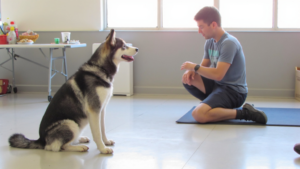
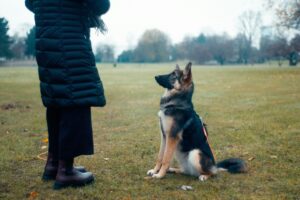
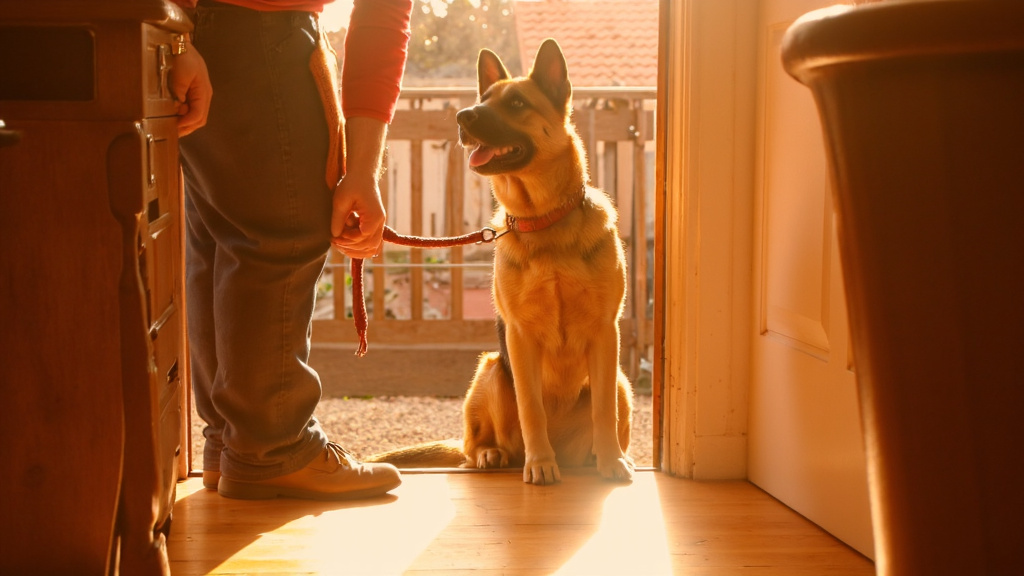
Teach a dog to wait at the door by rewarding them for staying behind the threshold while the door opens in small steps, then letting them through only on a release cue. Over time, the open door itself becomes the signal to pause. Start at a quiet inside door, not the front door, and keep your dog on a leash for every repetition at an outside door.
Step 1: Choose What Your Dog Does at the Door
Pick one default behavior for doorways. A sit works well because it is easy to see whether your dog is doing it. For a few days, reward sits everywhere, asked for or not, so sitting becomes your dog’s first idea when they are unsure what to do.
Step 2: Reach for the Handle
Stand at a closed door with your dog. Reach toward the handle; if your dog stays in position, mark the moment with “Yes,” bring your hand back, and give a treat. If they get up, wait for them to settle and try again with a smaller movement. Keep the treats in a pocket or pouch, not in the hand that opens the door.
Step 3: Open the Door an Inch at a Time
Open the door an inch, close it, and reward your dog for staying put. If your dog moves forward, calmly close the door (watching for paws) and try again; the closing door does the teaching, so there is no need to scold. Build up to a door that stands wide open over many short sessions.
Step 4: Add a Release Cue
Choose a release word that rarely comes up in everyday conversation, such as “Break” or “Free”, and let your dog through only after you say it. A word like “Okay” is a poor choice because people say it all day, so it could release your dog by accident. Once you are both through, wait for your dog to look back at you and reward that check-in. It keeps their attention on you instead of on whatever is outside.
“People treat the wait as the finish line, and then the release word goes off like a starter pistol. She’s held a beautiful sit for twenty seconds, you say the word, and she’s through that gap like something fired out of a tube — which is the exact behavior you sat down to fix, just with a two-second delay in front of it. What she’s learned is how to pause, not how to be calm. So the release is part of the exercise too. Say the word, and if she launches, close the door and set it up again. What you want is a dog who walks through a door she’s allowed to walk through. Give her a few weeks of that and the pause stops being something she’s holding in.”
– Charlie Angel Chun Expert Trainer & Consultant (Behavioral Rehabilitation & Society Acclimation)
Step 5: Practice at Every Door
Dogs do not generalize well, so a dog who waits perfectly at the back door may still bolt from the front. Practice at the bathroom, bedroom, crate, back door, garage, and car before the front door. Then add distractions one at a time: a knock, a recording of your doorbell, a person standing outside. Keep sessions to a few minutes, several times a day. Most dogs get the idea at quiet doors fairly quickly, but holding the wait at the front door with a guest on the step takes much longer, so keep the gate in place until your dog waits reliably in real situations.
What Mistakes Make Door-Dashing Worse?
Four mistakes make door-dashing worse: chasing your dog, punishing them when they come back, inconsistent rules, and removing management too early. Each one either rewards the dash or makes coming home less attractive.
Chasing
Running after a dog turns the dash into the best game of the day, and most dogs are faster than the person chasing them. Chasing also pushes a dog further from home.
Punishing the Return
Scolding a dog who comes back teaches them that coming back leads to trouble, so next time they stay away longer. However frightened you were, greet a returning dog calmly and kindly.
Inconsistent Rules
If one person asks for a wait and another lets the dog push past, the dog learns that waiting is optional. Everyone who opens the door needs to follow the same routine.
Removing Management Too Early
A dog who waits at a quiet door has not yet learned to wait when a delivery driver is on the porch. Take the gate away only after the wait holds with real distractions.
How Do You Handle Guests and Deliveries at the Door?
Handle guests and deliveries by deciding where your dog will be before the doorbell rings: behind a gate, in another room, or on a leash in a practiced sit. The doorbell is one of the strongest door triggers, because it usually means someone new is about to arrive.
You can turn the bell into a cue for a calmer behavior. Play a recording of your doorbell or a knock at low volume and reward your dog for going to a bed or mat away from the door; raise the volume slowly over several sessions. While you train, ask friends to text when they arrive instead of ringing. Let guests in while your dog is behind the gate, and bring your dog out only once the door is shut and everyone has settled.
How Do You Keep a Dog From Bolting on Halloween?
Keep a dog from bolting on Halloween by moving them away from the front door before trick-or-treating starts and keeping them there until the last visitors have gone. Halloween packs every door trigger into one evening: a doorbell that keeps ringing, a door that stays open, strangers in masks and costumes, and excited children. Even a dog who waits reliably on an ordinary day can break when a costumed figure appears in the doorway. The American Veterinary Medical Association’s Halloween pet safety guidance recommends putting pets who are wary of strangers in a room away from the front door during trick-or-treating hours.
“Halloween is the one night I tell people not to train. Every other evening I want her hearing the doorbell, doing her sit, getting paid for it — that’s how it gets solid. But a hundred knocks in three hours, kids shrieking on the porch, somebody in a mask at her eye level: that isn’t a training session, it’s a stress test, and she’ll fail it in a way that costs you weeks. So she goes in her crate in the back room with a chew, where it’s quiet and you know she’s safe, before the first knock, not after the third one when she’s already wound up. The timing is the whole thing. A dog who’s been back there since six is bored. A dog who gets moved at seven thirty has been told something is wrong.”
– Charlie Angel Chun Expert Trainer & Consultant (Behavioral Rehabilitation & Society Acclimation)
- Set up a quiet room at the back of the house with water, a bed, a chew or puzzle toy, and music or white noise, and settle your dog there before the first knock.
- Keep the door shut. Sit outside with the candy bowl, or leave a bowl on the porch, so the front door does not open every few minutes.
- Walk your dog earlier in the day, in daylight, rather than during trick-or-treating hours.
- Check identification: a microchip, a collar, and an ID tag with your current phone number. The same AVMA guidance points out that identification is what gets a pet home if they slip out an open door while you are busy with trick-or-treaters.
- Use the leash or the gate if your dog has to be near the door, and never hold the door open while your dog is loose.
The same plan works for other days when the door rarely stays shut, such as holiday parties or a birthday with children running in and out.
What Should You Do If Your Dog Gets Out?
If your dog gets out, do not chase them: stop, call them once in a calm, happy voice, then turn and move away or crouch down so that coming back to you looks like the better game. A squeaky toy or a rattled treat bag helps with a dog who is excited and exploring.
A frightened dog needs the opposite approach. If your dog ran out in panic, for example after a loud noise, repeated calling can push them further away; get low, stay quiet, and let them come to you, with food and a familiar scent nearby. A dependable recall is the skill that turns most escapes into a short interruption; see How to Train a Reliable Recall (Come When Called).
Once your dog is back, reward them, even if you are shaken. Then work out what happened: which door, who opened it, and what drew your dog out. That tells you which part of the plan needs attention.
How Can a GPS Dog Fence Help When the Door Is Left Open?
A GPS dog fence adds a boundary around your property that keeps working after your dog is past the threshold, cueing them to turn back before they reach the road. Door training and management stop the dash at the doorway; a wireless GPS dog fence covers what happens next if one of those layers fails.
No containment system can guarantee it will stop a dog at full sprint, so treat everything below as one layer, not a promise. On a system like Halo Collar 5, you draw the boundary around your property in the Halo App, at least 20 feet from the house and from the road. As your dog approaches the line, the collar gives a Warning cue about 7 to 10 feet before it and Boundary feedback at the line, using sound, voice commands, vibration, or optional, adjustable static feedback, depending on your settings. If your dog crosses and keeps moving away, Emergency Feedback starts and the app sends you a notification. About 300 feet past the line, the collar switches to Lost Mode with a Return Whistle, and you can follow your dog’s location in the app while the collar has a connection.
A dog bolting after a cat across the street is exactly the full-sprint case. That is why the boundary should leave a generous margin from the road, why your dog needs to learn the virtual fence through training before you rely on it, and why the gate and the wait at the door stay in place. Halo Collar supports fences from 900 square feet, but because the boundary has to keep that 20-foot margin from the house and the road, on a small or narrow lot the usable area can be much smaller than the lot itself, or not workable at all. Halo Collar is designed for dogs who weigh at least 10 lbs and are at least 5 months old. It should also come off for at least 8 hours in every 24, so plan that window for when the doors are closed and your dog is indoors. Deliveries and guests mostly arrive in the daytime, so overnight is usually the best fit.
Door-dashing is one of several ways dogs get out. If yours also jumps, digs, or slips through gates, see How to Stop a Dog From Escaping the Yard.
When Should You Get Help From a Trainer?
When your dog still bolts after several weeks of consistent management and training, or when the dashing comes with fear, guarding at the door, or panic when left alone, it is time to bring in a certified trainer. A trainer can break the wait into smaller steps and spot what keeps rewarding the dash.
Stopping a dog from bolting out the door comes down to the same three layers every time: a doorway your dog cannot rush, a wait at the threshold practiced until it holds under pressure, and a safety layer for the day the door opens anyway.