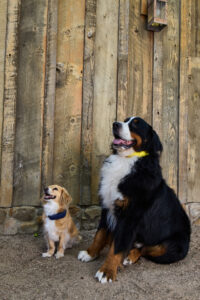
To stop a dog from jumping the fence, find out why they jump, make the fence harder to get over, and train them to stay away from the edge. The reason and the barrier need fixing together, because either one alone rarely holds. Fence jumping is not rebellion. It is a pattern driven by something the dog needs or wants – to burn off energy, to chase, to escape a frightening noise, to reach another dog – and the right fix depends on which one it is. This guide covers why dogs jump, how to diagnose your own dog’s reason, the fence changes that work against jumping and climbing, the training that makes the edge less interesting, and how a GPS boundary can work alongside a fence or where you cannot change one. For dogs who also dig, squeeze through gaps, or slip out of gates, see How to Stop a Dog From Escaping the Yard.
What Is Fence Jumping and Why Does It Happen?
Fence jumping is a repeated escape over the top of a fence – clearing it, climbing it, or scrambling up and over – and it is a symptom of an unmet need rather than a personality flaw. Dogs go over a fence because something on the other side is more compelling than staying, or because something in the yard is causing them distress.
Jumping, Climbing, and Scrambling
Dogs get over fences in three ways, and telling them apart matters because each needs a different fix. True jumping is clearing the fence in one leap. Climbing uses the fence itself – chain-link mesh, horizontal rails, decorative trim – as footholds. Scrambling is the most common: the dog jumps partway up, hooks the top with their front paws, and kicks off the fence face to haul themselves over. Many dogs who look as if they jumped a tall fence actually scrambled it.
A dog who clears the fence in one leap needs more height. A scrambler or climber needs a surface they cannot grip, or a top they cannot hold. And dogs often combine methods – jump partway, climb the rest, and dig if both fail – so blocking one route can simply move the attempt somewhere else.
How High Can Dogs Jump?
Higher than most owners expect. The Guinness World Record for the highest jump by a dog is 191.7 centimeters (75.5 inches), set by a greyhound named Feather in 2017, and dogs scaling a wall with a running start can go higher still. Most pet dogs come nowhere near that, but athletic, motivated dogs can clear far more than their size suggests, and small, springy terriers regularly surprise their owners.
The fence material matters as much as the height. Chain-link gives paws something to grip, so a dog who could never clear a 6-foot solid fence may scramble over a 6-foot chain-link one with ease.
Why Do Dogs Jump Fences? The 8 Root Causes
Dogs jump fences for eight main reasons, and each points to a different fix. A dog going over out of boredom needs enrichment; one going over in panic needs veterinary help; one chasing wildlife needs the view blocked and impulse-control work. Applying the wrong fix wastes time and money. For the motivations behind escapes in general, see Why Do Dogs Run Away?
“The first thing I ask isn’t how high the fence is. It’s what the dog was doing in the five minutes before she went over it. By the time she’s on top of it you’re looking at the last step of something that started well before that – and if the last step is the only bit you ever deal with, you’ll be raising that fence for the rest of her life. Tell me about the five minutes and I can usually tell you which of these eight you’re actually up against.”
— Arianna Melendez Halo Trainer Expert (Dog Psychology & Behavior Modification)
1. Boredom
An unstimulated dog makes their own entertainment, and a yard with nothing to do turns the other side of the fence into the interesting place: new scents, movement, people, other dogs. Breeds with high mental needs – Border Collies, Poodles, Australian Shepherds – are most at risk when left in the yard for long stretches without anything to engage them. Puzzle feeders, scatter-feeding across the lawn, snuffle mats, frozen treat toys, and a rotating set of toys all help turn the yard from a holding pen into somewhere worth being.
2. Not Enough Exercise
Physical energy that is not used up does not disappear; it comes out as restlessness, pacing, and escape attempts. High-energy breeds need vigorous daily exercise – running, swimming, fetch, flirt-pole work, or dog sports – rather than a gentle stroll around the block, and a family dog on two short, slow walks a day may still go over the fence. Match the exercise to the dog, not the schedule; for targets by breed and age, see How Much Exercise Does a Dog Need?
3. Prey Drive
A squirrel on the fence line can trigger a chase response that happens before the dog has made any decision at all. Terriers, hounds, Huskies, and Belgian Malinois tend to have the strongest prey drive, and a small terrier can leap several times their own height after a bird. Blocking the view of prey, removing bird feeders and brush piles near the fence, and structured impulse-control work all help; more in training dogs with high prey drive.
4. Separation Anxiety
Dogs with separation anxiety go over the fence in panic, not out of interest. Signs include barking or howling soon after you leave, destruction aimed at exits, repetitive pacing, drooling, and house soiling in a house-trained dog, and anxious escape attempts can lead to broken teeth, torn nails, and cut paws. A taller fence does not fix this and can add to the stress. It needs a behavioral plan, often with your vet involved – the FDA has approved medications specifically for separation anxiety in dogs, which your vet can discuss alongside gradual desensitization. See how to treat your dog’s separation anxiety.
5. The Mating Drive
An intact male can detect a female in heat from over a mile away, and that drive can override almost any physical containment – a dog who has never tried the fence may clear it the first time a female nearby comes into season. Spaying or neutering reduces mating-driven escapes most when it happens before the habit forms; a dog who has been going over for months may keep doing it out of habit. For timing, see when to neuter or spay a dog.
6. Loud Noises
Noise-phobic dogs can panic during thunderstorms, fireworks, construction, or gunfire and go over a fence they would never attempt calmly. This one is seasonal, with risk peaking around New Year’s Eve, the Fourth of July, and hunting season. Keep noise-sensitive dogs indoors during predictable events, use white noise or calming music to mask sounds, and ask your vet about short-term anxiety support; see these fireworks and noise anxiety tips.
7. Reactivity to Passersby
Some dogs go over the fence at a pedestrian, a delivery truck, or another dog because of barrier frustration: they want to approach, the fence stops them, and the frustration builds until it spills over. This is usually frustration rather than aggression. Solid fencing or screening that blocks the view, desensitization to the usual neighborhood triggers, and keeping the dog away from the fence line at peak times – mail delivery, school pickup – all help.
8. Looking for Company
Some dogs go over to reach a neighbor’s dog, a person who hands out treats, or simply company that is missing from their day. Arranged playdates with the dog they keep trying to reach, doggy daycare, and more social time at home address the reason directly.
How Do You Diagnose Why Your Dog Is Jumping the Fence?
Work through the possible causes systematically before spending money on the fence; the right solution only becomes clear once you know the reason.
- Record when escapes happen. Note the time, the day, the weather, and whether you were home. Escapes only when you leave point to separation anxiety; only during storms, to noise; at any time, to boredom or prey drive.
- Set up a camera. Watch for pacing, barking at particular triggers, or calm rest followed by a sudden bolt – a sign of an outside trigger rather than boredom.
- Identify triggers. Look for wildlife near the fence, neighboring dogs, construction noise, or delivery schedules that line up with escapes.
- Check exercise and enrichment. Track how much vigorous exercise and mental work your dog gets each day and compare it with what the breed needs.
- Inspect the fence. Walk the perimeter looking for worn grass at a take-off spot, scratch marks, loose boards, and anything near the fence that works as a launch pad.
- Talk to your vet if escapes involve self-injury, if your dog shows signs of anxiety when alone, or if the behavior started suddenly for no clear reason.
Which Fence Changes Stop a Dog From Jumping?
Fence changes make the barrier harder to beat, and they work best combined with training that deals with the reason behind the jumping.
How Tall Does the Fence Need to Be?
Six feet is the usual starting point for a determined medium or large dog. A 4-foot fence is often not enough for medium and large breeds, and 5 feet stops some dogs but not committed jumpers. Height can be added with lattice or trellis toppers on a wooden fence, chain-link extension kits – some angled inward – or replacement panels. Even 6 feet is not a guarantee for an exceptional athlete, which is why height works best combined with anti-climb measures.
Coyote Rollers
Coyote rollers are lengths of tube mounted along the top of the fence on brackets that let them spin. When a dog hooks their paws over the top, the roller turns and the paws slide off, so the dog cannot get the leverage to pull themselves over. They are sold commercially and can also be made at home from a pipe threaded over a thinner pipe or cable. Rollers stop scrambling and climbing but do not add height, so they work best on a fence that is already reasonably tall, and they fit wood, chain-link, vinyl, and block walls.
Angled Extensions
Extensions mounted at roughly 45 degrees, angled back into the yard, create an overhang that is very hard for a climbing dog to get past. They can be built from brackets and mesh or chain-link and are most effective against climbers and scramblers rather than dogs who clear the fence in a clean leap.
Privacy Screens
If the jumping is triggered by what the dog sees – passersby, other dogs, wildlife – taking away the view takes away much of the motivation. Bamboo or reed rolls on chain-link, privacy slats, solid panels, and dense planting along the fence line all work, and thick shrubs also break up a running approach. Screening does little for dogs who go over from boredom, anxiety, or the mating drive.
A Second Inner Fence
A shorter fence set a few feet inside the main one removes the running start a high jump needs, forcing the dog to clear two barriers from a standstill. Fencing the whole perimeter twice is expensive, so it is usually installed only at the stretch where the dog actually goes over.
Remove the Launch Pads
Anything raised near the fence – picnic tables, woodpiles, dog houses, trash cans, compost bins, play equipment – shortens the jump. A dog on a 3-foot table beside a 6-foot fence only has to find another 3 feet. Move these well away from the perimeter, and if the fence has horizontal rails on the inside, consider turning the panels so the smooth face is toward the yard.
If Your Dog Switches to Digging
A dog who cannot get over will often try under, so it is worth watching the base of the fence once the top is secured. Ground-level reinforcement is a different job from stopping jumping, and it is covered in the guide to stopping yard escapes linked at the top of this article.
What Training Stops Fence Jumping?
Fence changes control what a dog can do; training changes what they want to do. The most reliable containment uses both.
Boundary Training
Boundary training teaches your dog that staying away from the fence pays and approaching it gets nothing. Mark a line with small flags several feet inside the fence, walk your dog on a long line near it, and reward the moment they turn away on their own. Give more freedom gradually, then practice off the leash under supervision; expect the basics to come within a few weeks and real reliability to take a few months, with the flags staying up until it does. Timing matters: reward the decision to turn away, not the return after they have already reached the fence. The full method is in Boundary Training for Dogs.
Recall
A reliable recall is your backup when everything else fails – a way to call your dog off the fence before they go over. Start indoors with no distractions and high-value rewards, move to the yard only once it is solid inside, and build toward practicing near the fence with distractions. Expect it to take months of consistent practice; see how to build a reliable recall.
Desensitization for Fence-Line Reactivity
For dogs who react to what passes the fence, desensitization pairs the trigger with something good at a distance where the dog notices it but does not react, then closes that distance gradually over weeks. Progress is measured in months, and rushing it makes reactivity worse.
Yard Enrichment
A yard that meets your dog’s needs is one they are less inclined to leave. Scatter treats before letting them out, add a digging pit with buried toys, set out a shallow paddling pool in summer, and add simple agility obstacles. Rotate what is on offer, because dogs get used to the same setup fairly quickly; for ideas, see these backyard games to play with your dog.
Which Breeds Need Extra Measures?
Breed shapes both how a dog gets over a fence and why, so the fix for one type of dog may do little for another.
Huskies and Belgian Malinois
These combine jumping ability, strong prey drive, and huge stamina, and both have a reputation as escape artists. They usually need tall fencing with rollers or angled extensions, plenty of vigorous daily exercise, and structured mental work such as nosework or trick training. Huskies dig as readily as they jump, so the base of the fence matters too, and neither breed is a good candidate for long unsupervised spells in the yard.
Terriers and Hounds
Small terriers can clear heights far beyond their size, and scent hounds will follow a trail over almost anything. Screening that blocks sight of squirrels, cats, and rabbits helps, along with fencing tall relative to the dog’s size and outlets for the hunting instinct, such as scent games and lure coursing.
Herding Breeds
Herding breeds such as Border Collies, Australian Shepherds, and German Shepherds are natural problem-solvers that find weak spots – a loose board, a low section, a gate latch – and boredom is often what sends them looking. Obedience training, agility, herding activities, and puzzle-based enrichment give them the work they are bred for.
Guard Breeds
Guard breeds such as Rottweilers, German Shepherds, and Dobermans may go over a fence to confront what they see as a threat. Solid fencing that blocks the view is usually the better choice for them; chain-link gives both grip for climbing and a full view of every trigger.
What Makes Fence Jumping Worse?
A few common responses increase a dog’s motivation to leave or miss the reason entirely.
Punishment at the Fence
A dog who is shouted at or sprayed near the fence does not learn “don’t jump”; they learn that the yard is unpleasant, which makes leaving more attractive. Scolding a dog when they come back from an escape teaches them that coming back gets them in trouble, so the next escape lasts longer.
Punishment can suppress behavior for a while without touching the reason behind it. The boredom, anxiety, or prey drive is still there, and the dog simply finds another way or waits until no one is watching.
“Owners tell me the telling-off worked, and from where they’re standing it did – she stopped going near the fence. What she’s actually learned is that the fence is a problem while you’re in the garden. Nothing else has moved. She still wants what’s on the other side, and it’s still the same height. All you’ve added is a reason to wait until the back door shuts. That’s the bit that catches people out: the behaviour looks fixed right up until the afternoon nobody’s home. I’d rather spend that effort on making the middle of the garden worth staying in, because that one holds up whether you’re watching or not.”
— Arianna Melendez Halo Trainer Expert (Dog Psychology & Behavior Modification)
Tethering in the Yard
Tying a dog out does not solve fence jumping. It tends to increase frustration and barrier reactivity, carries real risks of entanglement and strangulation, and is restricted or banned in some places. A more frustrated dog is a more motivated one.
Leaving the Dog Out Alone for Long Stretches
No fence change fully replaces supervision, and a motivated dog left alone in the yard for most of the day will eventually find a way out. During long absences, bring your dog inside, arrange a midday walk, or use daycare for dogs with high exercise and social needs, and keep unsupervised yard time short and paired with something to do.
Can a GPS Dog Fence Help a Dog Who Jumps?
Yes – a GPS boundary works independently of the physical fence, so it can cue your dog before they reach the jumping spot, or contain them where you cannot raise or change a fence at all. With Halo Collar 5 inside a fenced yard, set the virtual boundary a few feet inside the physical fence. The Warning Area starts roughly 7–10 feet before the line, so your dog gets the cue before they reach the stretch where they usually take off – interrupting the run-up rather than the leap. Halo’s patented Direction-Based Feedback only responds when your dog is heading toward the boundary, and encouragement cues reward them the moment they turn back, which fits the same positive approach as the boundary training above; the in-app training program built with Cesar Millan works the same way.
Where a taller fence is not an option – a rental, an HOA cap, a property too large to fence – a GPS boundary can do the containing on its own. And if your dog does get out, you get an alert and can see where they are on the map, as long as the collar has a connection. No containment system is a guarantee against a dog already at full sprint after a deer, which is why the fixes above still matter. Halo Collar combines the boundary, tracking, and training in one collar.
What If You Can’t Change the Fence?
HOA rules, rental agreements, and local codes often limit fence changes, so check before you build. Many HOAs cap fence height and restrict materials and colors; a written request that explains the safety reason helps, and rollers in a matching color are often approved because they are hard to see. Renters usually need the landlord’s permission, which is easier to get when the change is framed as an improvement that reduces liability. Some cities also regulate fence height, setbacks, and materials, and taller extensions may need a permit. Where structural changes are not possible, lean on training, enrichment, supervised yard time, freestanding interior barriers or exercise pens, and a GPS boundary as the containment layer.
What Should You Do Until the Fence Is Fixed?
Supervise every trip outside until the fixes and training are in place. Keep your dog on a long line attached to a harness rather than a collar, which can choke a dog mid-jump. Block the usual take-off spot with temporary barriers, and bring your dog inside whenever you cannot watch directly. If your dog does get out, stay calm and do not chase – the steps that work best in the first hours are covered in How to Find a Lost Dog.
Fence Solutions at a Glance
| Solution | What it stops | Works best for | DIY difficulty |
|---|---|---|---|
| Lattice or trellis topper | Clearing a low fence | Casual jumpers | Easy |
| Coyote rollers | Scrambling and climbing over the top | Climbers, athletic breeds | Moderate |
| Angled extensions | Climbing past the top | Persistent climbers | Moderate to hard |
| Privacy screening | Jumps triggered by what the dog sees | Reactive and prey-driven dogs | Easy |
| Second inner fence | The running start | High jumpers at one spot | Hard |
| Removing launch pads | Shortcuts onto the fence | Every yard | Easy |
| Boundary training | The habit of approaching the fence | All causes, long term | Easy, but takes time |
| GPS boundary | The approach, before the jump zone; tracking if the dog gets out | Yards where the fence cannot change; extra layer inside a fence | Easy |
Combine at least two approaches. A fence change without training treats the symptom; training without a secure fence leaves the barrier as the weak point.
Frequently Asked Questions
Can a dog jump a 6-foot fence?
Some can – athletic breeds can clear it, and many more get over a 6-foot chain-link fence by climbing it. A solid 6-foot fence with no footholds on the inside stops most dogs.
Does neutering stop a dog from jumping the fence?
It reduces mating-driven escapes but does not undo a learned habit. A dog who has been going over for months may keep doing it after being neutered, so it works best as prevention rather than a cure.
What type of fence is best for a dog who jumps?
Solid wood or vinyl at around 6 feet, with no horizontal rails on the dog’s side. Chain-link is the hardest to secure against climbers because it gives paws a grip.
Will a taller fence just make my dog try harder?
For some dogs, yes – a taller fence can push a determined dog toward climbing or digging instead. Height works better combined with anti-climb measures, and best of all when the reason behind the jumping is addressed.
Are static collars safe to use for fence jumping?
That depends on the collar, the settings, and how it is introduced; a GPS fence with optional, adjustable static feedback is a different thing from a collar used to punish. For a fuller look, see Static Correction in Dog Collars: Facts vs Myths.
When Should You Get Professional Help?
Get help if your own training and fence changes have not made a difference within four to six weeks, or straight away if the escapes involve separation anxiety, aggression, compulsive behavior, or self-injury. A certified professional dog trainer can handle structured training and boundary work; a certified applied animal behaviorist works with complex cases involving anxiety, fear, and reactivity; and a board-certified veterinary behaviorist can diagnose anxiety disorders and prescribe medication as part of a wider plan. Medication can lower baseline anxiety enough for the training to take hold; more in anti-anxiety medications for dogs.
No single fix works for every dog. Understanding the reason, securing the fence, and building the habit of staying is what keeps a jumper home.