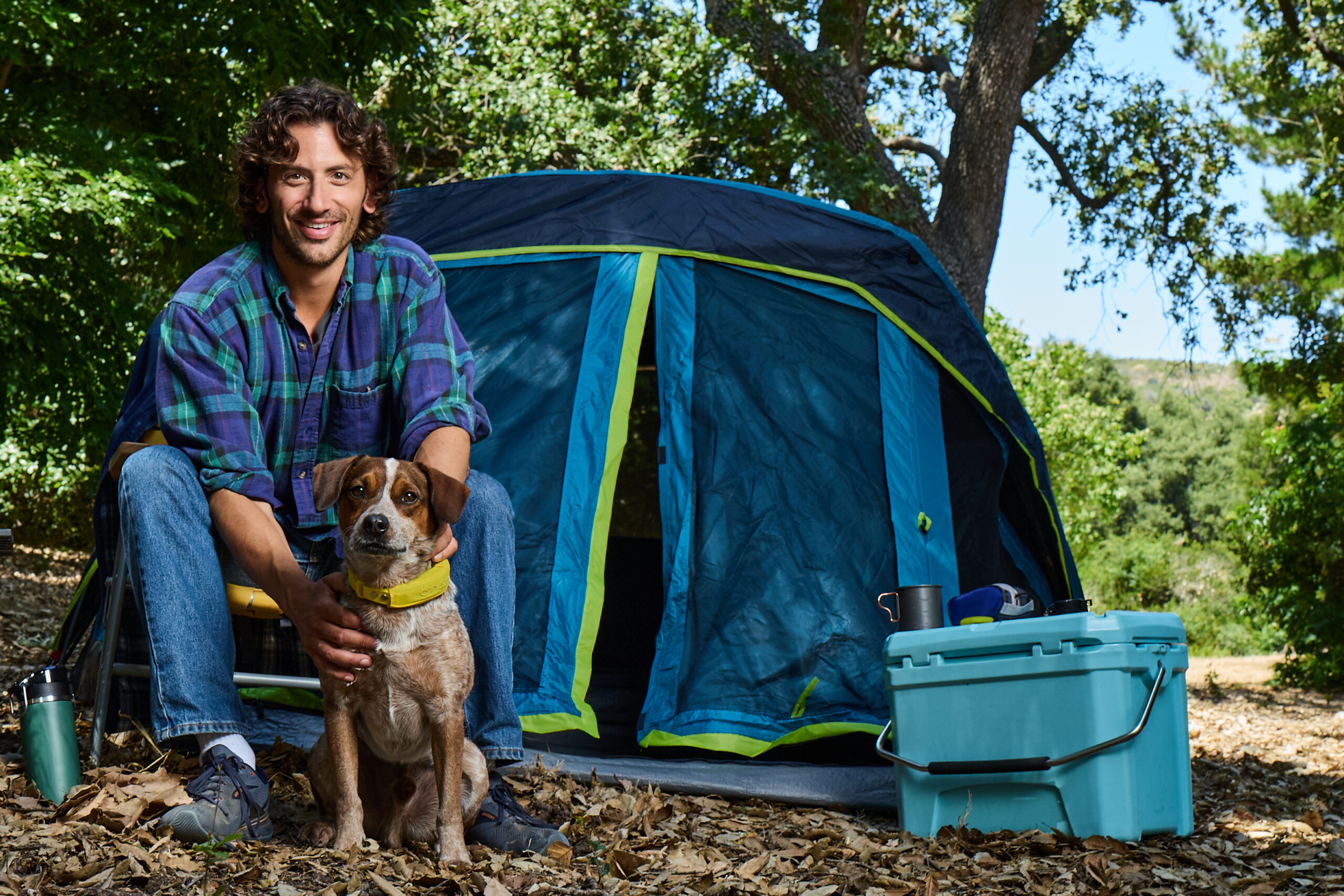
No – a Halo Fence keeps enforcing your dog’s boundary without cellular service, because the fence is stored on the collar and the feedback runs there too. What needs a connection is your view of it – live location and alerts on your phone. That surprises most dog parents, and the assumption behind it is reasonable – a collar with a SIM card and LTE looks like it should need cell towers to do anything. But Halo Collar 5 keeps its safety systems separate from its communication systems by design. The fence is a relationship between the satellites and the collar. The phone is a convenience layer on top of it.
So if your dog heads toward the boundary at a campsite with no bars of signal, the collar still reads which way they are moving, sounds the Warning cue, and escalates through stronger feedback if they keep going – without ever contacting your phone. This article covers why that works, what changes when cellular drops, and how to prepare before you head somewhere remote.
Why Are GPS and Cell Service Two Different Systems?
GPS tells the collar where it is; cell service tells your phone what the collar knows. They do different jobs, and the boundary depends only on the first. GPS is a one-way signal from space. Satellites orbiting roughly 12,550 miles above Earth broadcast timing signals, and the receiver in the collar uses them to calculate its position. The collar transmits nothing back to the satellites, and they work the same whether or not a cell tower is anywhere nearby. Halo Collar uses a dual-frequency L1 + L5 receiver and draws on 151 satellites across 6 constellations – GPS, Galileo, BeiDou, GLONASS, NavIC, and QZSS.
To work out its position, the receiver compares the time stamps arriving from several satellites at once and calculates where the collar must be for all of those timings to agree – a process called trilateration. All of it happens inside the collar. With signals arriving from multiple constellations, the collar can keep a usable lock in places where a single constellation would struggle, from forested valleys to streets between tall buildings.
What Cellular LTE Does – and Doesn’t Do
Cellular LTE is the bridge between the collar and the Halo App. It carries your dog’s location to the My Map screen, sends notifications when their status changes, and syncs Halo Health activity data. The collar connects automatically to major carriers – AT&T, Verizon, T-Mobile, and many more worldwide – and switches to the strongest available network on its own, so a weak signal from one provider does not necessarily mean no signal at all. What LTE does not do is calculate position, decide where the boundary is, or deliver feedback – those happen on the collar. For how the pieces of the system fit together, see What Is a GPS Dog Fence.
Losing cellular is a little like losing the rearview camera in a car: a useful display goes dark, but the steering and brakes keep working. The comparison is not perfect – the collar’s finest precision does depend partly on a connection, covered below – but the parts that keep your dog inside the boundary carry on regardless.
What Keeps Working Without Cell Service?
Everything that keeps your dog inside the boundary keeps working without cell service. Every Halo Fence you create is stored in the collar’s onboard memory, not on a server, and the collar checks your dog’s position against it continuously. The fences stay in memory even if the collar loses power and restarts. You can keep separate fences for home, a campsite, and a friend’s property – unlimited fences on higher plans – and each one works without a connection.
Fence Boundaries and Direction-Based Feedback
The feedback runs on the collar as well. Halo’s patented Direction-Based Feedback reads both how close your dog is to the boundary and which way they are heading, so a dog turning back toward the safe zone gets nothing, while a dog moving outward gets the Warning cue in the Warning Area, roughly 7–10 feet from the line, then Boundary feedback, then Emergency feedback if they cross – continuing through a Protection Zone that extends about 300 feet beyond the fence – with encouragement cues the moment they turn around.
The direction check is what keeps the system from crying wolf. A dog lying 8 feet from the line facing back toward the house gets no cue at all; a dog at the same spot heading outward does. That decision is made on the collar’s own processor, from its own position fixes, without referring to any server or network.
Escalation and Encouragement Without a Connection
Halo Collar uses six types of feedback – three prevention cues and three encouragement cues – and the whole sequence runs on the device. The encouragement cues, Return Whistle, Good Dog, and Go Home, reward your dog the moment they turn back, and they are built around the positive association at the heart of Halo’s training program with Cesar Millan. Each cue can be a tone, a voice command, vibration, or optional static feedback set to the minimum level your dog responds to. None of it needs a phone in your pocket, a Wi-Fi network, or a cell tower on the horizon.
AlwaysOn GPS on the Collar
Some GPS collars save battery by slowing their position updates, or switching GPS off, when a dog seems to be resting. The trade-off is a gap at exactly the wrong moment, because a dog can go from lying down to a full sprint in about a second. AlwaysOn GPS never enters that kind of sleep mode: Halo Collar keeps recalculating position 20 times per second whether it has LTE, Wi-Fi, or no connection at all, so a sudden dash toward the boundary is picked up immediately.
What Stops Working Without Cell Service?
Without cell service you lose the remote view: push notifications pause, and so does live location unless your phone is within Bluetooth range of the collar. Out of Bluetooth range, the pin on the My Map screen stays at the last position the collar reported, and you will not get an instant alert if your dog reaches the boundary. The collar is still responding to that moment with feedback in real time – the gap affects your awareness, not your dog’s containment. The collar never waits for your phone to acknowledge an event before acting on it.
“When the map goes still, people panic, and I understand why – the phone is the only bit of this they can actually see. But nothing has changed for her. The collar is still reading where she is, still giving the tone, still doing what it was doing five minutes ago. What’s gone quiet is your view of it. And that’s worth sitting with before you need it, because the risk in that moment usually isn’t her crossing a line – it’s somebody worried enough to do something they wouldn’t normally do, like driving off and leaving the one place she knows how to come back to. Losing the picture isn’t the same as losing the fence.”
— Arianna Melendez Halo Trainer Expert (Dog Psychology & Behavior Modification)
Activity Data and Halo Health
Halo Health keeps a record of your dog’s daily activity – movement and rest. A gap in coverage does not erase it: the activity recorded while the collar was offline catches up in the app once the collar reconnects, so your daily and weekly records stay complete, just on a delay.
What Backup Connections Does the Collar Have?
Bluetooth and Wi-Fi give the collar two more ways to reach your phone when cellular is weak or missing. Halo Collar uses independent Wi-Fi and Bluetooth chips, which Halo says makes both connections faster and more stable – and many dog parents underestimate how often one of the two is available.
Bluetooth Nearby
If your phone is within Bluetooth range of the collar – roughly 100 feet – you can still see your dog’s location in the Halo App with no cellular network at all. That covers a lot of real situations: working in the yard, sitting at a campsite, walking a trail with your dog close by.
Wi-Fi Indoors
Cellular reception is often weakest inside buildings, which is exactly where Wi-Fi is strongest. At home, the collar can use your Wi-Fi to stay connected to the app, so a patchy indoor signal does not cut you off. Halo also says Precision+ detects when the collar is indoors and suppresses the position drift GPS tends to produce inside a building.
Does GPS Accuracy Change Without Cell Service?
The boundary keeps working, but the extra precision from Precision+ pauses until the collar is back online. Precision+ corrects the satellite signal using data from a network of ground stations, and that correction arrives over the collar’s internet connection. Halo Collar reaches less than 2 feet (0.6 meters), independently verified, in open sky with those corrections applied. Without them, the collar still calculates position from 151 satellites on its dual-frequency receiver, with on-collar drift filtering still running – it simply works without the correction layer until the connection returns.
A-GPS, which gets Halo Collar a position fix in about 2 seconds, also relies on assistance data delivered over the network, so after a long stretch offline the first fix can take longer. None of this switches the fence off, but it is a good reason to give a boundary in a remote spot a wider margin from any road or hazard than you would at home. For everything else that affects how precisely a boundary holds, see How Accurate Is a GPS Dog Fence.
How Do You Prepare Before Going Off-Grid?
Set your fences up while you still have a connection, charge the collar, and check the settings before you leave coverage. Losing cell service is most common on camping trips, hikes, rural properties, and long drives through remote areas, and a few minutes of preparation means you arrive with everything already in place.
Set Fences Before You Leave Coverage
Create your Halo Fences while the app can reach the collar – over Wi-Fi, cellular, or Bluetooth. You can build a fence for a campsite, a trailhead, or a friend’s property, anywhere from 900 square feet to 1,200 square miles, before you set off – a tight perimeter around a campsite and a broad one for a rural property can be set up in the same session. Each fence is transferred to the collar and stored in its memory, where it stays active through restarts and days without a connection. You only need connectivity when you create the fence, not at the destination.
“She doesn’t behave differently at a campsite. You do. You’re somewhere unfamiliar, you can’t see the map, so you hover, you say her name every thirty seconds, you tighten up – and she picks up every bit of that and gets unsettled along with you. Which is why the useful part happens before you leave, and it’s dull: load the fence while you’ve still got signal, charge it, check the feedback settings are where you set them. Then let her get on with it the way you would at home. Half of preparing for a trip isn’t about the kit at all.”
— Arianna Melendez Halo Trainer Expert (Dog Psychology & Behavior Modification)
Charge, Lock, and Check
Battery. A full charge gives up to 48 hours of protection and takes about 60 minutes. On a multi-day trip, bring the cable and plan when you will charge.
GPS lock. Step outside with the collar on before you lose coverage and check that the Pet Card in the Halo App shows a strong GPS status, so the collar is tracking well from the moment you arrive.
Fences and feedback. Confirm your destination fences are loaded on the collar and that the feedback settings match your dog’s trained levels. It takes under a minute and removes the guesswork once you are off the grid.
What Happens When Cell Service Returns?
The collar reconnects on its own, and the app catches up without you doing anything. Once the collar is back on a network, the Pet Card in the Halo App updates to your dog’s current status – Safe, Warning, or Unsafe – their live position reappears on the My Map screen, and the Halo Health activity recorded during the gap syncs so your records stay complete. There is no need to restart the collar or reopen the app; the collar picks the strongest network available on its own.
How Is This Different From a GPS Tracker?
A cellular GPS tracker’s main job is reporting where your dog is, which depends on the network; a GPS dog fence does its main job on the collar. When coverage drops, a tracker may still know its position but generally cannot update your phone until the signal returns – and it was never stopping your dog leaving in the first place. A GPS dog fence keeps the boundary, reads your dog’s direction, and delivers feedback on the device, so losing signal costs you visibility rather than containment. The real question is whether you want a system that prevents a crossing or one that tells you about it afterwards – and when the signal drops, that difference stops being theoretical. For the full comparison, see GPS Dog Fence vs GPS Tracker.
Frequently Asked Questions
Will the Halo Collar still work while camping?
Yes. Create your fences before you reach the campsite while you still have a connection. They are stored on the collar and keep working whatever the local coverage, and if your phone is within Bluetooth range you can still see your dog’s location in the app.
Do I need my own cellular plan for the collar?
No. Halo Collar has a built-in SIM, and its cellular data is covered by the membership plan required for GPS services, starting at $9.99/month. For what the plan includes, see why GPS dog fences need a subscription.
Can I create a new fence without cell service?
You need some connection between the Halo App and the collar to send a new fence – Wi-Fi, cellular, or Bluetooth all work. With no connection at all, create the fence beforehand somewhere with coverage. Once it is on the collar, it works without any further connection.
Is Halo Collar a shock collar?
No. Halo guides your dog with tones, voice commands, and vibration, and static feedback is an optional, adjustable level rather than a requirement. For how the cues work and escalate, see Direction-Based Feedback.
Will the fence work at home if my cell signal is weak?
Yes. The fence runs on the collar regardless of signal, and at home the collar can use your Wi-Fi to stay connected to the app, so a weak indoor cell signal does not interrupt either containment or your view of it.
Give Your Dog Freedom With Boundaries – at home, on the trail, or anywhere your adventures take you. The Halo Collar 5 keeps your dog protected with or without a cellular signal, using onboard GPS, direction-based feedback, and patented escalation that never stops working.