To keep a dog off the couch, choose one house rule, give your dog a comfortable spot of their own nearby, teach an “off” cue and a “place” cue with rewards, and block the couch whenever you cannot supervise.
Getting on the couch is normal dog behavior, not defiance, so the fix is not to make the couch scary but to make the alternative better. This guide covers why dogs choose the couch, how to set a rule your whole household can keep, how to teach your dog to get off and to go to their own bed, what to do while you are out, and when a dog’s relationship with the couch is a sign of something else, such as guarding or joint pain.
Why Do Dogs Get on the Couch?
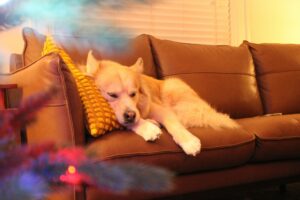
Dogs get on the couch because it is soft, warm, raised, often next to a window, and smells like you, the American Kennel Club notes.
Some dogs like the height because it lets them watch the room, and a couch by the window gives them a view of passing dogs and squirrels. The scent matters too: a couch is where the family sits, so it smells like the people your dog is attached to. A dog who stays off the couch while you are home may still head for it when you leave, which is why the rule needs management while you are out.
Should Your Dog Be Allowed on the Couch at All?
Whether your dog is allowed on the couch is your choice, but the rule has to be clear and the same for everyone: never, only when invited, or only on one piece of furniture.
The American Kennel Club describes the same three options and advises deciding before a puppy comes home, since what is fine for a small puppy may not be for a full-grown dog. The rule only works if every person in the house enforces it the same way and uses the same cues.
| Rule | How it works | Works best when |
| Never | Your dog stays off the couch at all times | You want the simplest rule, or your dog guards the couch |
| Only when invited | Your dog stays off until you give a specific cue, such as “up,” and gets off on “off” | Your dog already responds to “off” and gets off happily |
| One piece of furniture | One chair or couch is your dog’s; the rest is off-limits | Everyone in the house can keep track of which piece is allowed |
Dogs who growl, stiffen, or snap when asked to move belong in the first row: VCA Animal Hospitals advises keeping dogs off furniture where they might be possessive.
“Losing the couch doesn’t have to be permanent, and I say that up front because owners feel bad about it. Right now she doesn’t know the rule, so she’s off it altogether — leash on, bed of her own, nobody in the house making exceptions. Once she’s getting off on the first ask and going to her spot without an argument, you can start inviting her up again if that’s what you want. The rule she needs isn’t ‘never.’ It’s that the couch is yours to offer. Plenty of dogs end up back on the sofa. They just end up there by invitation.”
– Charlie Angel Chun Expert Trainer & Consultant (Behavioral Rehabilitation & Society Acclimation)
How Do You Teach a Dog to Get Off the Couch?
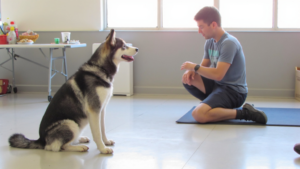
Teach a dog to get off the couch with a dedicated “off” cue: say it once, help your dog to the floor with a treat at first, and reward them the moment all four feet are on the floor.
- Pick the word. The American Kennel Club suggests “off” or “floor” for getting off furniture, so that “down” can keep meaning lie down.
- Show your dog what you mean. Say “off” once, then toss a treat on the floor a short distance from the couch. When all four feet land on the floor, praise and reward again.
- Fade the treat toss. After a few sessions, say “off” first and wait a moment; reward from your hand once your dog is on the floor.
- Send them somewhere better. Follow “off” with a cue to go to their own bed (see the next section). If your dog climbs back up, the AKC suggests silently taking them to their spot and rewarding them there.
- Keep it calm. Avoid pulling or pushing your dog off; a calm cue and a reward keep the request easy, while a struggle turns it into a contest.
Should You Use a Leash in the House?
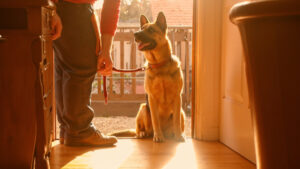
A light leash on your dog indoors for the first week or two gives you a calm way to follow through on “off” without grabbing their collar or pulling them down. Once a dog has claimed the couch as their spot, the cue alone often is not enough at first: they get down, then climb straight back up. With a leash on, you can say “off” once, guide your dog gently to the floor, walk them to their own bed, and reward them there. The leash does not punish anything; it makes the rule the same every time, which is what builds the new habit that the couch is not their designated spot.
- Use it only while you are home and watching. Take the leash off whenever your dog is unsupervised, so it cannot catch on furniture.
- Keep it light. A thin, lightweight leash clipped to a flat collar or harness is enough; the point is guidance, not correction.
- Guide, do not pull. Use the leash to lead your dog off and over to their bed, then reward them on the bed.
- Phase it out. Once your dog gets off on the first ask and goes to their bed without help, stop picking up the leash, then remove it.
It also helps to think about what the couch gives your dog. Some dogs choose it for the cushioning or the temperature as much as for the spot itself: a soft, raised seat off a cold floor, or a cool cushion on a hot day. If their own bed is thin, on a drafty floor, or in a warm sunny patch, matching what the couch offers, with a thicker or raised bed, a blanket in winter, or a cooler spot in summer, makes the swap easier.
“Most of the time this isn’t deep. She got on the couch, it was comfortable, nobody minded, and now it’s her spot. That’s the whole thing. What makes it hard is the part where she’s back up thirty seconds after you asked her off, and you end up either hauling her down or giving in. So put a light leash on her in the house for a week or two. Then ‘off’ comes with a bit of gentle guidance, and you never have to grab her collar or turn it into a wrestle. Ask once, guide her down, send her to her own bed, pay her for being there. She’ll have it quickly. Dogs usually do when the rule is the same every time.”
– Charlie Angel Chun Expert Trainer & Consultant (Behavioral Rehabilitation & Society Acclimation)
How Do You Teach a Dog to Go to Their Own Bed?
Teach a dog to go to their own bed with a “place” cue: reward them for stepping onto the bed, then for lying down on it, then for staying until you release them, and add the cue last.
A place cue gives your dog something to do instead of getting on the couch, which the American Kennel Club recommends over trying to prevent the behavior alone. Your dog should already lie down on cue and know a release word; if lying down is not reliable yet, start with How to Teach Your Dog to Lie Down in 6 Easy Steps.
- Step 1: Show your dog the bed or mat and reward any interest in it, or lure them toward it with a treat. Reward when at least one paw touches it, placing the treat on the bed.
- Step 2: Wait for more paws, then all four, rewarding on the bed each time. Add your release word, such as “Break” or “Free,” to tell your dog when they can leave.
- Step 3: Lure your dog into a down on the bed before you reward.
- Step 4: Build duration, then distance, then distractions, one at a time.
- Step 5: Add the cue, such as “place” or “bed,” once your dog goes to the bed and lies down reliably.
Move to the next step when your dog gets the current one right about 8 times out of 10. Make the bed worth choosing: put a soft bed with blankets and chew toys in the room with the most tempting furniture, and give new chews and toys on the bed. The AKC notes that a dog who sees their place as a punishment will be much harder to keep there, so never send your dog to their bed as a time-out.
How Do You Keep a Dog Off the Couch When You Are Not Home?
Keep a dog off the couch when you are not home by blocking access: close the door to the room, use a gate or crate, or cover and block the seats, and leave your dog a comfortable bed and a chew.
Dogs do what works for them, so every time your dog gets on the couch unseen, the habit gets a little stronger. Until the rule is solid, manage the times you cannot watch:
- Close off the room with a door or a pet gate, or leave your dog in a crate or a dog-safe room if they are used to it.
- Cover or block the seats with a throw, upturned cushions, or chairs, so the couch is not comfortable or reachable.
- Remove the view. If the couch is a lookout post, close the drapes or blinds, as the AKC suggests.
- Leave something better on your dog’s bed: a chew or food puzzle that is safe for your dog to have unsupervised.
Sprays, foil, and mats that make the couch unpleasant may stop some dogs for a while, but they do not teach your dog where to go instead. VCA Animal Hospitals notes that the primary goal of training should always be to teach the behavior you want rather than to punish the one you do not. If your dog seems distressed when left alone, not just drawn to the couch, see Dog Separation Anxiety: Signs, Causes, and How to Help.
Can an Electronic Keep-Away Zone Help?
An indoor keep-away zone from a Bluetooth beacon, such as Halo’s Zone Beacon, can help as one option: it cues your dog’s collar near the couch, but it works only after training and only while your dog wears the collar.
With the Halo Collar 5, this is the job of the Zone Beacon (part of the Halo Beacons family, sold separately) in Keep Away mode. According to Halo’s Help Center, you set the range in the Halo App rather than in feet, your dog gets a Warning at the outer edge of the range and Boundary feedback closer in, and you choose the feedback type in the app: sound, a voice command, vibration, or optional static feedback. The range is dome-shaped, so a high setting can reach the floor above or below. Two things matter for a couch:
- Keep your dog’s bed outside the range, or your dog will get cues on the very spot you are rewarding.
- Train it like any boundary. Pair the zone with the “off” and “place” cues above; the beacon is a training aid, not a lock. The collar also needs to come off for at least 8 hours in every 24, so block the couch during those hours.
What If Your Dog Growls When You Ask Them to Move?
If your dog growls, stiffens, or snaps when asked to get off the couch, stop asking and do not try to move them by force: guarding a resting place is a form of aggression and needs your vet and a behavior professional.
VCA Animal Hospitals lists resting places among the resources dogs guard, warns that physically confronting an aggressive dog can escalate the aggression and lead to injury, and advises that no one try to “out muscle” the dog. The Merck Veterinary Manual advises seeking help from a veterinarian as soon as any signs of aggression appear, and veterinarians also rule out medical causes. Until then, keep the couch blocked so the situation does not come up, and if your dog does get on it, call them away cheerfully or toss a treat on the floor rather than reaching for them. VCA notes that each case needs an assessment with a veterinary behaviorist.
What If Your Dog Has Trouble Getting On and Off Furniture?
Hesitating to jump onto or off furniture can be a sign of arthritis, VCA Animal Hospitals notes, so a dog who suddenly struggles with the couch should see a vet.
Osteoarthritis affects at least 20% of dogs over one year old and 80% of dogs over eight, according to VCA. Jumping up and down from furniture stresses the joints and raises the chance of injury, the American Kennel Club notes, and puppies’ still-developing bones are prone to damage from repeated jumps down. If your dog is allowed on the couch, a ramp or pet stairs can reduce that strain and a non-slip rug in front of it helps prevent slipping; if they are not, a supportive bed they do not have to climb onto gives them a comfortable alternative.
Frequently Asked Questions
Does aluminum foil keep dogs off furniture?
Foil can put some dogs off for a while because of the texture and noise, but it does not teach your dog where to go instead. A comfortable bed of their own, an “off” cue, and blocking the couch while you are out work on the cause.
How long does it take to keep a dog off the couch?
It depends on how long the habit has had to form and how consistent everyone in the house is. Management works from day one; the “off” and “place” cues take weeks of short daily practice before you can rely on them without blocking the couch.
Should I let my puppy on the couch?
Decide before your puppy comes home and keep the same rule as they grow, the American Kennel Club advises. If you do allow it, help small puppies up and down or use pet stairs, since their developing bones are prone to damage from jumping down.
How do I keep my dog off my bed?
Use the same approach: an “off” cue, a comfortable dog bed nearby, and a closed bedroom door while the habit forms. The American Kennel Club suggests that if your dog does share your bed, it should be by invitation only, with a dog bed nearby for when they want their own space.
Keeping a dog off the couch comes down to a clear rule, a spot your dog prefers, and two cues: “off” to get down and “place” to go to their bed. Block the couch while you are out until the habit holds, and treat growling as a reason to call your vet and a behavior professional, and difficulty jumping as a reason to see your vet, rather than as training problems.