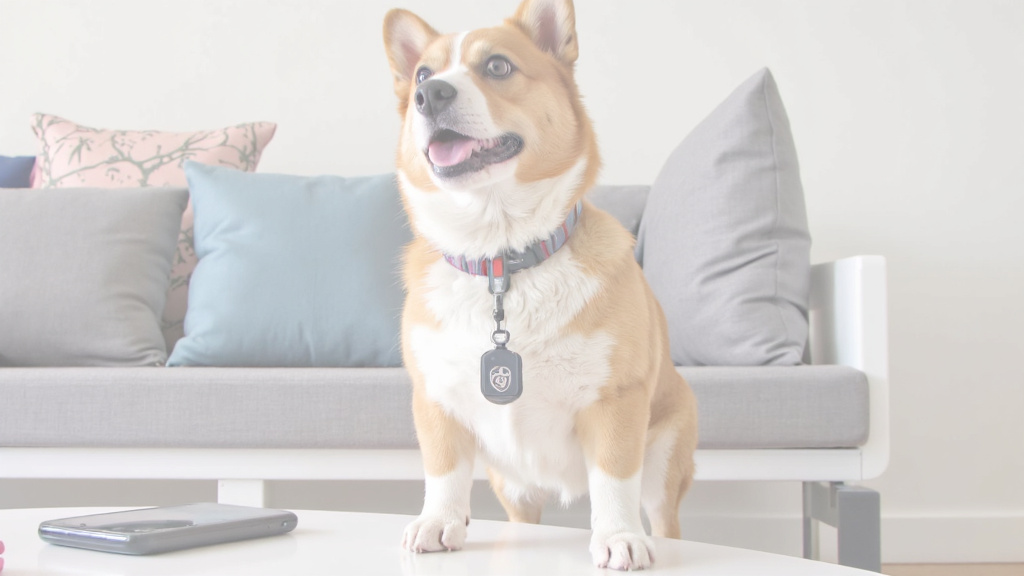
Only roughly. An AirTag shows where your dog was last picked up by a nearby Apple device, not where they are now – and Apple says it is designed for objects, not pets. A GPS tracker works out its own position and shows it live. The difference matters most in the first minutes after an escape. A dog at a sprint can cover 20 to 30 feet a second, which takes them out of Bluetooth range within seconds; after that, a Bluetooth tag can only report a new position when someone else’s phone happens to pass close by. This guide uses the AirTag as the main example to explain how Bluetooth trackers work, what the 2026 model changed, how GPS differs, where Bluetooth falls short, and when an AirTag can still be useful. For how GPS collars can also keep a dog inside a boundary, see What Is a GPS Dog Fence and How Does It Work?
Can You Put an AirTag on a Dog’s Collar?
You can, but Apple does not design it for that. Introducing the second-generation AirTag in January 2026, Apple described it as designed exclusively for tracking objects, not people or pets. When the first AirTag launched in 2021, Apple’s Kaiann Drance made the practical point in an interview with Fast Company: anyone who puts one on a pet has to make sure the moving animal gets into range of a device in the Find My network for its location to be tracked. That is the heart of the issue.
How the Find My Network Locates an AirTag
An AirTag has no GPS receiver and no cellular connection, so it cannot work out where it is on its own. Instead, it sends out a short-range Bluetooth signal. When an iPhone or other Apple device in the Find My network comes within range, that device notes its own location and passes it on, anonymously, to the AirTag’s owner. The result is a position that is only as fresh as the last Apple device to pass by.
Two consequences follow for a dog. First, there is no live location – just a series of “last seen” points that can be minutes or hours apart. Second, there is no route: according to Apple, AirTag does not store location data or history on the device, so you cannot see the path your dog took between sightings. Up close, Precision Finding can guide an iPhone to the tag with distance and direction, which is useful once you are already near your dog.
What Did the 2026 AirTag Change – and What Didn’t It?
Apple’s second-generation AirTag, released in January 2026, extends Precision Finding by up to 50% compared with the original, upgrades the Bluetooth chip for longer range, and has a louder speaker; the price stayed at $29. Those are real improvements for finding keys and bags. They do not change the basics for a dog: the tag still has no GPS, still needs a passing Apple device to report its position, and still cannot show you where your dog is right now.
How Does a GPS Dog Tracker Work?
A GPS tracker has its own satellite receiver, works out its position without any nearby phone, and sends it to your app over cellular – so you can see your dog live, wherever there is coverage. Because the collar knows where it is, the map keeps up with your dog as they move, so you can see where they are and which way they are heading, whether they are in the next yard or the next town. How often it updates varies by device: some check in every so often to save battery, while Halo Collar 5 recalculates its position 20 times a second with AlwaysOn GPS, using 151 satellites across 6 constellations, and reaches accuracy of less than 2 feet (0.6 meters), independently verified, under open sky. A GPS tracker’s limits are different from a Bluetooth tag’s: it needs a charge and, to send its position to your phone, a cellular, Wi-Fi, or Bluetooth connection.
How Do GPS and Bluetooth Trackers Compare?
A Bluetooth tag reports where it was last seen by someone else’s phone; a GPS tracker reports where it is.
| Category | AirTag (Bluetooth) | GPS tracker |
|---|---|---|
| Knows its own location | No – relies on nearby Apple devices | Yes – its own satellite receiver |
| Live location | No – “last seen” updates | Yes, wherever there is coverage |
| Route history | No – nothing stored on the tag (Apple) | Usually, depending on the device |
| Works far from people | Rarely – needs a passing Apple device | Yes |
| Finding it up close | Precision Finding with a recent iPhone | Map on your phone; some collars also play a sound |
| Alert when your dog leaves an area | Not designed for this | Common feature |
| Power | Replaceable coin-cell battery | Rechargeable – needs regular charging |
| Cost | $29, no subscription (2026) | Device plus a monthly plan |
GPS collars themselves range from location-only trackers to smart collars with activity monitoring, containment, and training; for the different types, see What Is a Smart Dog Collar? Features and Who Needs One
What Happens When Your Dog Gets Out?
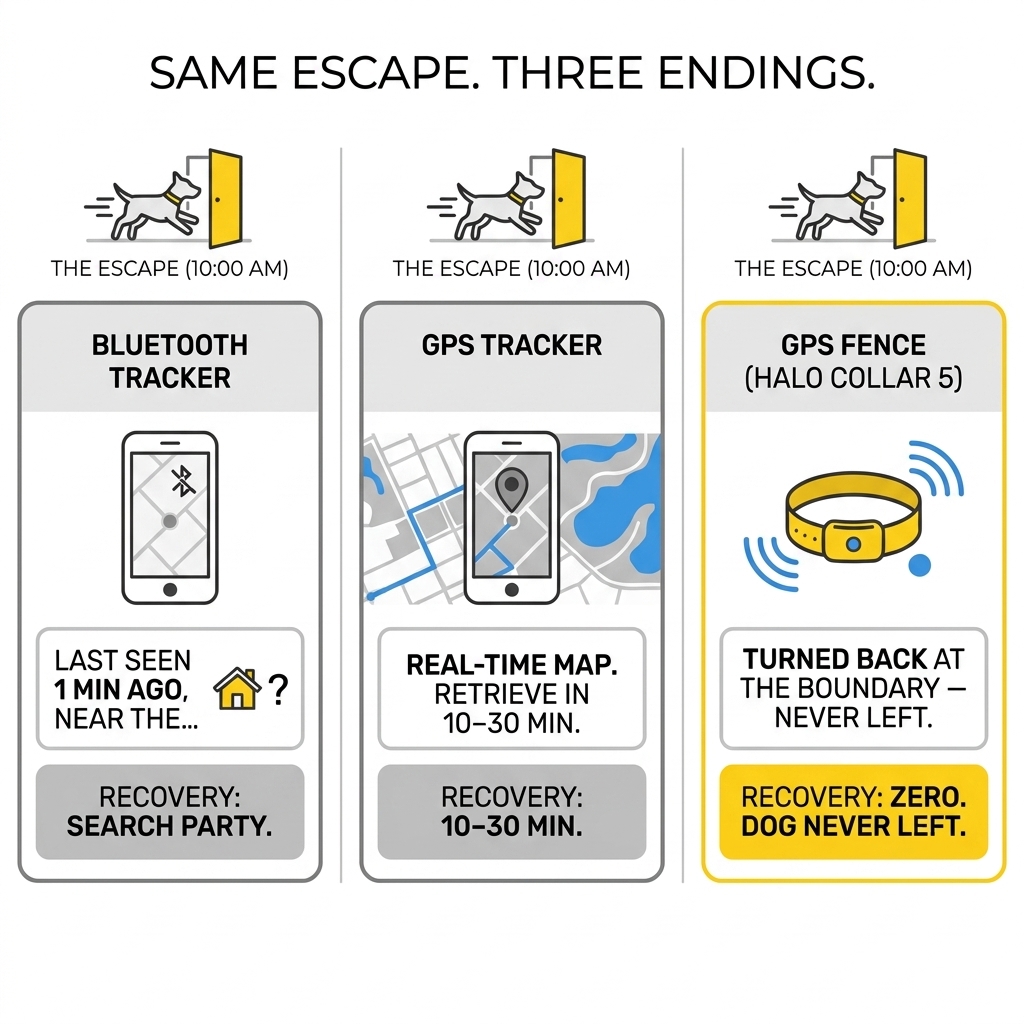
The real test is the first few minutes after your dog slips through an open gate.
- With an AirTag: your dog bolts when a guest arrives, and by the time you notice, a running dog may already be hundreds of feet away – well beyond Bluetooth range. The Find My app shows where the tag was last seen, perhaps by your own phone on the porch. From then on, you are searching on foot and hoping a passing Apple device picks up the tag. In a quiet suburb at night or out in the country, that may take a long time.
- With a GPS tracker: you open the app and see your dog moving on the map, and which way they are heading. You follow the map, by car if needed, and find your dog in a neighbor’s yard. The tracker did its job – but your dog still got out, and still crossed whatever lay in between.
If your dog does go missing, the steps that work best in the first hours are covered in How to Find a Lost Dog.
Why Do Bluetooth Trackers Fail in the Woods and the Countryside?
Because they depend on other people’s phones, and the places dogs go missing are often the places with the fewest people. In a busy city center, plenty of iPhones pass every block, and an AirTag’s position can update often. In a suburb, the number drops sharply, especially at night. On a wooded lot, a hiking trail, farmland, or a country road, there may be no Apple device within range for hours, and the app simply keeps showing an old position. A GPS tracker has no such dependency: it gets its position from satellites and needs only a connection to send it, so a dog in an empty field is as findable as one in a crowded park, wherever there is coverage.
When Is an AirTag Useful for a Dog?
An AirTag has a few genuine uses for dogs, but none of them replace live tracking when a dog has run off.
- Finding a dog who is hiding nearby. Precision Finding can lead you to a dog wedged behind furniture or tucked away in the garden.
- An extra contact point. In Lost Mode, someone who finds your dog can tap the AirTag with an NFC-capable phone to see a message and contact number from you. It is a useful addition to an ID tag and a microchip, not a replacement – see Can a Microchip Track a Dog? GPS vs Microchip.
- A low-cost extra layer. At $29 with no subscription, an AirTag can sit alongside a GPS collar as a backup way to find the collar itself.
Where an AirTag Falls Short for Dogs
- No live location. It shows where the tag was last detected, which may be minutes or hours old.
- No route. There is no record of where your dog went between sightings.
- No yard alerts. It is not designed to tell you the moment your dog leaves an area – for how geofence alerts work on GPS collars, see Geofencing for Pets.
- Easy to lose. It is built for keys and bags; a holder on an active dog’s collar can come loose during play, swimming, or rolling.
- Network dependency. Outside busy areas, the Find My network thins out – and suburban and rural homes with yards are exactly where many dogs get out.
- No activity data. It tells you nothing about your dog’s exercise or rest.
“I’ve had clients tell me they feel covered because they put an AirTag on the collar. I ask them one question: ‘If your dog bolts out the front door right now, what does that tag do in the next 60 seconds?’ The answer is nothing. It doesn’t know where it is. It doesn’t alert you. It doesn’t signal the dog. For the first critical minute of an escape – the minute that determines whether this is a retrieval or a search party – a Bluetooth tag is functionally identical to no tracker at all.”
— Charlie Angel Chun Expert Trainer & Consultant (Behavioral Rehabilitation & Society Acclimation)
What Does Each Cost?
An AirTag costs less up front and has no subscription; a GPS tracker costs more because it has its own receiver and a cellular connection. The 2026 AirTag costs $29, with a replaceable coin-cell battery and no monthly fee. GPS trackers combine a device price with a monthly plan for the cellular service that sends your dog’s location to your phone. Halo Collar costs $524, with plans from $9.99 a month, and adds containment, training, and activity monitoring to live tracking. What you are paying for, in the end, is the ability to see where your dog is right now. For a full breakdown of Halo’s plans, see Halo Collar Cost Analysis.
GPS vs Bluetooth Dog Tracker FAQs
Can I use an AirTag to track my dog?
You can attach one, but it will only show where your dog was last detected by a nearby Apple device, not where they are now, and it keeps no route. Apple describes the AirTag as designed for objects, not pets. In quiet suburbs, the countryside, or at night, updates may be few and far between.
Does an AirTag work if my dog runs into the woods?
Usually not well. With no Apple devices nearby to relay its signal, an AirTag in the woods may not report a new position until someone passes within range. A GPS tracker works from satellites, so it can still show where your dog is, as long as it can send its position over a connection.
Do GPS dog trackers work without cell service?
A GPS tracker can still work out its position from satellites, but it needs a cellular, Wi-Fi, or Bluetooth connection to send it to your phone, so the live map pauses until it is back in range. More in Does a GPS Dog Fence Need Cell Service to Work?
Is a GPS tracker better than an AirTag for a dog?
For finding a dog who has run off, yes: it shows a live location and direction of travel without relying on strangers’ phones. An AirTag can still be a handy extra for finding a dog hiding nearby or for giving a finder your contact details.