No – a microchip cannot track your dog. It identifies them once someone scans it; a GPS tracker shows you where they are so you can find them yourself. Neither one stops a dog getting lost in the first place. The two solve different problems at different points in the same emergency, and the difference matters. Microchips work: in a 2009 Ohio State University study published in the Journal of the American Veterinary Medical Association, stray dogs with microchips were returned to their owners 52.2% of the time, compared with 21.9% for dogs without. But a chip only helps after a stranger has found your dog and taken them somewhere with a scanner. This guide covers what a microchip does and does not do, whether shelters really scan, why a tag and a chip leave a gap, and where GPS closes it – including the prevention layer a GPS dog fence adds, which is explained in What Is a GPS Dog Fence and How Does It Work?
What Is a Dog Microchip?
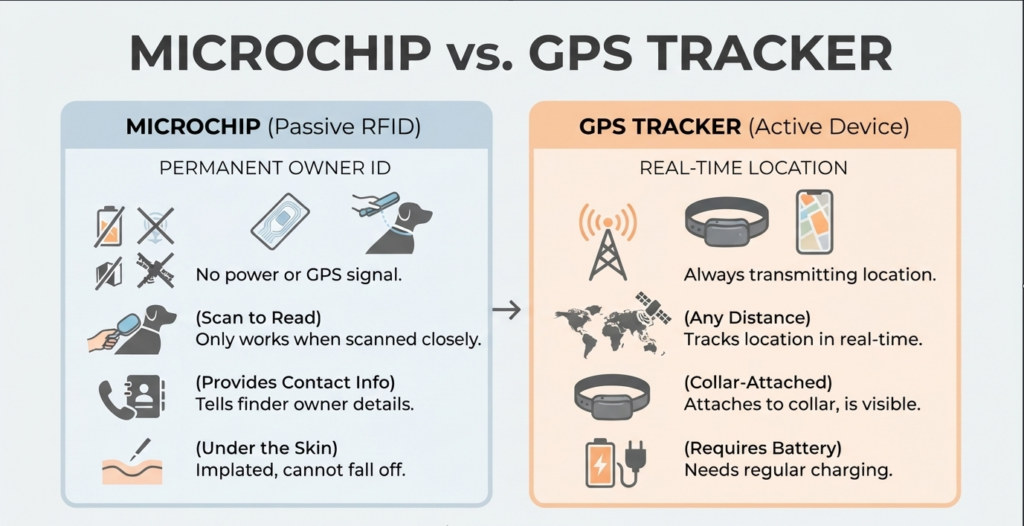
A dog microchip is a passive identification chip, about the size of a grain of rice, implanted under the skin between the shoulder blades, that stores a unique number linked to your contact details in a registry. It uses radio-frequency identification (RFID): when a scanner passes within a few inches, the chip is powered by the scanner’s signal just long enough to return its number. It has no battery, no GPS receiver, and no cellular radio, so it never sends a signal on its own and cannot be followed remotely.
Implanting a chip is a quick procedure, similar to a routine injection, and according to the American Veterinary Medical Association (AVMA), pet microchips are designed to last your pet’s lifetime, with nothing to charge and no subscription. Many shelters and rescues microchip animals before adoption, so a newly adopted dog may already have one.
The step that decides whether a chip ever helps is registration. The number on its own is meaningless; it only leads back to you if it is registered in your name and your phone number and address are current. Register the chip as soon as it is implanted or you adopt, update it whenever your details change, and ask your vet to scan it at checkups to make sure it can still be read.
Can a Microchip Track Your Dog’s Location?
No. A microchip is an identification device, not a tracking device – the AVMA states plainly that a pet microchip is not a GPS device and cannot track your animal. The confusion is understandable: “chip” suggests phones and other gadgets that do know where they are. A pet microchip is a passive transponder that holds one number and does nothing at all until a scanner wakes it. If you want to know where your dog is right now, you need GPS. If you want whoever finds your dog to know who they belong to, you need a microchip and a tag. They are complementary, not alternatives.
Is There a GPS Implant for Dogs?
No. There is no GPS implant for dogs, and today’s technology does not make one practical. To track a dog, a device has to receive satellite signals, work out its position, and then send that position to your phone over a cellular or other radio link. That takes an antenna, a receiver, a transmitter, and a battery that needs regular charging – all things a passive microchip deliberately does without, which is exactly why it can sit under the skin for life.
If you see a product described as a “GPS microchip” or “microchip tracker”, look closely at what it actually is. It will be one of two things: an ordinary ID microchip, which cannot track, or a GPS device worn on the collar, which can. Real-time tracking for dogs today means a device worn on the collar or harness.
Do Dog Shelters Scan Microchips? The Reality
Yes – shelters, veterinary clinics, and animal control routinely scan stray animals, but a scan only helps if the chip is found, read, and registered to someone who can be reached. According to the AVMA, most veterinarians, shelters, and animal control agencies now use universal scanners that read virtually all microchips commonly used in the U.S., including both the international ISO standard (134.2 kHz) and older 125 kHz and 128 kHz chips. Because chips can occasionally migrate from where they were implanted – the most frequently reported issue, the AVMA notes – a complete scan of the whole body is what makes sure one is found.
The bigger gaps come after the scan. In the 2009 Ohio State study of 53 shelters, registries had a registration on file for only 58.1% of the chips shelters asked about. Where shelters could not reach the owner of a microchipped animal, the main reasons were an incorrect or disconnected phone number (35.4%), owners not returning calls or letters (24.3%), a chip registered in a different database from the manufacturer’s (17.2%), and a chip that had never been registered at all (9.8%). Most of those failures are fixable from your kitchen table: register the chip, keep your details current, and make sure you can be reached.
There is one more catch no scanner can solve: a chip only helps once your dog reaches someone who has one. A neighbor who takes in a friendly stray and keeps them overnight, or a finder who never thinks to visit a vet, will not see the chip at all.
Why a Collar Tag and a Microchip Aren’t Enough
A tag and a microchip are both identification – they help someone who has found your dog contact you, but neither can tell you where your dog is. A tag with your phone number is the fastest way home if your dog is found by a stranger, because anyone can read it without a scanner; but tags fall off, wear smooth, and come off with the collar. A microchip is permanent but out of sight, and depends on the finder reaching a scanner and on the registry details being right.
Both share the same limitation: they wait for someone else to find your dog. In the meantime, a loose dog may be crossing roads, running further from home, or hiding somewhere unfamiliar, and there is nothing either one can do to shorten that time. That gap – between your dog getting out and someone finding them – is what GPS addresses: instead of waiting for a call, you can see where your dog is and go to them.
What Is a GPS Dog Tracker?
A GPS dog tracker is a device worn on the collar that works out your dog’s position from satellites and sends it to an app on your phone. Unlike a microchip, it does not need a scanner, a vet, or a stranger: you open the app, see your dog on the map, and go and get them. Trackers use cellular networks to send their location, and many also use Bluetooth or Wi-Fi nearby, so how often the map updates and how far they reach depends on the device and the coverage.
Trackers range from location-only devices to smart collars that add activity monitoring, containment, and training. Their main limitation is power: a tracker has to be charged, and a flat battery or a collar that comes off means no location at all – one reason a microchip remains essential as a backup.
How Do Microchips and GPS Trackers Compare?
A microchip identifies, a GPS tracker locates, and a GPS smart collar adds containment and training on top of tracking.
| Category | Microchip | GPS tracker | GPS smart collar |
|---|---|---|---|
| What it does | Identifies your dog when scanned | Shows your dog’s location | Location, containment, training, activity |
| Real-time location | No | Yes | Yes |
| Virtual boundary | No | Some models alert only | Yes – cues as your dog approaches |
| Power | None – passive | Rechargeable battery | Rechargeable battery (Halo Collar 5: up to 48 hours) |
| Without cell service | Works whenever scanned | Location stops reaching your phone | Boundary still works; map updates resume with a connection |
| Can come off | No – implanted | Yes, with the collar | Yes, with the collar |
| Helps prevent escapes | No | No | Yes – though no system is a guarantee |
Bluetooth trackers such as Apple’s AirTag are a different category again: they rely on nearby phones rather than satellites, so they can only show a dog’s position when one passes close by. That comparison is covered in GPS vs Bluetooth Trackers.
What Does a GPS Smart Collar Add?
A GPS smart collar combines tracking with a virtual boundary, so it can help keep your dog from getting lost in the first place rather than only helping you find them afterwards. The collar holds a boundary drawn on a map and gives your dog cues as they approach it. On Halo Collar, Halo’s patented Direction-Based Feedback gives those cues – tones, voice commands, vibration, or optional static feedback – only when your dog is heading toward the boundary, never when they are standing still or walking along it, and a training program built with Cesar Millan teaches your dog what the cues mean.
What One Device Covers
- Real-time location, as a GPS tracker does.
- A virtual boundary, which neither a microchip nor a basic tracker provides.
- Boundary and recall training cues, which no passive technology can offer.
- Activity monitoring, through Halo Health – more on what that data shows in Dog Activity Trackers: What They Measure and Why.
Why the Microchip Still Matters
A smart collar does not replace a microchip. A collar can come off, be removed, or run out of charge; a microchip cannot. The chip is your dog’s permanent identification if the collar is lost or your dog is taken, so the two belong in the same safety plan rather than competing for a place in it.
Which Should You Choose: Microchip, GPS Tracker, or Both?
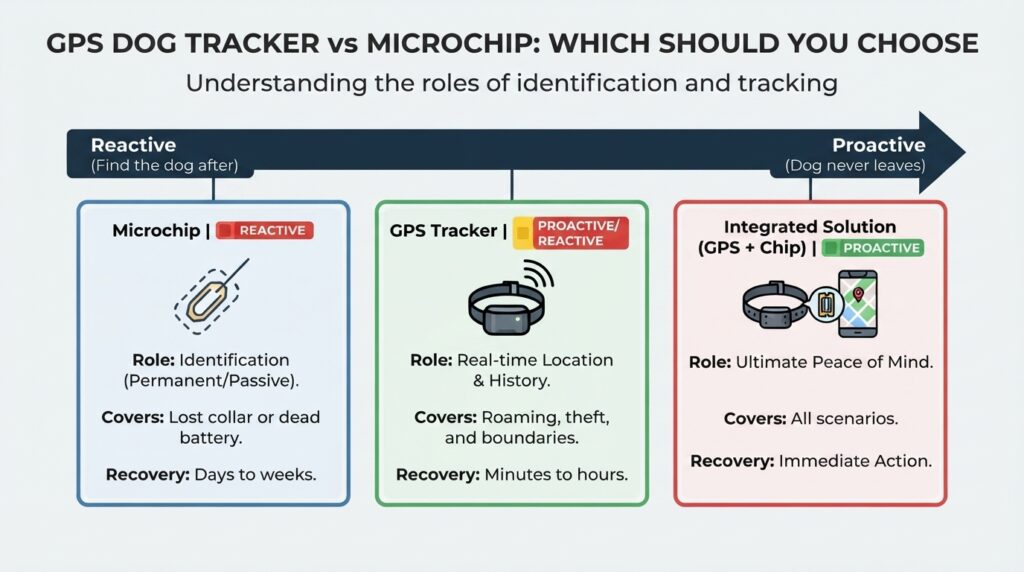
Use layers, because each one covers a different way things go wrong.
- Identification – tag and microchip. A tag for a quick call from whoever finds your dog; a microchip as the permanent backup when the collar is gone. Both depend on someone else finding your dog, so recovery can take days.
- Location – GPS tracking. You see where your dog is and go to them yourself, so recovery is usually much faster – as long as the collar is on, charged, and connected. It does not stop your dog leaving.
- Prevention – a GPS dog fence. A trained dog gets a warning before reaching the edge and learns to turn back, and if they do cross, you are alerted and can track them. It reduces the chance of the lost-dog situation rather than only responding to it.
Microchips and trackers are reactive – they help after your dog is already out. Prevention is the only layer that works before that happens. For a closer look at how a fence differs from a tracker, see GPS Fence vs. GPS Tracker.
How Fast Can Each Technology Help You Find a Lost Dog?
Speed matters: every minute widens the search area and increases the chance your dog meets traffic or ends up somewhere unfamiliar.
- Microchip only: your dog has to be found by someone, taken to a shelter or vet, scanned, and matched to current registry details. That can take days, and many friendly strays are kept by kind finders without ever being scanned.
- GPS tracking: you notice your dog is gone – or get an alert – open the app, and go to where they are. The time depends on how quickly you notice and how far they have gone, but it is typically measured in minutes or hours rather than days.
- GPS dog fence: a trained dog usually turns back at the warning cue before reaching the line. If they do cross, the collar keeps cueing them through a Protection Zone of about 300 feet, you get a notification, and you can follow them on the map.
Together the layers cover far more situations than any one alone: the fence makes an escape less likely, tracking finds a dog who gets out, and the microchip identifies them if the collar is lost. If your dog does go missing, the steps that work best in the first hours are covered in How to Find a Lost Dog.
GPS Tracker vs Microchip FAQs
Is microchipping required by law?
It depends where you live. Microchipping has been compulsory for dogs in England, Scotland, and Wales since 2016, and a microchip is required for pet travel within the European Union. The U.S. has no federal requirement, though some states and cities have their own rules, and according to the AVMA, all dogs returning to or entering the U.S. now need a microchip that can be read by a universal scanner. Wherever you are, the AVMA recommends microchipping.
Do GPS trackers work without cell service?
Most trackers need a cellular connection to send your dog’s location to your phone. A GPS dog fence works differently: with Halo Collar, the boundary is stored on the collar, so containment keeps working in a dead zone; what pauses is the live map and alerts, which resume when the collar is back on cellular or Wi-Fi. More in Does a GPS Dog Fence Need Cell Service to Work?
Can a microchip be removed or stop working?
Microchips are designed to be permanent and, according to the AVMA, to last your pet’s lifetime. They have no on/off switch and cannot be switched off remotely; removal is a veterinary procedure that is rarely done. The most common problem is migration away from the original spot, which is why a full-body scan – and a check at your dog’s regular vet visits – is worthwhile.
Do I still need a microchip if my dog wears a GPS collar?
Yes. A GPS collar shows you where your dog is, but it can come off or run out of charge. A microchip, together with a tag, is what lets anyone who finds your dog get them home when the collar is not there.