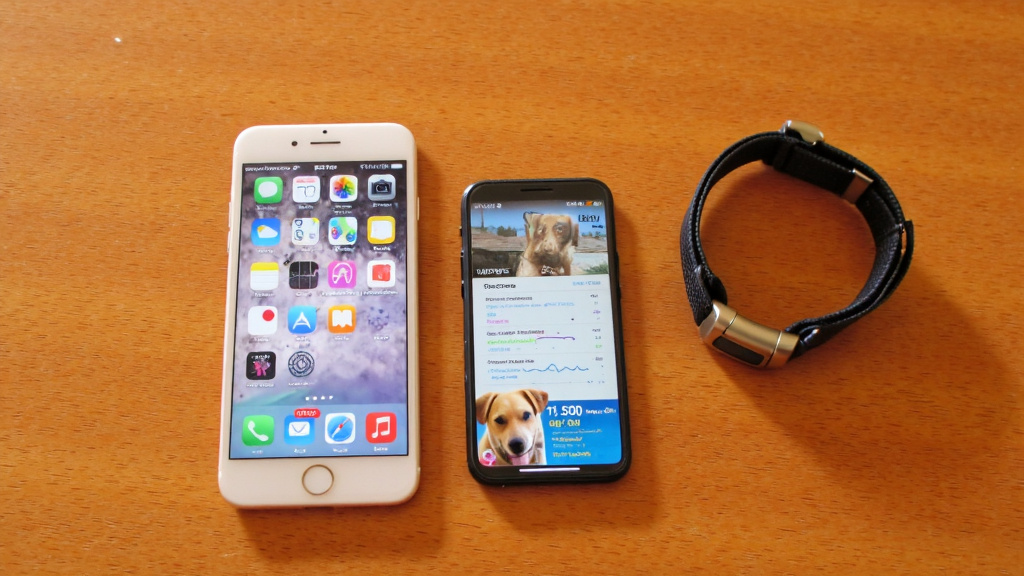
A smart dog collar uses GPS, sensors, and a phone app to show where your dog is and how active they are – and, in the most advanced models, keeps them inside a virtual boundary and helps train them. A traditional collar holds ID tags and a leash. A smart collar keeps gathering information about where your dog is, how much they move, how well they rest, and whether they stay within the boundaries you set, and sends it to your phone – turning a passive piece of equipment into an active safety and health tool. The term covers a wide range, from Bluetooth tags that only work nearby to GPS fence collars with multi-constellation positioning and direction-based feedback, and knowing what separates them is the difference between buying a gadget and choosing a safety system.
How Does a Smart Dog Collar Work?
A smart collar combines three things: sensors that work out where your dog is and how they are moving, a wireless connection that sends that information to your phone, and an app that displays it and lets you set up safety features. The collar’s GPS receiver uses satellite signals to calculate its position. Simpler models rely on fewer satellites and update less often; Halo Collar 5 draws on 151 satellites across 6 constellations – GPS, Galileo, BeiDou, GLONASS, NavIC, and QZSS – recalculates its position 20 times a second, and reaches accuracy of less than 2 feet (0.6 meters), independently verified, under open sky.
The collar sends its location to your phone over cellular (LTE), Wi-Fi, or Bluetooth, depending on its hardware and what is available, and the app shows it on a map alongside activity data and any notifications. Motion sensors inside the collar distinguish walking, running, resting, and sleeping, which is what powers activity tracking. For how a GPS dog fence builds on this to hold a boundary, see What Is a GPS Dog Fence and How Does It Work?
What Features Do Smart Dog Collars Include?
Features range from simple location checks to complete safety systems; here they are from the most common to the most advanced.
GPS Location Tracking
GPS tracking is the defining feature of a smart collar: the collar works out its position from satellites and shows your dog on a map in your phone. Quality varies a great deal between devices. Some update only every so often to save battery; Halo Collar recalculates 20 times a second with AlwaysOn GPS. Accuracy varies just as much – GPS.gov puts typical smartphone accuracy at about 4.9 meters (16 feet) under open sky, while dual-frequency collars with correction can get far closer. For a dog heading toward a road, that difference matters. More in How Accurate Is a GPS Dog Fence.
Activity and Health Monitoring
Activity monitoring records how much your dog moves and rests each day and compares it with their own normal. That helps you spot under-exercise – a common driver of barking, chewing, and escape attempts – notice gradual changes worth raising with your vet, and check that your dog’s routine suits their needs. Halo Collar includes Halo Health, which tracks activity, rest, sleep, and walks and keeps a history in the Halo App, so you can see whether today looks like your dog’s normal. For how to read that data, see Dog Activity Trackers: What They Measure and Why.
Geofence Alerts
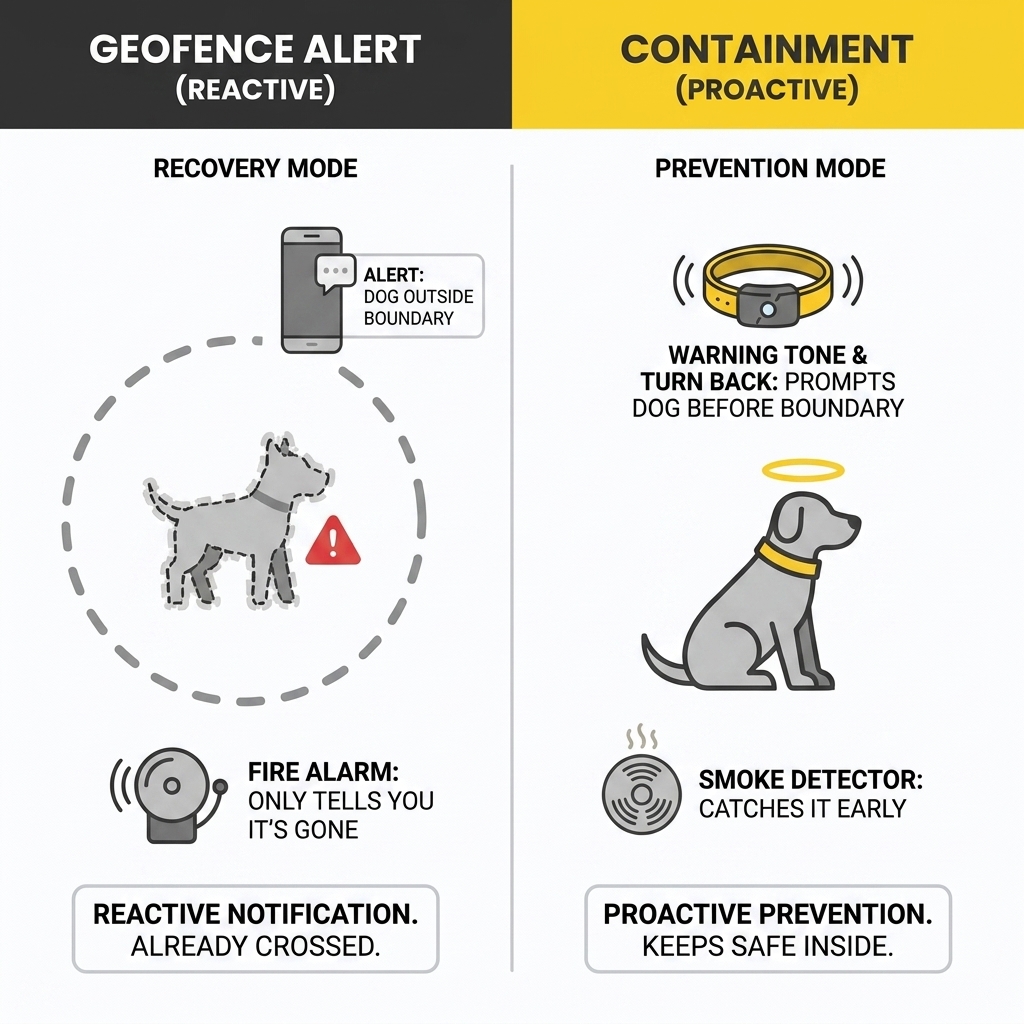
A geofence is a boundary you draw on the app’s map; if your dog crosses it, the collar sends a notification to your phone. It is a monitoring feature rather than containment: it tells you your dog has left, but it does nothing to stop them or guide them back. Many GPS trackers, such as those from Tractive and Fi, include geofence alerts. By the time the notification arrives, your dog is already outside the zone, so its value depends on how quickly you notice and respond. For the full difference between tracking and containment, see GPS Fence vs. GPS Tracker.
“I tell clients to think of it this way: a geofence alert is the fire alarm after the fire has already spread. The geofence tells you the dog is gone – now you’re in recovery mode. A virtual fence with graduated feedback is the smoke detector that warns you at the first sign of trouble. The graduated feedback catches the dog at the first sign of approach and gives it a reason to turn around. Both are useful, but they’re solving the problem at completely different stages, and the stage you intervene at determines the outcome.The alarm tells you there’s a problem. The smoke detector gives you the chance to act before it becomes a bigger one.”
– Charlie Angel Chun Expert Trainer & Consultant (Behavioral Rehabilitation & Society Acclimation)
Virtual Fence Containment
A virtual fence is what separates a GPS fence collar from a GPS tracker: instead of only telling you when your dog crosses a boundary, the collar cues your dog to turn back before they reach it. On Halo Collar, the cues escalate through Warning, Boundary, and Emergency levels, each set to sound, a voice command, vibration, or optional static feedback. Halo’s patented Direction-Based Feedback responds to which way your dog is heading, so a dog walking along the boundary or already turning back gets no cue at all, and encouragement cues reward them the moment they turn for home.
There is no wire to bury and nothing to install. Fences are drawn in the app in minutes, stored on the collar, and work anywhere with a view of the sky – home, a relative’s yard, a campsite – with unlimited fences on higher plans. For what happens if a dog does go past the line, see What Happens When a Dog Crosses a GPS Fence Boundary?
Training Programs
The most complete smart collars include a structured program that guides you through teaching your dog to respect the boundary and respond to cues. Halo’s app includes a positive-association training program built with Cesar Millan, taking you step by step from introducing the collar through boundary work and distractions to supervised off-leash time, so the technology and the training work together. For the method itself, see How to Train Your Dog on a GPS Fence.
What Are the Different Types of Smart Dog Collars?
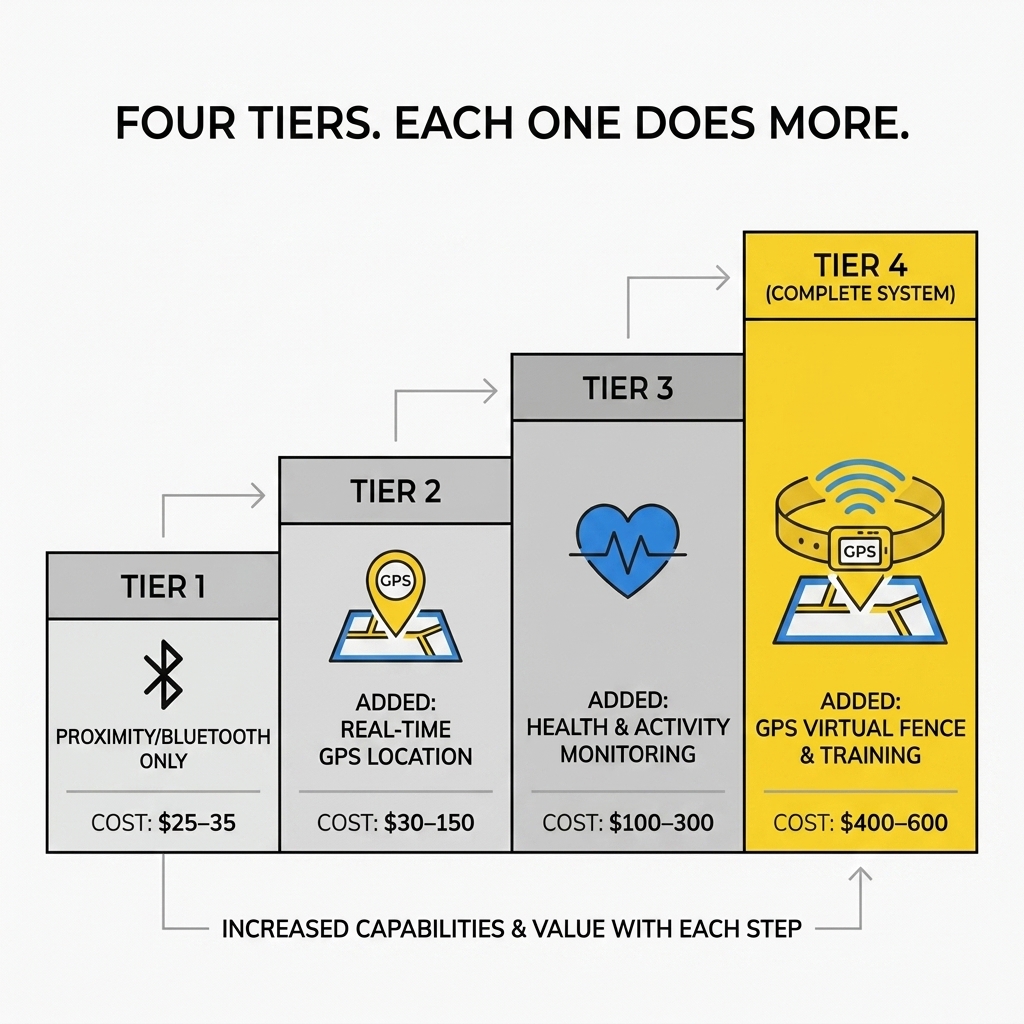
Smart collars fall into four broad categories, each built for a different job.
| Category | Bluetooth tag | GPS tracker | GPS smart collar | GPS fence collar |
|---|---|---|---|---|
| Examples | Apple AirTag, Tile | Tractive, Fi | Fi Series 3 | Halo Collar, SpotOn |
| Live location from anywhere | No – only near phones | Yes, with coverage | Yes, with coverage | Yes, with coverage |
| Activity tracking | No | On some models | Yes | Yes (Halo Health on Halo) |
| Geofence alerts | No | Yes – alerts only | Yes – alerts only | Yes – plus containment |
| Cues your dog at the boundary | No | No | No | Yes |
| Training program | No | No | No | Halo: built with Cesar Millan |
| Subscription | Usually none | Usually | Usually | Halo: from $9.99/month |
Moving from left to right, each type does more. A Bluetooth tag shows roughly where your dog is when a phone is nearby; a GPS tracker shows where they are from anywhere with coverage; a GPS fence collar also keeps them inside a boundary, tracks them if they leave, and helps train them. The right choice depends on the problem you are solving. For why a Bluetooth tag is not the same as GPS, see Can You Track a Dog With an AirTag? GPS vs Bluetooth
What Should You Look For in a Smart Dog Collar?
Six things decide whether a smart collar delivers or ends up as an expensive piece of plastic on your dog’s neck.
- Accuracy. It decides whether the collar knows your dog is on the sidewalk or in the road. Look for independently verified figures rather than best-case claims; for a virtual fence on a smaller yard, precision matters most.
- Update rate. How often the collar recalculates position. A collar that updates once a second shows where your dog was a moment ago; one that updates 20 times a second keeps up with a running dog.
- Battery life. Collars that track continuously need charging more often than ones that check in occasionally. Halo Collar runs for up to 48 hours with AlwaysOn GPS and recharges in about 60 minutes. For what affects battery life across devices, see GPS Collar Battery Life.
- Connectivity. Cellular is standard for GPS collars; Wi-Fi helps indoors and Bluetooth works up close. More options mean fewer gaps – Halo Collar uses all three.
- Durability and water resistance. An active dog’s collar has to survive mud, rain, and swimming. Check the rating: Halo Collar is rated IPX7.
- Subscription. Most GPS collars need a monthly plan for cellular service and app features, so count it in the total cost, not just the price of the collar.
How Much Does a Smart Dog Collar Cost?
Prices rise with what the collar does: Bluetooth tags are the cheapest, GPS trackers add a monthly plan, and GPS fence collars cost the most up front because they also contain and train. Halo Collar costs $524, with plans from $9.99 a month – about $884 over three years on the starting plan. For comparison, a physical fence averages about $3,277 to install, according to Angi’s 2026 data, and stays at one property. A GPS fence collar needs no installation, moves with you, and adds tracking, training, and activity monitoring that no fence provides. For a full breakdown of plans, see Halo Collar Cost Analysis.
Smart Dog Collar vs. Traditional Dog Collar
A traditional collar is a passive strap for ID tags and a leash; a smart collar is an active system that tells you where your dog is and what they are doing – and, in a GPS fence collar, talks to your dog too. If a dog wearing an ordinary collar runs off, the collar does nothing until someone finds them and reads the tag. A smart collar keeps track of your dog’s position and movement and reports it to your phone; a GPS fence collar also gives your dog cues through sound, vibration, or optional static feedback that guide them back from the boundary.
It helps to think about which way the information flows. A traditional collar sends information outward – the tag tells a stranger who your dog belongs to. A smart collar sends it to you – where your dog is and whether they are safe. A GPS fence collar adds a third direction: it tells your dog where the boundary is. For the full range of ordinary collar types – flat, martingale, harnesses, and more – see Types of Dog Collars.
When to Upgrade From a Standard Collar to a Smart Collar
It is worth upgrading when your dog has freedom outdoors, when knowing where they are would make a real difference, or when you want a clearer picture of their health.
- Your dog spends time off-leash outdoors. In an unfenced yard, on hikes, or at unfenced places you visit, containment and tracking both matter – the combination a GPS fence collar provides.
- You live with traffic, open gates, or busy streets. Knowing exactly where your dog is gives you a safety net an ordinary collar cannot.
- Your dog has escaped, or nearly has. A collar that cues your dog before the edge and alerts you if they cross changes what happens next.
- You want to keep an eye on your dog’s health. Activity and sleep data can show a gradual change worth discussing with your vet, especially in older dogs.
A dog who stays indoors and only goes out on a leash, never unsupervised, may not need one; up-to-date ID tags and a registered microchip may be enough. Whatever you choose, keep the tag and the chip – a collar can come off. For why identification and tracking are different jobs, see Can a Microchip Track a Dog? GPS vs Microchip
Smart Dog Collar FAQs
Are smart dog collars safe?
Yes, when they fit well and are used as designed. Halo Collar weighs about 130 grams (4.6 ounces), is rated IPX7, and should sit snugly enough that two fingers fit between the strap and the neck. On a GPS fence collar, static feedback is optional and adjustable, and most trained dogs respond to sound or vibration; for how Halo’s cues work, see Direction-Based Feedback.
How long do smart dog collar batteries last?
It depends on the type and how often the collar checks its position. Collars that track continuously need charging every day or two; Halo Collar runs for up to 48 hours on a charge and recharges in about 60 minutes. Charging overnight is the simplest routine.
Do smart collars work without cell service?
The collar can still work out its position from satellites, but sending it to your phone needs a cellular, Wi-Fi, or Bluetooth connection, so the live map pauses until the collar is back in range. On Halo Collar, the fences are stored on the collar, so containment keeps working in a dead zone – more in Does a GPS Dog Fence Need Cell Service to Work?
Which smart collar is right for my dog?
Start with the problem you want to solve. Seeing where your dog is on a live map is something any GPS collar with tracking does, Halo Collar included. If you also want your dog to stay inside a boundary – with cues before the edge, tracking if they leave, activity monitoring, and a training program in one device – you need a GPS fence collar such as Halo Collar.