A GPS dog tracker uses satellites and cellular networks to show your dog’s exact location from anywhere in the world. A Bluetooth tracker uses short-range radio signals to tell you the dog is somewhere within 30 to 100 feet of your phone. When a dog escapes, the difference between these two technologies is the difference between seeing your dog’s real-time position on a map and seeing a screen that says “last seen 4 minutes ago.”
Bluetooth trackers like Apple AirTag and Tile were designed to find keys, wallets, and luggage. They were never engineered for a moving animal that can cover 20 to 30 feet per second at a sprint. A dog running at full speed exits Bluetooth range in under 3 seconds. After that, the tracker is blind – it cannot calculate its own position and cannot tell you where it is.
This guide compares GPS and Bluetooth tracking technologies on the metrics that matter for pet safety: range, accuracy, response time, coverage reliability, and – critically – whether the technology can prevent a lost dog situation or only help recover one.
How Does a Bluetooth Dog Tracker Work?
A Bluetooth tracker is a small, battery-powered device that broadcasts a short-range radio signal detectable by compatible smartphones within approximately 30 to 100 feet. The tracker does not contain GPS hardware. It does not know its own location. It cannot calculate where it is without a nearby phone to relay its signal.
When a compatible smartphone comes within Bluetooth range of the tracker, the phone’s GPS (not the tracker’s) records the location and reports it to the tracker’s app. Apple AirTag extends this with Apple’s “Find My” network, which uses the collective Bluetooth signals from hundreds of millions of Apple devices worldwide to crowd-source the tracker’s position – but only when another Apple device happens to pass near the tracker.
This crowd-sourced model has a fundamental dependency: it requires other people’s phones to be near your lost dog. In a dense urban environment with high foot traffic, the network works reasonably well. In a suburban neighborhood after 10 PM, a rural road, or a wooded area, there may be zero compatible devices within a mile – and the tracker provides no location data at all.
How Does a GPS Dog Tracker Work?
A GPS dog tracker contains its own satellite receiver that communicates directly with orbiting satellites to calculate its position independently – no nearby phones required. The tracker then transmits that position to your smartphone app through a built-in cellular (LTE) connection, providing real-time location updates from anywhere with cellular coverage.
GPS trackers work globally, across unlimited distance, 24 hours a day. Whether your dog is in the backyard, the next county, or (with international plans) another country, the tracker shows you the exact location on a map. Update frequencies range from once per minute (basic trackers in power-saving mode) to 20 times per second (the Halo Collar 5 in active mode).
The most advanced GPS collars go beyond tracking. GPS fence collars like the Halo Collar 5 add virtual fence containment, Direction-Based Feedback, activity monitoring, and a structured training program – creating a system that prevents lost-dog scenarios rather than simply responding to them. For a deeper breakdown of tracking categories, see smart dog collar.
How Do GPS and Bluetooth Trackers Compare?
The table below compares Bluetooth trackers, GPS trackers, and GPS fence collars across the attributes that determine real-world pet safety.
| Feature | Bluetooth Tracker | GPS Tracker | GPS Fence Collar |
| Examples | Apple AirTag, Tile | Tractive, Fi | Halo Collar 5, SpotOn |
| Tracking range | 30–100 ft (Bluetooth) | Unlimited (cellular) | Unlimited (cellular) |
| Knows its own location? | No – relies on nearby phones | Yes – GPS satellites | Yes – 6 constellations, 151 satellites (Halo) |
| Real-time tracking? | No – crowd-sourced, delayed | Yes – every 1–60 seconds | Yes – 20×/sec (Halo) |
| Accuracy | Proximity only (near/far) | ~15 ft (single-frequency) | <2 ft (Halo Precision+ GPS) |
| Prevents escape? | No | No – alerts only | Yes – graduated feedback at boundary |
| Works without nearby phones? | No | Yes | Yes |
| Activity monitoring? | No | Some models | Yes (Halo Health) |
| Training program? | No | No | Yes (Halo: Cesar Millan) |
| Battery life | ~1 year (coin cell) | ~3–7 days | 48 hours (Halo) |
| Price | $25–$35 | $30–$150 | $524 (Halo) |
| Subscription | None | $5–$15/mo | From $9.99/mo (Halo) |
For a broader comparison including microchips, see GPS dog tracker vs microchip.
What Happens When Your Dog Escapes? A Real-World Comparison
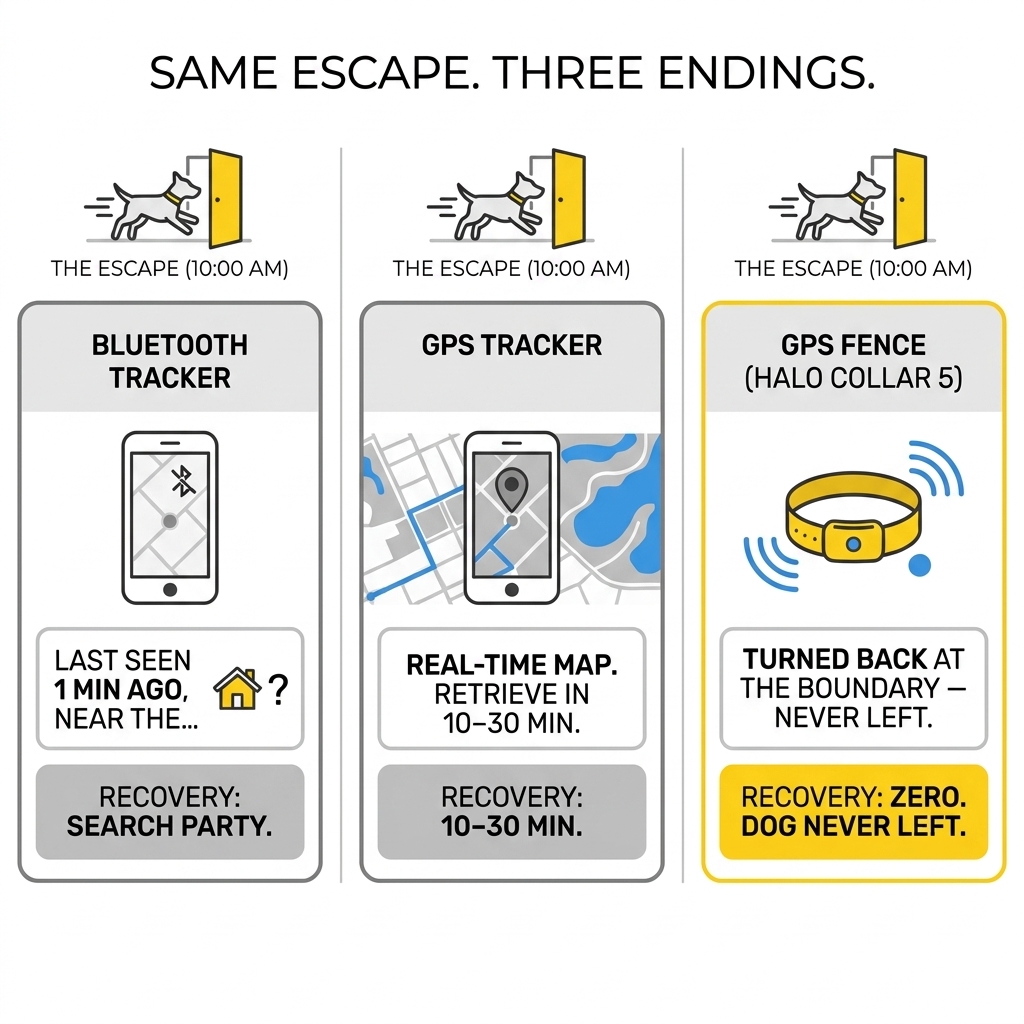
The true test of any tracking technology is not what it does on a spec sheet. It is what happens in the first five minutes after your dog gets through an open gate.
Scenario: Bluetooth tracker. Your dog bolts through the front door when a guest arrives. By the time you realize the dog is gone (30 to 60 seconds), the dog has covered 600 to 1,800 feet at a sprint – far beyond the 100-foot Bluetooth range. You open the AirTag app and see: “Last seen: 1 minute ago, near your front porch.” The tracker has no GPS and no cellular connection. It cannot tell you where the dog went. You are now searching on foot, calling the dog’s name, hoping another Apple device in the neighborhood picks up the signal. If you live in a suburban or rural area after dark, that may never happen.
Scenario: GPS tracker. Same escape. You open the tracker app and see the dog’s real-time position on a map, moving northeast at speed. The app updates every few seconds, showing the route. You get in the car, follow the map, and retrieve the dog from a neighbor’s yard 10 to 30 minutes later. The dog is safe. The technology worked. But the dog still escaped, still ran through traffic, and still could have been injured before you arrived.
Scenario: GPS fence collar. The guest opens the door. The dog approaches the boundary and hears a warning tone from the collar. The dog pauses, turns around, and returns to the living room. Your phone shows a notification: “Boundary approach detected – dog self-corrected.” The collar delivers an encouragement tone to reward the turn-back. Recovery time: zero. The dog never left. The Halo Collar’s patented Direction-Based Feedback detected the dog’s trajectory toward the boundary and responded before the dog reached the door.
Why Do Bluetooth Trackers Fail for Dogs in Rural and Suburban Areas?
Bluetooth trackers that rely on crowd-sourced networks – Apple’s Find My, Tile’s network – depend on a critical assumption: that another compatible device will pass near your lost dog within a useful timeframe.
In a busy city center, this assumption holds. Thousands of iPhones pass through every block every hour, and the AirTag’s position updates frequently. In a suburban neighborhood, the density drops dramatically. At 10 PM on a Tuesday, the number of iPhones walking past a wooded lot behind your house is close to zero. In a rural area – farms, open land, national forest – the assumption fails entirely. The tracker broadcasts its Bluetooth signal to no one, and the app shows a stale location from hours or days ago.
GPS trackers do not have this dependency. The collar communicates directly with satellites (for positioning) and directly with cellular towers (for data transmission). The only requirement is cellular coverage, which is available across 99% of the US population and improving annually. No nearby phones needed. No crowd-sourced network. No waiting for a stranger’s device to walk past your lost dog.
When Is a Bluetooth Tracker Useful for a Dog?
Bluetooth trackers have a narrow set of use cases where they function adequately for dogs – but none of those use cases involve the primary reason people search for a pet tracker: finding a lost dog that has escaped.
- Finding a dog hiding inside the house. If your dog wedges itself behind furniture or hides in a closet, a Bluetooth tracker’s proximity signal can help you narrow down the room. This is a convenience feature, not a safety feature.
- Backup identification tag. An AirTag clipped to a collar provides one more way for a finder to identify your dog (by scanning the tag with their phone). This is useful but redundant with a microchip, which provides the same function permanently and cannot fall off.
- Budget-constrained supplementary device. At $25–$35 with no subscription, a Bluetooth tracker costs less than two months of a GPS subscription. For owners who already have a GPS tracker or GPS fence collar, an AirTag on a secondary collar adds a minor layer of redundancy at minimal cost.
The disadvantages, however, significantly limit Bluetooth’s role in pet safety:
- No real-time tracking. The tracker cannot show you where your dog is right now. It shows where the tracker was last detected by a nearby phone – which could be minutes or hours old.
- No escape alerts. A Bluetooth tracker cannot define a geofence or send you a notification when the dog leaves the yard. You discover the dog is missing the same way you would without a tracker: by noticing the dog is gone.
- No containment. A Bluetooth tracker cannot deliver any cue to the dog. It has no speaker, no vibration motor, no feedback mechanism. It is entirely passive.
- Attachment risk. Bluetooth trackers are designed for wallets and keys, not for active dogs. They clip or slide into a collar holder, and active dogs can dislodge them during play, swimming, or rolling. A lost tracker defeats the entire purpose.
- Crowd-sourced dependency. Outside dense urban areas, the network that makes AirTags functional for general tracking thins to the point of unreliability. For dogs – which are most likely to escape in suburban or rural settings where yards exist – this is a critical failure mode.
- No health or activity data. A Bluetooth tracker provides zero insight into the dog’s exercise, rest patterns, or behavioral trends. It is a locating device in theory, but in practice it is a locating device that works only when conditions are ideal.
For most dog owners, a Bluetooth tracker is not a pet safety device. It is a key finder attached to a collar.
“I’ve had clients tell me they feel covered because they put an AirTag on the collar. I ask them one question: ‘If your dog bolts out the front door right now, what does that tag do in the next 60 seconds?’ The answer is nothing. It doesn’t know where it is. It doesn’t alert you. It doesn’t signal the dog. For the first critical minute of an escape – the minute that determines whether this is a retrieval or a search party – a Bluetooth tag is functionally identical to no tracker at all.”
– Charlie Angel Chun Expert Trainer & Consultant (Behavioral Rehabilitation & Society Acclimation)
What Is the Total Cost of Each Tracker Type?
The upfront price tells only part of the story. Subscription costs, replacement frequency, and what the device actually protects against determine the real value.
- Bluetooth tracker (AirTag, Tile): $25–$35 upfront, no subscription. Battery replacement every ~12 months ($5–$8). 3-year cost: approximately $40–$60. Provides: proximity finding only. Does not provide: real-time tracking, escape alerts, containment, activity data.
- GPS tracker (Tractive, Fi): $30–$150 upfront plus $5–$15 per month. 3-year cost: approximately $210–$690. Provides: real-time GPS tracking, geofence alerts, basic activity monitoring. Does not provide: escape prevention, training, containment.
- GPS fence collar (Halo Collar 5): $524 upfront plus from $9.99 per month. 3-year cost: approximately $884. Provides: real-time GPS tracking (<2 ft accuracy, 20 Hz), virtual fence containment with Direction-Based Feedback, activity and health monitoring, structured training program, unlimited portable fences.
The cost gap between a GPS tracker and a GPS fence collar narrows significantly when you factor in what the fence collar prevents. A single emergency vet visit after an escape can cost $800 to $3,000+. A single lost-dog search can cost hundreds in time, stress, and community resources. The GPS fence collar’s value is not just in tracking – it is in preventing the emergency that makes tracking necessary.
GPS vs Bluetooth Dog Tracker FAQs
Can I use an Apple AirTag to track my dog?
You can attach an AirTag to your dog’s collar, but it is not designed for pet tracking and has significant limitations. The AirTag does not contain GPS – it relies on nearby Apple devices to relay its position. In areas with low Apple device density (suburbs, rural properties, nighttime), the AirTag provides no useful location data. It also has no geofencing, no escape alerts, no activity tracking, and no containment capability. Apple explicitly states that AirTags are designed for items, not for tracking people or pets.
Do GPS dog trackers work without cell service?
GPS positioning works without cell service – the collar calculates its location from satellites. Transmitting that location to your phone requires a cellular, Wi-Fi, or Bluetooth connection. Without connectivity, the collar stores location data and uploads it when service resumes. GPS fence collars like the Halo Collar 5 store fence boundaries in the collar itself, so containment continues working even without cell service – the dog still receives feedback cues at the boundary.
Is a GPS tracker worth it for a dog that stays in the yard?
A GPS tracker alone may not be necessary for a dog that stays in a fenced yard reliably. A GPS fence collar, however, provides value even for well-behaved dogs: it tracks activity levels, monitors rest patterns, delivers containment if the dog tests boundaries during unusual situations (storms, fireworks, wildlife), and travels with the dog to unfenced locations. The question is not whether your dog escapes today – it is whether you want visibility and protection for the unexpected moments when routine breaks.
What is the best GPS tracker for dogs?
For GPS tracking only, Tractive and Fi offer reliable real-time location at a lower cost. For GPS tracking combined with virtual fence containment, <2-foot accuracy, Direction-Based Feedback, activity monitoring, and a structured training program in a single device, the Halo Collar provides the most comprehensive GPS collar system available. For a complete breakdown of how geofencing and virtual fencing differ, see geofencing for pets.