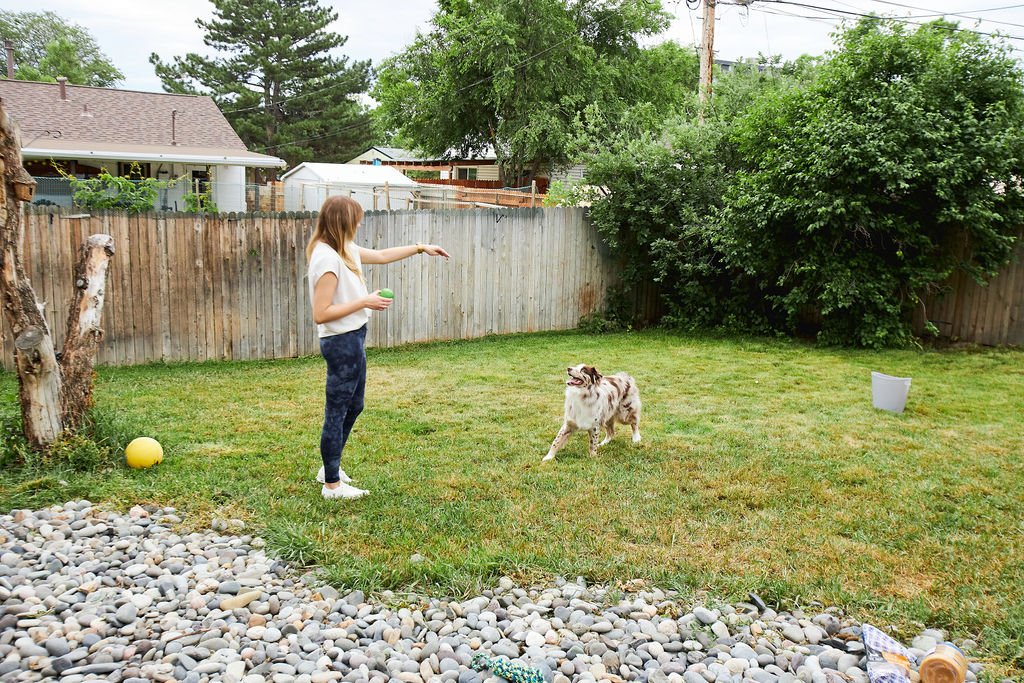
Most dog owners don’t start looking for a GPS dog fence because they read about it in a magazine. They start looking because something went wrong – the dog got out, the neighbor complained, the landlord said no to a physical fence, or the vet bill from the last escape attempt was more than the collar would have cost.
A GPS dog fence creates a virtual boundary using satellite positioning and delivers graduated feedback through the collar when your dog approaches the edge – a warning tone, then vibration, then optional static correction. The dog learns where the boundary is and chooses to stay inside, without a physical barrier, buried wire, or visible fence line.
If any of the following seven signs describe your situation, a GPS fence is worth serious consideration.
1. Your Dog Has Escaped More Than Once
A single escape can be a fluke – a gate left open, a delivery driver who didn’t latch the latch. Two escapes reveal a pattern. Three or more escapes mean your dog has learned how to get out and is actively looking for the next opportunity.
Dogs that escape repeatedly do not stop on their own. They escalate. A dog that started by squeezing through a gap in the fence will progress to jumping, digging, or working the gate latch once the gap is fixed. Physical barriers address the current method but not the underlying motivation – and the dog has unlimited time to find the next weak point.
A GPS fence changes the equation. Instead of blocking escape routes one at a time, the collar teaches the dog to respect a boundary line through consistent, predictable cues. The dog learns the rule rather than testing the structure. For a complete guide to stopping persistent escape behavior, see escape artist dog.
2. You Live in a Rental or HOA-Restricted Property
Rental leases typically prohibit permanent modifications to the property, and many homeowners’ associations restrict or ban visible fencing entirely. If you cannot install a physical fence, your containment options are limited to supervision, a leash or tie-out, or a fenceless containment system.
A GPS fence requires no installation, no digging, no landlord approval, and no HOA review. The boundary exists in the collar and the app – not in the ground or on the property. When you move to the next rental or sell the house, the system moves with you. There is nothing to remove, repair, or leave behind.
For a full comparison of fenceless containment options, see keep dog in yard without fence.
3. Your Property Is Too Large or Irregular to Fence
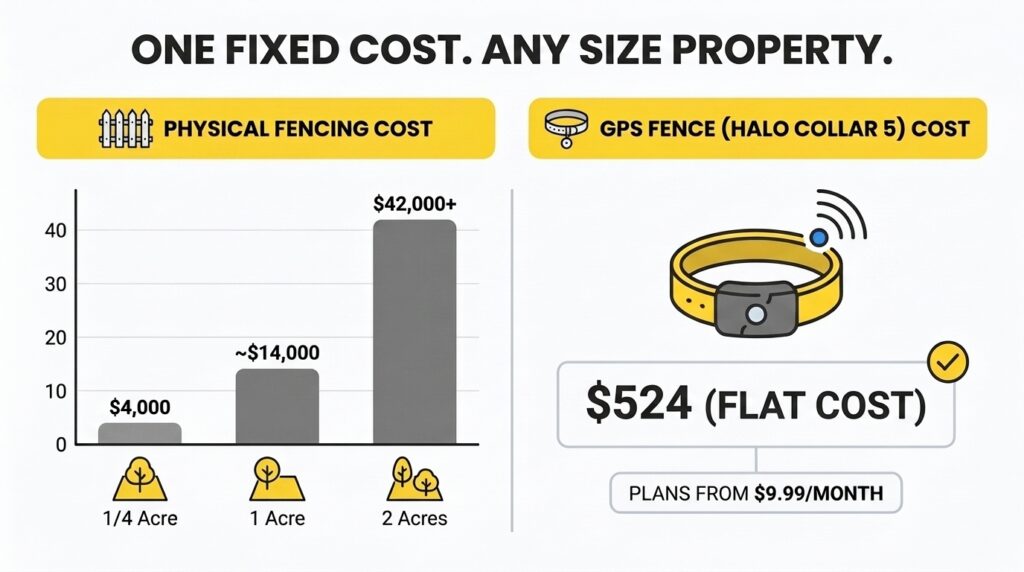
Physical fencing costs $10 to $35 per linear foot installed, depending on material and terrain. A standard quarter-acre suburban lot requires approximately 400 linear feet of fencing, totaling $4,000 to $14,000. A 2-acre property requires approximately 1,200 linear feet – $12,000 to $42,000. At 5 acres, the cost often exceeds what the property itself is worth fencing.
A GPS fence covers any property size for the same device cost. The boundary is drawn in the app – whether the property is a quarter acre or fifty acres, the collar price and subscription are the same. The Halo Collar 5 is $599 with plans starting from $9.99 per month. Over three years, that totals approximately $959 – a fraction of the cost of physical fencing on any property larger than a small urban yard.
GPS fences also handle irregular property shapes that physical fencing struggles with – L-shaped lots, waterfront properties, wooded acreage, and properties with shared driveways or right-of-way easements. The boundary follows the actual property line, not the nearest straight line a fence installer can dig.
4. Your Dog Runs Through or Ignores Your Current Fence
If your dog has already defeated an underground wire fence, a physical fence, or a tie-out system, the containment method has failed – not the concept of containment. The question is why the current system failed and whether a GPS fence addresses the specific failure mode.
Common failure modes that GPS fences handle differently:
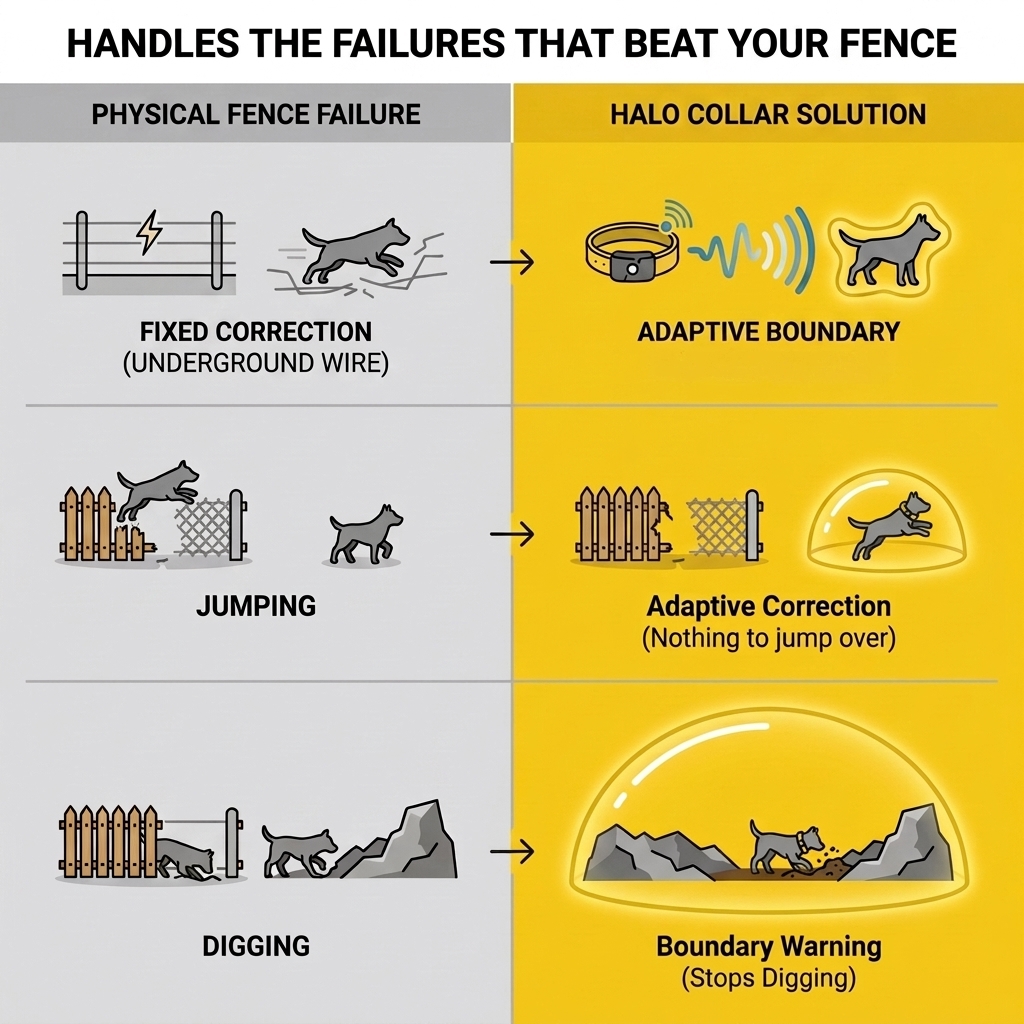
- Underground wire fence run-throughs. Many underground wire systems deliver a single, fixed-level correction that highly motivated dogs learn to power through. GPS fence collars like the Halo Collar 5 use graduated, escalating feedback – warning tone, vibration, then static – with patented Direction-Based Feedback that responds to the dog’s trajectory, not just its position. The dog receives multiple opportunities to self-correct before the strongest cue is reached.
- Physical fence jumping or climbing. A physical fence is a challenge for an athletic dog. A GPS fence boundary is invisible – there is nothing to climb, jump, or vault over. The containment comes from the dog’s trained understanding of the boundary, reinforced by collar cues.
- Digging under the fence. A GPS fence has no buried component that a dog can circumvent by digging. The boundary is GPS-defined and exists at any height – underground digging does not bypass it.
5. You Travel with Your Dog to Unfenced Locations
Campgrounds, vacation rentals, relatives’ unfenced backyards, and dog-friendly hotels all present the same containment challenge: your dog needs safe outdoor space, and there is no fence.
Physical fences and underground wire systems exist at one location. When you leave, the containment stays behind. A GPS fence travels in the collar. The Halo Collar stores unlimited boundaries – you can create a new fence at any location in the app in under a minute, and the boundary coordinates download to the collar automatically. The same system that keeps your dog safe at home keeps them safe at a lake cabin, a state park campsite, or a friend’s property with no fence at all.
For owners who travel frequently with their dogs, the portability of GPS fencing eliminates the need to research pet-friendly accommodations that happen to have fenced yards – you bring the fence with you.
6. Your Dog’s Behavior Problems Are Getting Worse
Excessive barking, destructive chewing, digging, hyperactivity, and escape attempts often share the same root cause: the dog does not have enough physical activity and outdoor stimulation. A dog confined to a leash, a small run, or indoor-only living does not get the movement and environmental enrichment its breed requires.
A GPS fence gives your dog access to the full yard – off-leash, within defined boundaries, with the freedom to run, explore, and burn energy on their own schedule. Dogs with adequate outdoor access and exercise are calmer indoors, less destructive, less vocal, and easier to train. The behavior problems are not fixed by the fence directly – they are fixed by the freedom the fence enables.
If your dog’s behavioral issues have been escalating despite training efforts, the missing variable may be outdoor access and exercise volume. The Halo Collar’s built-in activity tracking lets you verify whether your dog is actually meeting its daily exercise requirements or falling short.
“Dogs are naturally driven to explore, move and experience the world trough their instincts.A dog that wanders, test boundaries or constantly looks for oportunities to escape isnt necessarily being disobedient.they are often following their natural instincts. as a dog trainer and dog owner i believe is our job to understand those instincts and create clear, consistent boundaries that allow dogs to safely experience freedom.a gps fence can be a valuable tool for giving dogs clear, consisten boundaries while still allowing them the freedom to explore safely. the more we understand a dogs nature the better we can create a lifestyle where both the dog and human feel more connected,confident and fufilled.“
– Arianna Melendez Halo Trainer Expert (Dog Psychology & Behavior Modification)
7. You Want Your Dog to Have Off-Leash Freedom Safely
Not every GPS fence purchase is driven by a problem. Some owners simply want to give their dog the joy of off-leash outdoor time without the anxiety of wondering whether the dog will stay in the yard.
A GPS fence lets you open the back door and let your dog out while you drink your coffee, work from your home office, or watch from the window – knowing that the collar’s boundary system is active, the GPS is tracking, and you’ll receive a notification if the dog approaches the boundary line. The dog gets freedom. You get confidence. That combination is the core value proposition of every GPS fence system.
The Halo Collar 5 adds encouragement feedback – a positive tone that rewards the dog for turning away from the boundary and returning to the safe zone. Your dog is not just contained. Your dog is learning, making choices, and being rewarded for staying where it’s safe. Over time, the boundary becomes a habit, and the collar’s cues fade into the background of a dog that knows exactly where home is.
When Is a GPS Dog Fence Not the Right Choice?
A GPS fence is a strong fit for the majority of dog owners, but a few practical considerations are worth checking before you buy.
- Dog size. Most GPS fence collars are designed for dogs weighing 20 pounds and above. The collar unit needs to be large enough to house GPS hardware, a battery, and contact points, which makes it too heavy for very small breeds. If your dog is under 20 pounds, check the manufacturer’s weight specification before purchasing.
- Puppy age. GPS fence training requires the dog to understand cause-and-effect associations. Most manufacturers recommend waiting until the dog is at least 5 to 6 months old before starting. Younger puppies should use positive reinforcement boundary training with visual markers and a long line until they are old enough for the collar.
- Separation anxiety as the primary issue. If your dog escapes specifically to find you when you leave, the motivation is anxiety-driven, not exploration-driven. Adding a GPS fence can still help contain the dog, but addressing the separation anxiety directly – through desensitization training and, if needed, veterinary guidance – will make the containment system more effective. The two work best together.
- Cellular coverage. GPS fences need satellite signal to calculate position (available almost everywhere outdoors) and cellular coverage to send tracking data and alerts to your phone. The fence itself works without cell service – boundary data is stored in the collar – but real-time tracking and notifications require connectivity. In extremely remote areas with no LTE coverage, verify that the collar’s connectivity options (LTE, Wi-Fi, Bluetooth) will function in your environment.
What Should You Look for in a GPS Dog Fence?
If you recognized yourself in one or more of the signs above, these are the features that separate a reliable GPS fence from one that creates more problems than it solves.
- Containment, not just alerts. A GPS tracker with geofencing sends you a notification when the dog leaves. A GPS fence collar sends the dog a cue to turn back before it leaves. The difference is reactive monitoring versus proactive containment. For a detailed comparison, see GPS dog fence vs geofencing alerts.
- GPS accuracy under 5 feet. On a suburban yard, a 15-foot GPS error makes the boundary unreliable. The Halo Collar 5 achieves <2 feet using dual-frequency Precision+ GPS with 6 satellite constellations.
- Direction-Based Feedback. A collar that knows which direction the dog is heading – not just where it is – responds faster and more accurately. The Halo Collar 5’s patented Direction-Based Feedback adjusts its response based on the dog’s trajectory.
- A structured training program. Technology without training produces confusion. The Halo Collar includes a positive association training program developed with Cesar Millan, delivered step by step through the app.
- Portable, unlimited fences. If you travel or move, your fences should travel with you. The Halo Collar supports unlimited virtual GPS fences stored in the collar and managed from the app.
GPS Dog Fence FAQs
How much does a GPS dog fence cost?
GPS fence collars range from $400 to $600 for the device plus $5 to $30 per month for the subscription that powers GPS, cellular connectivity, and app features. The Halo Collar is $524 with plans starting from $9.99 per month. Over three years, this totals approximately $884 – significantly less than the $4,000 to $14,000+ cost of a physical fence on a typical suburban property.
Do GPS dog fences really work?
Yes. GPS dog fences are proven containment systems used by hundreds of thousands of dog owners. Their effectiveness depends on three factors: the accuracy of the GPS hardware (dual-frequency systems under 5 feet are reliable; single-frequency systems at ~15 feet are not), proper training during the introduction period (2 to 4 weeks of daily practice), and correct collar fit with consistent contact point positioning. With all three in place, most dogs learn to respect the boundary reliably.
Can a GPS fence replace a physical fence?
A GPS fence replaces a physical fence for containment purposes – keeping your dog inside a defined boundary. It does not replace a physical fence for keep-out purposes – preventing other animals, people, or stray dogs from entering your yard. If predator protection or property security is a primary need, a GPS fence should supplement a physical barrier rather than replace it.
What size dog can use a GPS fence?
Most GPS fence collars are designed for dogs weighing 20 pounds and above. The Halo Collar 5 weighs 130 grams (4.6 ounces) and fits neck sizes from 8 to 30.5 inches. Dogs under 20 pounds may find the collar too heavy relative to their body weight. For very small breeds, a lightweight GPS tracker (without containment) paired with boundary training is a better fit.