The best way to keep a dog safe and free on an RV trip is a wireless GPS travel fence – a boundary you set in minutes, with no panels to haul or wires to bury. RV travel with a dog raises one big question: how do you give your dog room to roam at each new stop without them wandering off? The old answer was a heavy portable fence you hauled and rebuilt at every campsite; the modern one fits on your dog’s collar. This guide covers your containment options, how a wireless travel fence works on the road, the features that matter most for RVers, and practical tips for safe, happy travel with your dog.
What’s the Best Dog Fence for RV Camping?
The best dog fence for RV camping is a wireless GPS fence, because it travels on your dog’s collar and needs no setup at each site. Unlike a heavy portable physical fence, a GPS fence lets you draw a custom boundary anywhere in minutes, keeps working without cell service, and guides your dog back if they near the edge – ideal for a campsite that changes every week.
Your Options: Wireless Fence vs. Portable Fence vs. Tie-Out
RVers have three main ways to contain a dog at a campsite, and each makes a different trade-off between convenience and freedom. Here is how they compare.
|
Option |
Pros |
Cons |
|
Wireless GPS fence |
No setup, fully portable, customizable anywhere, guides your dog back, and tracks when you have coverage |
Requires training, a charged collar, and a site with room for a minimum boundary |
|
Portable physical fence |
Visible barrier, no training needed |
Bulky and heavy to carry, slow to set up, fixed size, no way to guide an escapee back |
|
Tie-out / long line |
Cheap, simple, lightweight |
Very limited movement, tangle and safety risks, no real freedom |
For most RVers, a wireless GPS fence offers the best balance – the security of a boundary with none of the hauling, and far more freedom than a tie-out. A GPS dog fence gives your dog room to actually be a dog at every stop.

How a Wireless Travel Fence Works on the Road
A wireless travel fence uses GPS to create a virtual boundary your dog’s collar enforces, wherever you set it. You designate a custom boundary at your campsite – by walking the perimeter with the collar or tapping a satellite map in the app – and the collar stores those coordinates. When your dog approaches the edge, the collar gives gentle feedback that prompts them to turn back, the same way how a GPS fence prevents escapes works at home. No panels, no wire, no digging – just a boundary that moves with you.
One practical limit to plan around: a Halo Fence needs a minimum of about 30 by 30 feet. That is fine for most campsites and generous for a beach or trailhead, but a tightly packed RV park with sites shoulder to shoulder may not leave room. Check the site dimensions when you book if the fence is central to your plan.
Does a GPS Dog Fence Work Without Cell Service?
Yes – the containment side works without cell service, because the collar stores your fence’s coordinates and enforces them with Precision+ (DGNSS) GPS on the collar itself rather than over the internet. This matters enormously for RVers, since the best campsites are often the most remote. Once you create a fence, it downloads to the collar and stays in its onboard memory, holding even with no Wi-Fi or cellular signal and surviving a loss of power. You can set a campsite’s boundary in advance while you still have signal, so it is ready the moment you arrive off-grid.
Be clear about which half of the system needs coverage, though, because the two are not the same. The boundary and the feedback run on the collar and do not care about signal. Live location on your phone does: it travels over cellular, so in a true dead zone the map may lag until service returns. In practice that means the fence is doing the work at a remote site, and the map catches up when you drive back into coverage.
Travel Fence Features That Matter for RVers
A few specific features turn a wireless fence into a genuine travel tool for life on the road. These are the ones RVers rely on most:
- Unlimited saved fences – keep your home, favorite campgrounds, and regular stopovers on file, each one editable and reusable with a tap.
- Walk-the-perimeter setup – create a fence by walking the boundary with the collar, or place points on the map; both take only minutes.
- Offline enforcement – fences live in the collar’s memory, so remote sites are no problem.
- Real-time tracking – when you have coverage, the app shows where your dog is at an unfamiliar site, which is the moment you most want to know.
- Gentle guidance– Direction-Based Feedback guides your dog back from the boundary, and the Return Whistle can call them home.
- Keep-away zones – a Zone Beacon, sold separately, marks spots your dog should avoid inside the fence, like the fire pit or a neighbor’s hookups.
“A hole in the middle of a space is a much harder idea than a line round the outside, and it gets sold as the same thing because on the app it’s the same tap. A boundary makes sense to her – she walks out, something happens, she comes back, and after a few goes she’s got it. A no-go patch four feet from where you’re all sitting, with sausages on it, is a different proposition entirely. So I’d use those zones and I’d not lean on them the first night. Put something physical round the fire pit as well, and keep an eye on her while she works out what the new rule is. The setting is instant. Her understanding of it isn’t.”
— Charlie Angel Chun Expert Trainer & Consultant (Behavioral Rehabilitation & Society Acclimation)
There is one accessory worth knowing about specifically for road life. Set a beacon to Ignore Fences mode and keep it in the cab, and you can drive in and out of your own active boundary without your Halo Collar 5 giving feedback – which, when you are pulling out of a saved fence every few days, saves a lot of confusion for your dog.
RV Travel Tips for Dog Owners
Beyond containment, a few habits keep your dog safe and comfortable on the road. Keep these in mind on every trip:
- Watch the heat – never leave your dog in a parked RV in warm weather. The specific RV risk is an air conditioner that quits or a generator that stops while you are out, so if you ever leave your dog inside, run a temperature monitor that alerts your phone and have a backup plan for a power failure.
- Bring plenty of water – pack more than you think you need, plus a travel bowl for stops and hikes.
- Check campground rules – many campgrounds have leash laws and pet policies, and some prohibit off-leash dogs regardless of your fence; confirm before you arrive.
- Keep ID current – a collar tag and a microchip are what work when a phone has no signal, so keep both up to date rather than relying on the app alone.
- Exercise daily– a tired dog travels better, so build in a walk, a hike, or time off-leash inside a travel fence, backed by a reliable recall.
Where to Use a Travel Fence: Campsites, Beaches, and Rest Stops
A travel fence earns its keep at every kind of stop on an RV trip, though not every stop should be off-leash. The most useful places to set one up:
- Campsites: give your dog room to move around your site freely instead of being tethered to the picnic table. Set the boundary well inside the site markers on any side facing a road or a through lane, so there is space to turn around before the edge means anything.
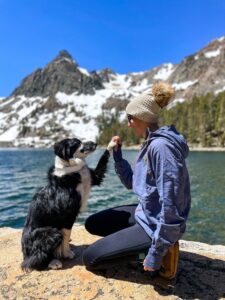
- Day trips: set a boundary at a beach, park, or trailhead so your dog can run while staying contained, once you have checked that off-leash is permitted there.
- Rest stops: keep your dog on leash. A highway rest area sits a few seconds’ sprint from traffic at speed, and no containment system – GPS, wire, or physical – is fast enough to be the only thing between an excited dog and an interstate. A saved fence there is a useful second layer if your dog slips a collar or bolts from the door, not a reason to unclip.
Frequently Asked Questions
What’s the best dog fence for RV camping?
A wireless GPS fence is the best choice for RV camping because it needs no setup, travels on the collar, keeps working without signal, and adapts to any campsite in minutes.
Does a GPS dog fence work without cell service?
For containment, yes – the boundary is stored on the collar and enforced by Precision+ GPS on the collar itself, so it holds at remote sites with no Wi-Fi or cellular signal. Live location on your phone does need coverage, so the map may pause until you are back in range.
How do you contain a dog at a campsite?
You can contain a dog at a campsite with a wireless GPS fence, a portable physical fence, or a tie-out – a GPS fence offers the most freedom with the least setup, provided the site has room for a minimum boundary.
Is a wireless fence better than a portable physical fence for camping?
For most campers yes – a wireless fence is far lighter, sets up in minutes anywhere, and can guide a dog back, while a portable physical fence is bulky and fixed in size.
How big does a campsite need to be for a GPS fence?
Plan on at least 30 by 30 feet. Most standard campsites clear that easily, but a compact space in a densely packed RV park may not, so check dimensions when you book if you intend to rely on the fence.