Train your dog on a GPS fence in three phases: get them comfortable wearing the collar, teach the boundary on a leash with plenty of rewards, then add distractions and freedom step by step. GPS fence training teaches your dog to recognize a virtual boundary and choose to stay inside it, without a barrier, a leash, or you standing at the edge. It works because the collar’s cues are clear and predictable, and your dog learns that turning away from the boundary makes the cues stop and earns a reward. The method is not complicated, but it is sequential: skipping the collar introduction, rushing the boundary work, or dropping the leash too early are the most common reasons it fails, and dogs who seem “untrainable” on a GPS fence are usually dogs whose owners moved too fast.
This guide covers each phase with clear benchmarks for moving on, how to use the cues and your own commands, training several dogs, older dogs on a new fence, what to do when training stalls, and how to start again after a failed attempt.
How Long Does GPS Fence Training Take?
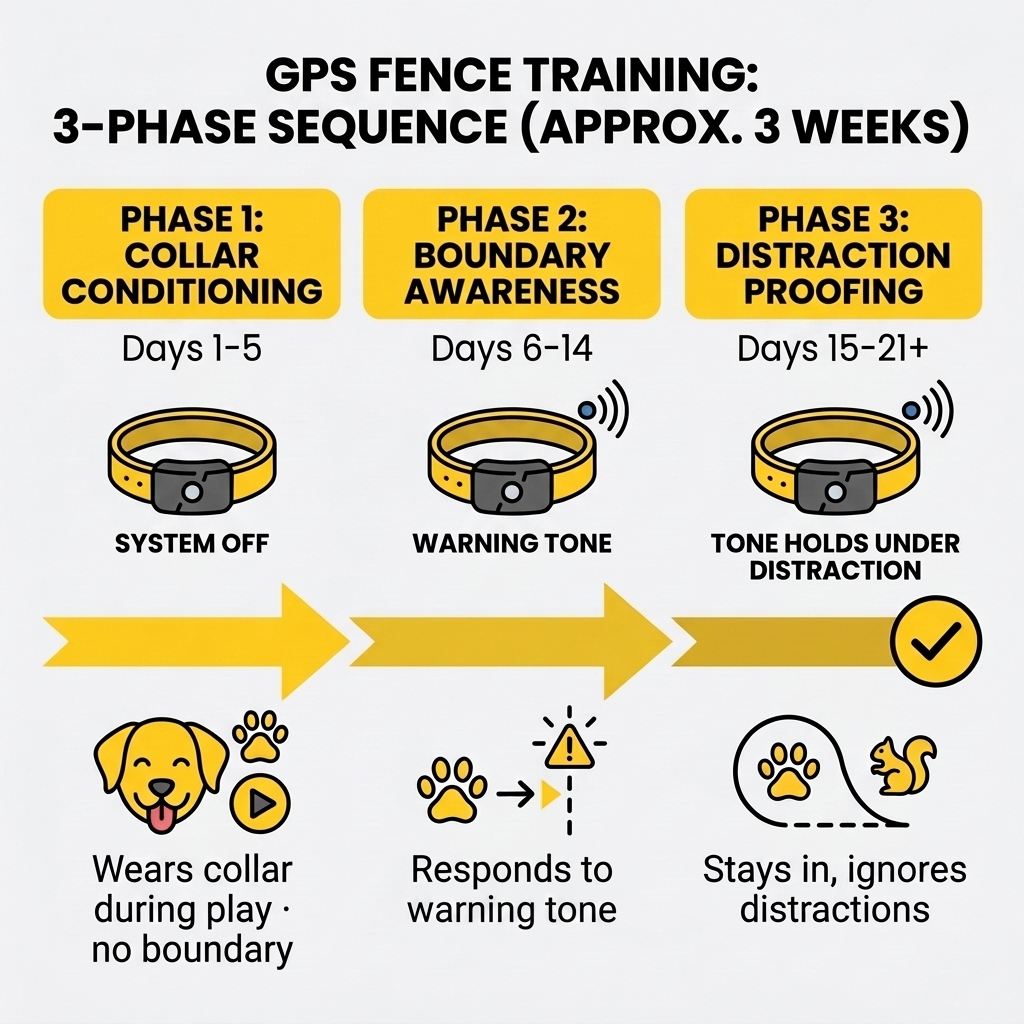
Most dogs grasp the boundary within two to four weeks of short daily sessions, and it becomes reliable over the following months. High-drive dogs and dogs with an established escape habit usually need longer, especially under distraction. Rushing is the most common mistake: a dog given freedom before they reliably turn at the warning will test the boundary, meet a stronger cue they do not understand, and come to feel uneasy about the yard rather than confident in the rule. For what affects the timeline, see How Long Does GPS Fence Training Take?
What Do You Need Before You Start?
Set Up and Walk-Test the Boundary
Draw the boundary in the app and walk it yourself with the collar in your hand before any training. With Halo Collar 5, the Warning Area starts roughly 7–10 feet before the line, and Halo’s guidance is to keep at least 20 feet between the fence and any road, and between the fence and your house. Check that the warning comes where you expect it, especially near the house and under trees. Start with your home fence; travel fences can come later. For the full setup, see How to Set Up a GPS Dog Fence: Step by Step.
Gather Your Training Supplies
- Boundary flags: small flags every 10–15 feet along the line, so your dog can see where the warning starts. They come down gradually later.
- A long line: a light 15- to 30-foot line attached to a harness, not to the GPS collar, so you can guide without pulling on the collar’s contact tips.
- High-value treats: small, soft rewards your dog loves and does not get every day – turning away from the boundary should pay well.
- A charged, well-fitted collar: snug enough that two fingers fit between the strap and the neck, with the contact tips touching the skin, and feedback set to the gentlest level your dog notices.
Phase 1 – Get Your Dog Comfortable With the Collar
In the first phase, your dog wears the collar with the fence paused, so the collar becomes an ordinary, pleasant thing rather than a signal that something unpleasant is coming. The aim is to avoid a “collar-wise” dog – one who behaves only when the collar is on.
“Collar-wise dogs are made in the first week, not the first month. The owner is excited, the collar arrives, and they want to see it work – so they strap it on and walk straight to the boundary. Now the collar predicts something unpleasant from day one. The dog doesn’t learn a boundary. She learns that this thing on her neck means something unpleasant is coming. Undo that association and you’re adding three weeks to the process. Prevent it and you’re saving three weeks.”
— Charlie Angel Chun Expert Trainer & Consultant (Behavioral Rehabilitation & Society Acclimation)
- Put the collar on well before going outside, so putting it on does not predict training.
- Pair it with good things: meals, play, walks, attention.
- Take it off a while after coming in, not the moment you step through the door, and vary the timing so there is no pattern to predict.
- Give your dog’s skin a break: Halo’s instructions are to remove the collar for at least eight hours in every 24, which fits neatly with charging it overnight.
Move on when your dog shows no reaction to the collar going on or coming off – no scratching, freezing, or change in behavior. For many dogs that takes a couple of days; for a day-by-day plan through the first two weeks, see The First 14 Days of GPS Fence Training.
Phase 2 – Teach the Boundary on a Leash
In the second phase, the fence is active and your dog is always on the long line, learning what the warning means and what to do about it.
Walk the Boundary Together
Walk your dog along the flagged line and let them approach the flags at their own pace. When the Warning cue sounds, your dog may pause or look puzzled – that is normal. The instant it sounds, give a calm verbal cue such as “this way” and guide your dog back toward the middle with light pressure on the line; never yank.
Use the Cues – and Your Own Commands
Your dog needs to learn three simple links: the warning means “you’re near the edge,” turning away means “you’re safe and good things happen,” and carrying on toward the line means stronger cues. The warning is the most important cue of all – a well-trained dog responds to it and rarely meets anything stronger, which is there as a safety net rather than the main teacher.
Halo Collar adds the other half of the conversation. When your dog turns back toward safety, encouragement cues play – an automatic “Come Back” cue, plus Return Whistle, Good Dog, and Go Home – so the right choice is rewarded even when you are not there with a treat. Because Halo’s patented Direction-Based Feedback only responds when your dog is heading toward the boundary, a dog standing still or walking along it gets nothing. Each cue can be sound, a voice command, vibration, or optional static feedback; start gentle and raise a level only if your dog does not notice. Pair the warning with your own word – such as “this way” – every time, and that word becomes a useful backup anywhere. Keep “come” for recall, so it always means “run to me.”
Reward the Turn-Back
Every time your dog hears the warning and turns away – guided or on their own – reward within a second or two with a high-value treat and real praise. Keep sessions short, a few times a day, and approach the line from different starting points and angles so your dog meets the warning along the whole boundary, not just one stretch. For more on the flag-and-reward method, see Boundary Training for Dogs.
Move on when your dog turns away at the warning in about 8 out of 10 approaches without help from the line, on three days in a row. If they still need guiding, give Phase 2 more time.
Phase 3 – Add Distractions and Freedom
The third phase checks that the boundary holds in real life – with dogs walking past, squirrels, deliveries, and you not standing at the line – and gradually hands your dog more freedom.
Add Distractions Gradually
- Have someone walk outside the boundary while your dog is near the line, and reward a turn at the warning.
- Toss a toy toward the boundary, not past it, and reward your dog for turning at the warning instead of chasing.
- Have a friend walk a dog past to test social and chase drive together.
- Practice at busy times – when the mail arrives, neighbors are out, or wildlife is active.
From Long Line to Drag Line
Once your dog turns reliably with distractions while on the long line, let a light line drag behind them, still attached to the harness, so you have something to grab without holding on. When your dog consistently turns back on their own, the line can come off for supervised sessions.
Supervised Off-Leash Time
Stay in the yard for the first off-leash sessions and watch how your dog behaves near the boundary. Then step back gradually – to the porch, to a window – with your phone handy; if your dog crosses, you get a notification and can see where they are. Take the flags down in stages over the following weeks, so your dog responds to the cues rather than the markers. Unsupervised time comes later still, once the boundary has held up for months. For readiness signs, see Off-Leash Training: When Is Your Dog Ready?
How Do You Know When Your Dog Is Reliably Trained?
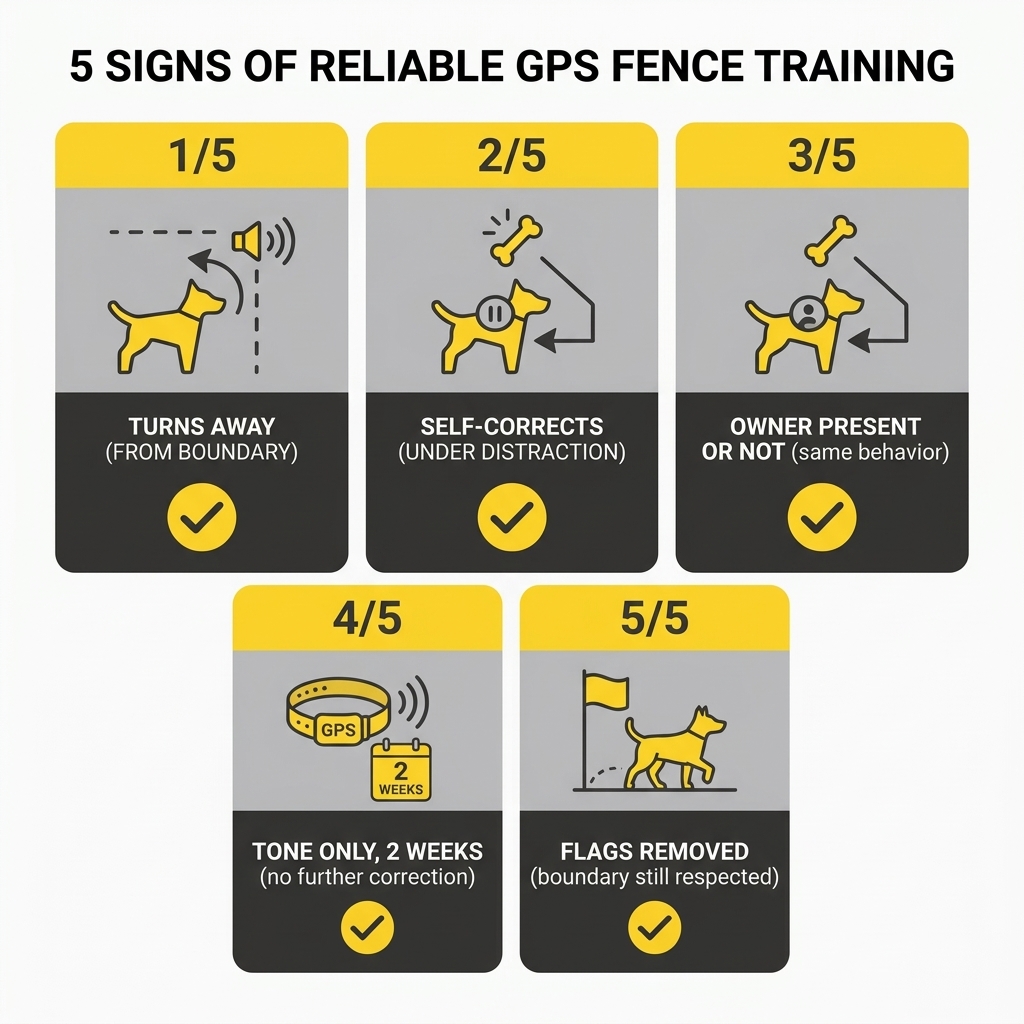
Your dog is reliably trained when the boundary holds without you:
- They turn at the warning in about 9 out of 10 approaches without any help.
- They turn back under distraction – another dog, a squirrel, a visitor.
- They behave the same whether you are in the yard or watching from inside.
- They have not needed anything beyond the warning for a couple of weeks.
- The flags are gone and the boundary still holds.
If any of these is missing, keep practicing at the current stage. Reliability is about building a lasting habit, not speed – and no system can guarantee to stop a dog in full pursuit, which is why the training and a sensible buffer from roads both matter.
How Do You Train More Than One Dog?
Train each dog on their own first, then bring them together once each one is reliable. Each dog needs their own collar, and each can have their own feedback settings – a large, determined dog and a small, sensitive one rarely need the same levels. Working one at a time matters because dogs influence each other: one dog’s reaction to a cue can distract another, and a dog who bolts after a squirrel can pull a less experienced dog along. Once each dog turns reliably at the warning, practice together on the long line before giving shared off-leash time, and keep an eye on the less confident dog.
How to Train an Older Dog on a New Fence
Older dogs can learn a GPS boundary at any age; they often just need more time and a gentler start. A dog with little previous training may take longer than one who already responds to basic cues, and a dog with years of escaping behind them needs extra time in Phase 3. Adapt to the body as well as the mind: keep sessions shorter for dogs with stiff joints, use vibration rather than sound for a dog whose hearing is fading, and lean more on the flags for a dog whose sight is not what it was. A dog who used to wear a buried-wire collar may already link boundaries with something unpleasant, so go slowly in Phase 1 and make the turn-back extra rewarding. Ask your vet if a health issue might affect training, and consider a professional trainer if old habits are firmly set.
What Should You Do If Training Stalls?
Plateaus and setbacks are normal; the fix depends on what you are seeing.
- Your dog ignores the warning. Check the fit first – the contact tips must touch the skin. The cue may be too gentle, or Phase 1 may have been rushed. Raise the level by one step and retest; if your dog still ignores it, go back to leash work for another week.
- Your dog runs through despite the warning. High arousal is overriding the training, which is common in prey-driven dogs. Pull the boundary further back from what triggers them for now, build distractions more gradually, and check that your dog is getting enough exercise – an under-exercised dog is more likely to break through.
- Your dog was trained, then started testing again. Regression is normal after changes – new landscaping, a new neighbor, seasonal wildlife. Go back to supervised Phase 3 sessions for a few days with plenty of rewards; most dogs settle back quickly.
- Your dog becomes anxious about the yard. The level may be too high, or your dog met a cue they did not understand. Lower it, pause the fence, and spend a few days in the yard doing only pleasant things before restarting Phase 2 more gently.
For dogs with a persistent escape habit, see How to Stop a Dog From Escaping the Yard.
Retraining a Dog After a Failed Fence Attempt
If a first attempt went wrong – on a GPS fence or a buried-wire one – start over deliberately rather than picking up where it broke down. First work out why it failed. The usual culprits are a loose collar, levels set too high or too low, moving to off-leash too soon, a boundary drawn too close to a road or a strong trigger, or skipping the collar introduction altogether. Then reset: pause the fence, take a few days of collar-on, fence-off time doing pleasant things, and begin Phase 1 again. Restart Phase 2 at the gentlest level your dog notices, set the boundary further back from whatever caused the trouble, and be generous with rewards for every turn-back. Expect the second attempt to take longer at the start and go more smoothly afterwards. For the mistakes that most often undo containment, see Common Mistakes That Lead to Dog Escapes.
Does Breed Affect GPS Fence Training?
Yes – breed affects how fast a dog learns and how hard they test the boundary, though the three phases stay the same.
- High-drive breeds such as Huskies, Beagles, Jack Russell Terriers, and Border Collies often learn the boundary quickly but are the most likely to test it when excited. Give them a longer distraction phase, higher-value rewards, and plenty of exercise before sessions.
- People-focused breeds such as Labradors, Golden Retrievers, and spaniels often learn fastest, because the reward for turning back suits them so well – though reliability still builds over months.
- Sensitive dogs often learn quickly but need the gentlest settings; start with sound or vibration, and use static feedback only if it is truly needed.
For daily exercise targets by breed and age, see How Much Exercise Does a Dog Need?
Can You Train a Dog on More Than One Boundary?
Yes. Once your dog understands one boundary, learning another – at a campsite, a relative’s yard, or a rental – is usually much quicker, because the idea is already familiar. Run a short version of Phase 2 at the new place: walk the new line on the long line, let your dog hear the warning there, and reward the turn-back. With Halo, you can save fences for places you return to – unlimited on higher plans – and switch to the right one when you arrive. For tips on keeping a dog safe on the road, see RV Travel With Your Dog.
GPS Fence Training FAQs
What age can you start GPS fence training?
Halo Collar is designed for dogs of at least 5 months and 10 pounds. Before then, use supervised time, a long line, and positive boundary work with visual markers – no electronic cues. More in GPS Fence for Puppies: Minimum Age and How to Start.
Do you need a professional trainer?
Most owners can train their dog on a GPS fence themselves by following a structured program – Halo’s app includes one built with Cesar Millan that walks you through each phase. If your dog has severe anxiety, a history of aggression, or is not making progress after several weeks, a certified professional trainer can pinpoint the problem. More on the program in Cesar Millan’s training program.
What if my dog is afraid of the collar?
Fear of the collar usually means Phase 1 was skipped or rushed, so the collar came to predict something unpleasant. Pause the fence, take the collar off for a few days, then restart Phase 1 and use the collar only during good things – meals, play, walks – for a full week before reactivating the boundary at a lower level.
Should I keep practicing recall too?
Yes. A reliable recall is your backup if your dog ever does get past the boundary, so practice it alongside fence training – as its own cue, separate from the word you use at the boundary. For a step-by-step method, see How to Train a Reliable Recall.