A GPS dog tracker and a microchip solve different problems at different stages of the same emergency. A microchip identifies your dog after someone else finds them. A GPS tracker shows you where your dog is so you can find them yourself. Neither one prevents the dog from getting lost in the first place.
This distinction matters more than most comparison guides acknowledge. An estimated 10 million pets are lost or stolen in the United States each year, according to the American Humane Association. Dogs with microchips are returned to their owners at a rate of about 52%, compared to 22% for dogs without microchips. GPS-tracked dogs are typically located within minutes to hours rather than days or weeks. And dogs with GPS virtual fencing – the third tier most guides ignore entirely – are far less likely to become lost at all.
This guide covers what microchips do, what GPS trackers do, what GPS smart collars add beyond basic tracking, and how the three technologies layer together into a complete safety system. If you’re deciding between a microchip and a GPS tracker, the short answer is: you need both, plus a prevention layer if your dog has any outdoor freedom.
What Is a Dog Microchip?
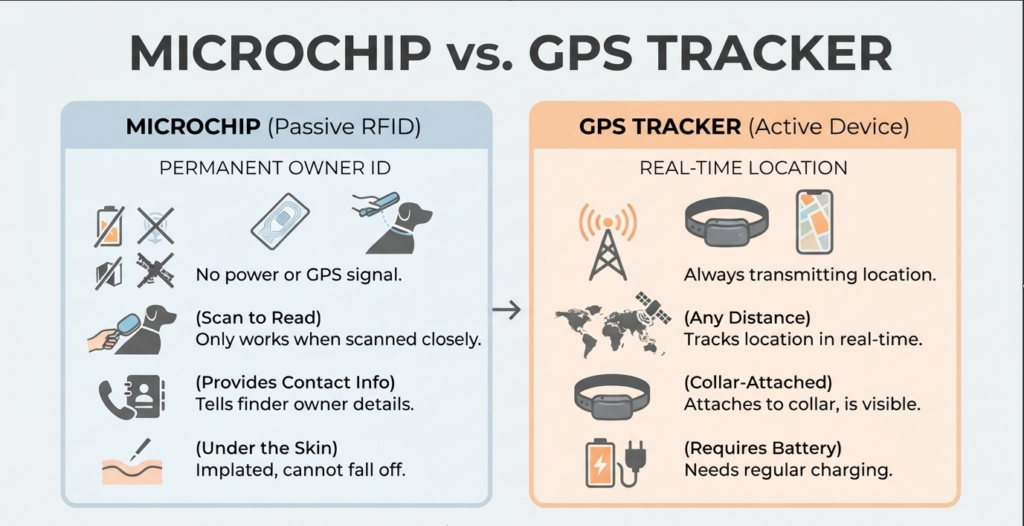
A dog microchip is a passive RFID (radio-frequency identification) chip, roughly the size of a grain of rice, that is implanted under the dog’s skin between the shoulder blades by a veterinarian. The chip stores a unique identification number. When scanned with a compatible RFID reader, the number links to the owner’s contact information in a pet registry database.
Microchips contain no battery, no GPS antenna, and no cellular module. They do not emit a signal. They cannot be tracked remotely. They function only when a scanner is held within a few inches of the chip and activates it with a radio-frequency pulse.
The implantation procedure takes seconds, is comparable to a routine vaccination injection, and costs $25 to $60 including registration. The chip lasts the lifetime of the dog with no maintenance, no charging, and no subscription fees. Most veterinary clinics, animal shelters, and animal control officers carry universal scanners capable of reading all major microchip frequencies.
Microchip registration is the critical step most owners skip. The chip is useless if the registry database does not contain current contact information. After implantation, register the chip with the manufacturer’s database and update your phone number and address whenever they change.
What Is a GPS Dog Tracker?
A GPS dog tracker is a collar-mounted or collar-integrated device that uses GPS satellites, cellular networks, and sometimes Bluetooth or WiFi to calculate and transmit the dog’s location to a smartphone app in real time.
Unlike a microchip, a GPS tracker is always transmitting. It does not require a scanner, a veterinarian, or someone else finding your dog. You open the app, see the dog’s location on a map, and go get them. Most GPS trackers update location every 2 to 60 seconds depending on the mode, and work anywhere with cellular coverage.
GPS trackers range from simple location-only devices to advanced smart collars that add activity monitoring, health tracking, virtual fencing, and training features. Basic GPS trackers cost $30 to $150 plus a monthly subscription of $5 to $15 for cellular connectivity. Smart GPS collars with containment and training features cost $400 to $600 plus $5 to $30 per month.
The primary limitation of any GPS tracker is battery life. Basic trackers last 1 to 7 days on a single charge depending on update frequency. Smart collars with larger batteries and power management features last 1 to 3 days under active use. A dead tracker provides no location data – which is one reason a microchip remains essential as a backup.
→ For a full breakdown of collar categories, see: Different Types of Dog Collars.
Can a Microchip Track Your Dog’s Location?
No. A microchip cannot track your dog’s location. This is the most common misconception in pet safety technology. A microchip is an identification device, not a tracking device. It contains no GPS hardware, no battery, and no ability to transmit a signal. It can only be read when a scanner is held directly against the dog’s body.
The confusion likely stems from the word “chip,” which people associate with smartphones and computers that do have location capabilities. A pet microchip is fundamentally different – it is a passive transponder that stores a single number and does nothing until activated by an external radio-frequency pulse.
If you want to know where your dog is right now, you need a GPS tracker. If you want someone who finds your dog to know who the dog belongs to, you need a microchip. These are complementary technologies, not alternatives.
How Do GPS Trackers and Microchips Compare?
The table below compares four pet safety technologies across the attributes that matter most. Most guides compare only microchips and GPS trackers. This table adds GPS smart collars and Bluetooth trackers (like Apple AirTag) to provide the complete picture.
| Feature | Microchip | GPS Tracker | GPS Smart Collar | Bluetooth (AirTag) |
| Primary function | Identification | Location tracking | Tracking + containment + training | Proximity finding |
| Real-time tracking? | No | Yes | Yes | Crowd-sourced only |
| Virtual fencing? | No | Some models | Yes – unlimited, portable | No |
| Training features? | No | No | Yes – sound, vibration, static | No |
| Activity monitoring? | No | Some models | Yes | No |
| Battery required? | No – passive | Yes – 1–7 days | Yes – 1–3 days | Yes – ~1 year |
| Works without cell? | Yes (needs scanner) | No | Yes (Fences operate offline via satellite; App sync requires cell/Wi-Fi) | Yes (BT range only) |
| Can be lost/removed? | No – implanted | Yes – collar off | Yes – collar off | Yes – can detach |
| Upfront cost | $25–$60 | $30–$150 | $400–$600 | $25–$35 |
| Monthly cost | None | $5–$15/mo | $5–$30/mo | None |
| Prevents escape? | No | No – alerts only | Yes – graduated feedback | No |
What Is a GPS Smart Collar and How Is It Different?
A GPS smart collar is a collar with built-in GPS tracking, virtual fence containment, training feedback, and activity monitoring in a single device. It is the third tier of pet safety technology that most comparison guides omit entirely.
Where a microchip helps recover your dog and a GPS tracker helps locate your dog, a GPS smart collar helps prevent your dog from getting lost in the first place. The collar creates virtual boundaries using GPS coordinates and delivers graduated feedback through Halo’s patented Direction-Based Feedback system – warning tones, vibration, and optional static – only when your dog moves toward the boundary, not when standing still or walking parallel to it. Your dog learns where the edge is and chooses to stay inside.
The Halo Collar is a GPS smart collar that combines real-time GPS location tracking, virtual GPS fencing, a customizable feedback system (sound, vibration, optional static), activity monitoring, and a structured training program developed with Cesar Millan.
This means a single device provides:
- Real-time location tracking (what a GPS tracker does)
- Escape prevention through virtual fencing (what neither a microchip nor a basic GPS tracker does)
- Boundary and recall training (what no passive technology can do)
- Activity and health monitoring (what only advanced trackers provide)
A GPS smart collar does not replace a microchip. The collar can come off. The microchip cannot. The microchip provides permanent identification that survives a lost collar, a stolen dog, or a dead battery. The two technologies are layers in the same safety system, not competing alternatives.
Which Should You Choose: Microchip, GPS Tracker, or Both?
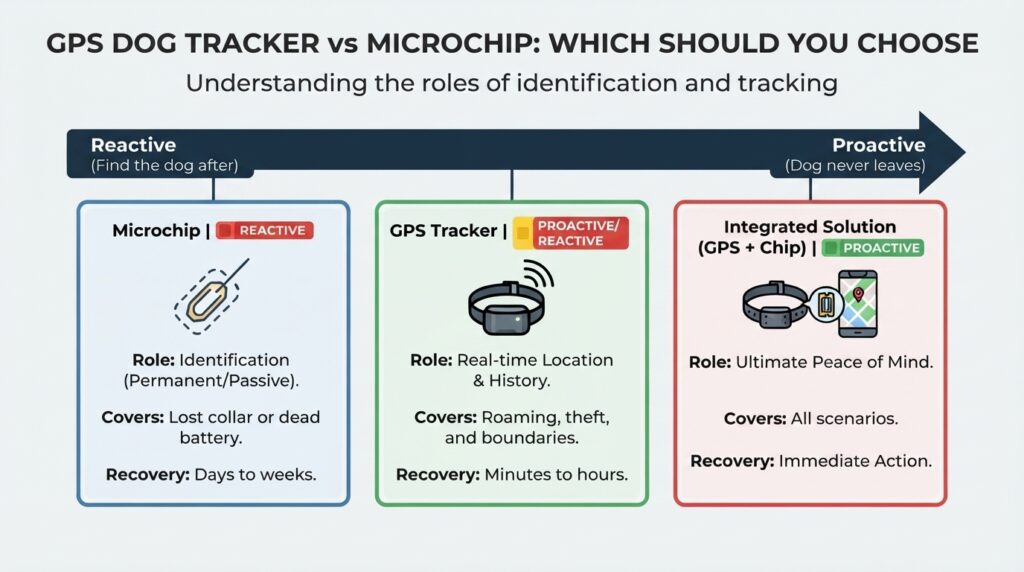
The safest approach uses three layers, each covering a different failure mode:
Layer 1 – Microchip (identification): Permanent, passive, zero-maintenance. Works when the collar is lost, the battery is dead, or the dog is stolen. Requires someone else to find the dog and bring it to a scanner. Recovery time: days to weeks.
Layer 2 – GPS tracker (location): Active, real-time, owner-controlled. You see the dog’s location on your phone and go get them. Does not prevent the dog from leaving. Recovery time: minutes to hours.
Layer 3 – GPS smart collar (prevention): Active containment through virtual fencing and graduated feedback. The dog learns boundary rules and is warned before reaching the escape point. Prevents the lost-dog scenario rather than responding to it. Recovery time: not applicable – the dog doesn’t leave.
Most comparison guides stop at “use both a microchip and a GPS tracker.” That advice is correct but incomplete. A microchip and a GPS tracker are both reactive technologies – they help after the dog is already lost. The third layer is the only proactive one.
→ For a direct comparison of GPS fences and GPS trackers, see: GPS Fence vs GPS Tracker.
How Fast Can Each Technology Help You Find a Lost Dog?
Speed matters when a dog is lost. Every minute increases the search radius, the risk of traffic encounters, and the chance the dog ends up in an unfamiliar area where it cannot navigate home.
- Microchip only: The dog must be found by a stranger, brought to a shelter or veterinarian, scanned, and matched to your contact information. Average recovery time: days to weeks. Many microchipped dogs are never scanned because they are taken in by well-meaning finders who don’t check for a chip.
- GPS tracker: You receive an alert the moment the dog leaves a geofence zone (if the tracker supports geofencing) or notice the dog is missing and open the app. You see the real-time location, drive to the coordinates, and retrieve the dog. Typical recovery time: 15 minutes to 2 hours, depending on how quickly you notice and how far the dog has traveled.
- GPS smart collar with virtual fencing: The collar warns the dog before it reaches the boundary. The dog turns back. You receive a notification that a boundary approach occurred but the dog self-corrected. Recovery time: zero – the dog never left.
The progression from microchip to GPS tracker to GPS smart collar is a progression from reactive to proactive. Each layer is valuable. Together, they cover every scenario: the collar prevents escape (Layer 3), the tracker locates the dog if the collar fails (Layer 2), and the microchip identifies the dog if both collar and tracker are lost (Layer 1).
GPS Tracker vs Microchip FAQs
Is a microchip required by law?
Requirements vary by jurisdiction. In the United Kingdom, microchipping has been mandatory for all dogs since 2016. In the European Union, microchipping is required for cross-border pet travel. In the United States, no federal law requires microchipping, but some states and municipalities have local mandates, and many shelters and rescues microchip all animals before adoption. Regardless of legal requirements, the American Veterinary Medical Association (AVMA) recommends microchipping all pets.
Do GPS trackers work without cell service?
While basic GPS trackers require cellular service to send location updates to your phone, advanced GPS smart collars like Halo handle safety differently. With Halo, your virtual fence boundaries are stored directly on the collar itself. This means even if you are in a total cellular dead zone, the collar will still fully contain and protect your dog using direct satellite GPS. You simply won’t see live map updates on your phone until cellular or Wi-Fi connection returns.
Can a microchip be removed or deactivated?
Microchips are designed to be permanent. Once implanted, they migrate slightly and bond with surrounding tissue within 24 to 48 hours. Surgical removal is possible but requires a veterinarian and is rarely performed except for medical necessity. Microchips do not have an on/off switch and cannot be remotely deactivated. They remain functional for the lifetime of the dog – typically 20 to 25 years of operational life.
What is the best GPS tracker for dogs?
The best GPS tracker depends on what you need. For location-only tracking at the lowest cost, devices like Tractive and Fi offer reliable GPS with cellular connectivity at $30–$150 plus $5–$10/month. For location tracking combined with virtual fencing, boundary training, and activity monitoring in a single device, the Halo Collar provides an all-in-one GPS smart collar system at $400–$600 plus $5–$30/month. For proximity-based finding only (not true GPS tracking), Apple AirTag is an inexpensive option at $25–$35 with no subscription.