A virtual dog fence is a GPS-based containment system that creates wireless boundaries around any outdoor area using satellite positioning, a smart collar, and a smartphone app – with no buried wires, no physical barriers, and no professional installation.
Unlike a wooden fence or chain-link barrier that physically blocks a dog from leaving a yard, a virtual dog fence establishes a digital perimeter the dog learns to respect through structured training and consistent feedback. The collar communicates with the dog through escalating cues – sound, vibration, and optional static – so the dog understands where the boundary is before they reach it. The result is safe off-leash freedom for the dog and real-time visibility for the dog parent, anywhere with open sky access.
Virtual GPS fencing represents the current standard in wireless pet containment. Systems like the Halo Collar 5 combine dual-frequency GPS (L1 + L5 bands), on-collar boundary storage, and direction-based feedback into a single device that replaces the need for physical fencing entirely.
How a Virtual Dog Fence Works
A virtual dog fence relies on three components working together: GPS satellites that provide positioning data, a collar that processes that data on-device, and an app that gives you control over boundaries and feedback settings.
GPS Satellite Positioning and the Collar
The collar contains a GPS receiver that communicates with satellites orbiting Earth to calculate your dog’s position in real time. Basic GPS systems use a single frequency band (L1) and connect to one satellite constellation, which provides accuracy in the range of 3–10 meters depending on environmental conditions. More advanced systems use dual-frequency GPS (L1 + L5 bands) and connect to multiple constellations – GPS, Galileo, BeiDou, GLONASS, NavIC, and QZSS – improving accuracy to sub-meter levels. Halo Collar 5 uses Precision+ (DGNSS), delivering independently verified accuracy within 0.6 meters of a dog’s true outdoor position across 151 satellites from 6 constellations.
The collar’s position update rate determines how quickly it detects movement toward a boundary. A collar updating once every few seconds may miss rapid directional changes. Systems with higher update rates – Halo updates position 20 times per second – detect boundary approaches faster and deliver more timely feedback.
Setting Up a Virtual Boundary
You create a virtual fence through the companion app. Most GPS fence systems offer two setup methods: drawing a boundary on a satellite map with your finger, or walking the perimeter while holding the collar so the GPS traces your path. Both methods produce a stored fence that the collar enforces autonomously once activated.
The fence shape is fully customizable – not limited to circles or preset geometries. You can trace a boundary around an irregularly shaped yard, exclude a garden or pool area, or follow the contour of a property line. Halo supports unlimited fences stored directly on the collar, so you can create separate boundaries for your home, a friend’s property, a campground, or a vacation rental and switch between them automatically.
What Happens When a Dog Approaches the Boundary
When your dog moves toward the edge of a virtual fence, the collar initiates a structured feedback sequence designed to redirect them before they cross the boundary. The typical escalation follows three stages.
The first cue is a warning tone – an audible signal that begins when the dog enters the Warning Area, typically 7–10 feet from the fence line. If the dog continues toward the boundary, the feedback escalates to vibration. If the dog still moves outward, the collar may deliver optional static feedback – a gentle sensation comparable to a tap on the shoulder – calibrated to the minimum effective level for that individual dog.
Advanced systems add a second layer on top of that escalation. They read which way the dog is heading, not only how close they are, so a dog walking parallel to the line or turning back receives nothing at all – covered in detail further down. Encouragement cues complete the loop: when the dog turns away from the boundary and heads home, the collar delivers positive signals – a Return Whistle, a “Good Dog” tone, or a “Go Home” cue – reinforcing the correct behavior. Halo Collar 5 provides six feedback types in total: three prevention cues and three encouragement cues, designed with Cesar Millan’s positive-association methodology.
Types of Wireless Dog Fences
The term “wireless dog fence” covers three distinct technology categories, each with different mechanics, limitations, and levels of safety. Understanding the differences helps you evaluate which type fits your property and your dog’s needs.
Underground Wire Fences
An underground electric fence uses a wire buried 2–6 inches below ground around the perimeter of a yard. A transmitter inside the home sends a radio signal through the wire, and a receiver collar worn by the dog detects proximity to the wire using radio frequency – not GPS. When the dog approaches the buried wire, the collar delivers a static correction.
Underground electric fences are fixed to one property and require professional installation or hours of manual trenching. They offer no GPS tracking, no app control, and no ability to adjust the boundary without digging up and re-routing the wire. Once a dog runs past the wire, the electric fence has no further response – no tracking, no alert, and no way to locate the dog. Installation typically costs $1,200–$3,500 for materials and labor.
Radio-Frequency Wireless Fences
A radio-frequency (RF) wireless fence uses a base station plugged into an outlet indoors. The base station broadcasts a signal in a circular radius, and the collar activates when the dog moves outside that radius. Setup is faster than burying wire, but the boundary shape is limited to a fixed circle centered on the base station.
RF wireless fences are affected by signal interference from walls, metal structures, and terrain changes. The coverage range is typically limited to 0.5–1.5 acres, making them unsuitable for large properties. Like underground electric fences, RF systems offer no GPS tracking and no ability to create custom boundary shapes.
GPS Virtual Fences
GPS virtual fences represent the current generation of wireless containment technology. They use satellite positioning to determine a dog’s location and enforce customizable boundaries of any shape and size, with the workable range depending on the system – Halo, for instance, covers anything from 900 square feet to over 1,200 square miles. Boundaries are stored digitally, either on the collar itself or in the cloud, and can be created, edited, or relocated through a smartphone app in minutes.
GPS virtual fences are portable: the same collar works at home, at a park, at a campsite, or at a vacation rental. Systems like the Halo Collar 5 store fences directly on the collar’s onboard memory, so boundary enforcement continues even without Wi-Fi or cellular connectivity. GPS fences also integrate real-time tracking, allowing you to see your dog’s position on a map whenever you have coverage.
Why Dog Parents Choose Virtual Fences Over Physical Ones
The most common reasons dog parents switch from physical fencing to a virtual GPS fence involve flexibility, cost, and practical constraints that traditional barriers cannot solve.
Many neighborhoods enforce homeowner association (HOA) rules that restrict or prohibit visible fencing. A virtual GPS fence creates a real boundary around a property with no posts, no panels, and no visual footprint on the landscape. The yard stays open and unobstructed while the dog stays safely contained.
Portability is a factor that physical fences simply cannot address. Dog parents who travel with their dogs – whether by RV, to vacation rentals, to a friend’s property, or to campgrounds – need a containment solution that works in multiple locations. A GPS virtual fence travels with the collar. You can create a new boundary at a new location in under a minute, and the dog’s trained behavior transfers to any fence created anywhere.
On cost, a wood or vinyl fence for a standard suburban yard runs $1,500–$10,000+ depending on materials, height, and lot size. Chain-link is less expensive but still requires installation, concrete footings, and periodic repair. A GPS virtual fence system replaces all of that with a collar, an app, and a data plan – a lower total cost of ownership over 1–2 years in most cases.
Maintenance is another differentiator. Physical fences weather, rot, lean, and require repair. Dogs can dig under them, jump over them, or push through damaged sections. A virtual GPS fence has no physical components to maintain outdoors. The collar charges in about 60 minutes, and firmware updates arrive automatically through the app.
What to Look for in a Virtual Dog Fence
Not all GPS virtual fence systems deliver the same level of safety, accuracy, or training support. Five technical attributes separate reliable containment systems from basic tracking devices with optional boundary alerts.
GPS Accuracy and Update Rate
GPS accuracy determines how closely the digital boundary matches the real-world perimeter you intend to enforce. A system accurate to 5–10 meters may trigger feedback when a dog is still well inside the intended boundary, or fail to trigger when the dog has already crossed it. For properties near roads, water, or other hazards, this margin of error creates a safety gap.
Dual-frequency GPS (L1 + L5 bands) significantly improves accuracy over single-frequency systems by filtering out signal distortions caused by atmospheric interference, buildings, and tree canopy. Halo Collar 5 achieves accuracy within 0.6 meters, independently verified – at the precise end of what GPS dog fences currently achieve.
Update rate matters equally. Systems vary widely here, from a position check every couple of seconds to one a minute apart, and at the slower end a collar can miss a fast-moving dog’s approach to the boundary entirely. A collar updating 20 times per second detects movement in real time and delivers feedback before the dog reaches the fence line.
Direction-Based Feedback vs. Distance-Based Systems
This is the single most important technical distinction in virtual dog fence design, and one that most buyers never learn about.
A distance-based system triggers feedback whenever a dog is within a certain distance of the boundary, regardless of which direction they are heading. If a dog wanders near the boundary and then turns back toward the center of the yard, a distance-based system still delivers a warning – or even a correction – because the dog’s proximity alone triggers the response. Over time, this teaches the dog to avoid an entire zone around the perimeter, not just the boundary itself. It can also cause confusion: the dog receives a negative cue while doing the right thing.
A direction-based system monitors both position and heading. Feedback activates only when the dog is moving toward the boundary. A dog walking parallel to the fence, standing near it, or turning back toward the yard receives no feedback at all. This distinction preserves the dog’s confidence to move freely within their entire safe zone and eliminates contradictory signals.
Halo Collar 5 uses patented direction-based feedback: the collar knows which way your dog is heading relative to the boundary and responds accordingly. The dog can control the outcome through their own behavior – which is the philosophical core of a communication-based containment system.
“The question I’d ask of any of these systems isn’t how gentle it is. It’s whether she can switch it off herself. That sounds like a small thing and it’s most of the story. A dog who works out that turning round stops the tone has got something to do about it, and dogs manage well when there’s something to do. A dog who can’t find the connection between what she did and what happened stops trying things out – and that dog often gets described as calm, when she’s really just given up guessing. Gentle and predictable aren’t the same thing. Predictable is the one I’d be protecting.”
– Charlie Angel Chun Expert Trainer & Consultant (Behavioral Rehabilitation & Society Acclimation)
Training Integration
A virtual dog fence is only as effective as the training that teaches a dog to understand and respect the boundary. Look for systems that include structured, in-app training programs rather than leaving you to figure out the process alone.
Effective training follows a progressive arc: indoor conditioning first, where the dog associates cues with behavior; then leash-guided boundary walks outdoors; and finally supervised off-leash practice. The goal is positive association – the dog learns that responding to boundary cues earns encouragement, not that crossing a boundary causes discomfort.
Halo Collar 5 includes the Halo training program, designed with Cesar Millan, built directly into the app. The program is milestone-based, so each dog progresses at their own pace. Dogs learn through association, not reasoning – and boundary respect becomes second nature through conditioning, not avoidance.
Autonomous Operation and Connectivity
Some GPS fence systems require an active internet connection to enforce boundaries. If Wi-Fi drops, cellular coverage fails, or your phone is out of range, those systems stop functioning as containment devices.
Look for a system that stores fences directly on the collar and processes GPS data on-device. This means the collar enforces boundaries autonomously – even when your phone is not nearby, even in areas without Wi-Fi or cellular signal, and even when the app is closed. Real-time tracking and app-based alerts do require connectivity, so the map on your phone can lag in a dead zone – but the core safety function, keeping the dog inside the fence, should never depend on it.
Halo Collar 5 stores fences on the collar’s onboard memory and runs AlwaysOn™ GPS continuously. Your dog remains protected in areas without Wi-Fi, cellular signal, or phone proximity. The collar enforces boundaries autonomously – no cloud dependency.
Fence Size, Shape, and Portability
Different GPS fence systems support different minimum and maximum fence sizes. Some require large open areas; others work in compact suburban yards. Halo supports fences as small as 900 square feet (approximately 30 × 30 feet) and as large as 1,200 square miles, covering everything from a suburban backyard to a rural ranch.
Shape flexibility matters for irregularly shaped lots, properties with pools or gardens to exclude, or multi-zone configurations. The most capable systems allow custom polygon shapes, not just circles. And unlimited fence storage means you can maintain separate boundaries for home, family properties, parks, and travel destinations – all stored on the collar and available instantly.
How Dogs Learn a Virtual Fence Boundary
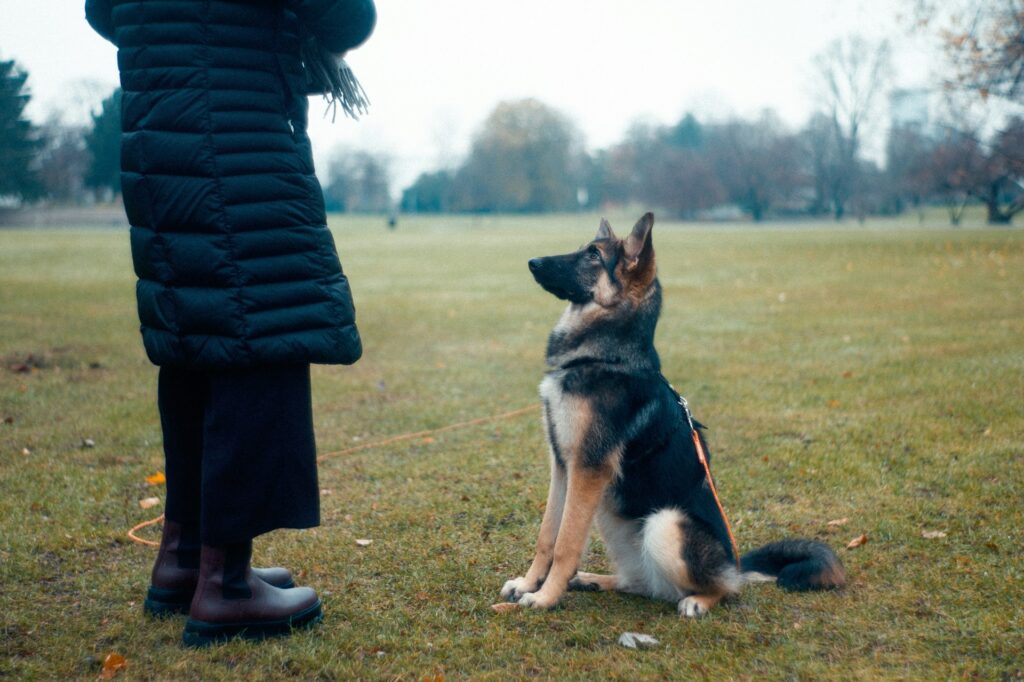
Training is the factor that separates a reliable virtual fence from a collar that happens to beep. A dog does not inherently understand what a GPS boundary is. They learn it through structured, consistent conditioning – the same way they learn any behavior.
The process works in stages. During the first phase, the dog wears the collar indoors and learns to associate the feedback cues – tones, vibrations – with simple directional guidance. There is no boundary involved yet. The dog simply learns that a specific sound means “change direction” and that responding to it earns an encouragement cue.
In the second phase, training moves outdoors with the dog on a leash. You walk them toward the boundary and let the collar’s feedback sequence activate naturally. When the dog hears the warning tone and turns back – even with your guidance – they receive a positive cue. You repeat this at multiple points along the perimeter, building a mental map of where the boundary exists.
The third phase is supervised off-leash practice within the virtual fence. The dog has now associated the collar cues with the boundary location and understands that moving away from the boundary earns encouragement.
This is what “communication, not punishment” means in practice. The collar is a communication tool the dog learns to understand. The design goal is that the cues stay predictable – a warning always comes before anything stronger – controllable, since the dog can stop the feedback by changing direction, and adjustable, because you set the minimum effective level for your individual dog. Those three properties are what keep a dog confident with the collar rather than wary of it, which is why they are worth checking in any system you consider.
Dogs thrive on clear rules and the satisfaction of following them. A well-trained dog on a virtual fence does not hover anxiously in the center of the yard – they explore, play, and patrol with confidence, because the boundary feedback is consistent and fair.
“When I want to know whether a boundary is really working, I don’t watch the line. I watch the middle. A dog who’s got it right uses the whole garden – she’ll lie down near the edge, wander over, have a sniff along it, take herself off to the far corner. A dog who hasn’t got it right stays central and tightens up whenever she drifts outward. Both of those dogs are contained, so on paper both systems look like a success. Only one of them has actually gained anything. Containment is the easy thing to measure. It isn’t the thing I’d judge it on.”
– Charlie Angel Chun Expert Trainer & Consultant (Behavioral Rehabilitation & Society Acclimation)
How Much Does a Virtual Dog Fence Cost?
Virtual dog fence pricing varies significantly across product categories. The total cost of ownership depends on the device price, whether a data plan is required, and how those figures compare to the alternatives.
GPS dog fence collars range from approximately $69 for basic GPS trackers with boundary-alert features to $999 for systems with advanced satellite technology, training integration, and containment-grade feedback. The Halo Collar 5 is priced at $524 and includes the collar hardware, the Halo training program designed with Cesar Millan, and access to six feedback types.
Most GPS fence systems require a data plan to enable GPS services, real-time tracking, and app connectivity – similar to how a smartphone requires a data plan. Halo’s Pack Membership Plan starts at $9.99/month and includes LTE data, firmware updates, GPS services, and full app access. Some competing systems offer fencing without a data plan, but without it, real-time tracking and remote alerts are unavailable – meaning if the dog leaves the boundary, you have no way to locate them through the system.
For context, a standard 6-foot wood privacy fence for a quarter-acre lot costs $3,000–$8,000 installed. A chain-link fence runs $1,500–$4,000. An underground electric fence with professional installation costs $1,200–$3,500. Over a 1–2 year period, a GPS virtual fence with a data plan costs less than any of these physical alternatives – and travels with you to every location your dog visits.
Do Virtual Dog Fences Work for Every Dog?
Almost. A GPS virtual fence suits dogs of any breed – Halo is in use across more than 350 breeds – but three requirements set the floor: the dog needs to be at least 5 months old, at least 10 pounds, and have a neck measuring between 8 and 30.5 inches. Puppies below that age are excluded on developmental grounds rather than size: boundary training asks a dog to hold a rule about space they cannot see, which is beyond a very young puppy.
Beyond those limits, breed and temperament influence training duration, not effectiveness. A calm, people-oriented breed may complete boundary training in a matter of days. A high-energy breed with a strong prey drive – a Husky, a Beagle, a Jack Russell Terrier – typically requires more repetitions and more structured training time before off-leash use is reliable. The technology works identically; the training timeline varies.
For dogs with strong independent temperaments or high prey motivation, the most effective approach is a GPS fence system that includes a structured training program and direction-based feedback. Direction-based systems prevent confusing signals that could undermine a strong-willed dog’s trust in the boundary, and integrated training programs provide a clear conditioning arc from indoor introduction to unsupervised outdoor freedom.
Virtual Dog Fence vs. Physical Fence – Key Differences
The two approaches differ on almost every practical measure – what it costs to put in, what it costs to keep, whether it moves with you, and what happens the moment a dog gets past it. One row is worth reading first: a physical fence does nothing once a dog is on the other side of it, while a GPS system keeps tracking and can alert you through the Protection Zone, the wider buffer beyond your boundary where the collar continues to work.
| Attribute | Physical Fence | GPS Virtual Fence |
|---|---|---|
| Installation | Professional labor; days to weeks | App-based; minutes |
| Upfront cost | $1,500–$10,000+ | $69–$999 (collar) |
| Ongoing cost | Repairs, staining, replacement | Data plan from $9.99/month |
| Portability | Fixed to one property | Works at any location with open sky |
| Boundary shape | Follows property line; fixed | Fully customizable; any shape |
| Aesthetics | Visible; may violate HOA rules | No visual footprint |
| GPS tracking | None | Real-time location on a map |
| Training support | None built in | In-app training programs available |
| Maintenance | Weather damage, rot, digging repairs | Collar charging; firmware updates |
| Protection beyond boundary | None once dog escapes yard | Tracking, alerts, Protection Zone |
| HOA compliance | Often restricted | No restrictions |
Frequently Asked Questions
Is a virtual dog fence safe for dogs?
Yes. A well-designed virtual dog fence uses predictable, controllable, and adjustable feedback – meaning the dog receives a warning before any stronger cue, the dog can stop the feedback by changing direction, and the dog parent sets the minimum effective level. The Halo Collar 5 feedback system is designed around communication, not punishment. The collar uses sound, vibration, and optional static feedback – with static calibrated to feel like a tap on the shoulder and never required. Many dogs respond to sound or vibration alone.
Can a virtual dog fence work in a wooded area?
GPS accuracy decreases under dense tree canopy because foliage can partially block satellite signals. Single-frequency GPS systems are more affected than dual-frequency systems. A dual-frequency GPS collar using L1 + L5 bands – like Halo Collar 5 with Precision+ – filters out signal distortions caused by trees, buildings, and atmospheric conditions, maintaining reliable boundary enforcement in partially wooded environments. For heavily forested areas with minimal sky visibility, set boundary margins wider to account for any residual signal variation.
Do virtual dog fences need a monthly subscription?
Most GPS virtual fence systems require a data plan to enable real-time GPS tracking, app-based fence management, and escape alerts. The data plan covers LTE cellular data, GPS satellite services, and firmware updates – similar to how a smartphone requires a data plan to function. Some systems offer basic fencing without a data plan, but without it, you lose the ability to track your dog’s location or receive alerts if they leave the boundary. Halo’s Pack Membership Plan starts at $9.99/month and includes full GPS services, tracking, and app access.
Can I use a virtual dog fence with multiple dogs?
Yes. Each dog wears their own GPS collar, and all collars can share the same virtual fence boundaries. You can customize feedback settings individually for each dog – different feedback types, different intensity levels, different sensitivity based on each dog’s size, temperament, and training stage. Boundaries are created once and apply to every collar assigned to that fence.
What is the smallest area a virtual dog fence can cover?
GPS-based virtual fences require a minimum boundary size for reliable satellite positioning. Many systems need something closer to half an acre of open space. Halo Collar 5 supports fences as small as 900 square feet – approximately 30 × 30 feet – which keeps it workable in compact suburban yards that larger minimums rule out. The maximum supported boundary extends to 1,200 square miles, covering properties of virtually any scale.
How small a dog can wear a GPS fence collar?
Halo Collar 5 is designed for dogs of at least 10 pounds, with a single adjustable strap fitting necks from 8 to 30.5 inches. Very small toy breeds below that weight are not suited to a GPS containment collar, since the hardware needed for satellite positioning and on-collar processing has a minimum practical size.