Dog containment is not a single choice between a fence and a collar – it is a hierarchy of layers that build on one another. A physical fence blocks, training teaches, and a GPS fence communicates and travels, and each layer covers a weakness the one below it leaves exposed. Most guides line these methods up as rivals and tell you to pick one; the more useful question is how they stack. This framework walks through the three layers of dog containment from the ground up, shows what each one covers and where it fails, and explains why a GPS fence sits at the top of the stack – the only layer that communicates with your dog at the boundary and helps recover them past it.
What Is the Dog Containment Hierarchy? The Short Answer
The dog containment hierarchy is a three-layer model of keeping a dog safe: a physical fence that blocks, training that teaches the boundary, and a GPS fence that communicates and travels. Each layer builds on the last, and the strongest setups combine them rather than relying on any one alone.
Why Containment Works in Layers, Not Either-Or
Containment fails when it depends on a single point that a motivated dog can defeat. A fence is just wood and wire until a digger goes under it; training fades without reinforcement; a boundary your dog does not understand is only a suggestion. Thinking in layers solves this, because each layer compensates for the one beneath it: the fence buys time, training builds the habit, and the GPS layer adds intelligence and a safety net. The single most common containment mistake is trusting a fence alone to do a job that actually takes a system. Viewed this way, the methods stop competing and start reinforcing each other.
The Three Layers of Dog Containment
Dog containment stacks into three layers, each covering something the one below it cannot. They ascend from a fixed physical barrier, to a boundary your dog carries in their head, to one that travels with them and talks back.
Layer 1 – The Physical Fence: A Barrier That Blocks
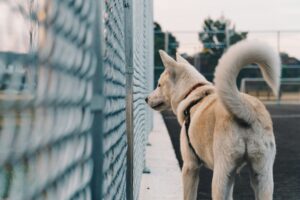
A physical fence is the foundational layer, a literal barrier that physically blocks a dog from leaving. Wood, vinyl, chain link, or wrought iron, it is the most tangible form of containment and the only one that also keeps other animals out. Its strengths are reliability and simplicity; its weaknesses are cost, a fixed location, and the fact that a determined digger or jumper can still defeat it. A fence sets the stage, but on its own it addresses the method of escape, never the motivation.
Layer 2 – Training: The Boundary Your Dog Carries
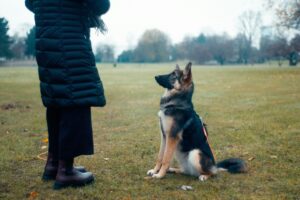
Training is the connective layer that turns a physical boundary into an understood one. This is the layer most comparison guides treat as optional, yet it is the tissue that makes every other layer work: a dog who has learned their boundary respects it whether or not a wall is present. Recall, boundary cues, and consistent reinforcement build a limit your dog carries in their own head. Done with positive methods, training is humane and durable, though it takes time and consistency to hold. Build it with a reliable recall – the layer that travels with your dog for life, and the one that keeps paying off long after the hardware is forgotten.
Layer 3 – The GPS Fence: A Boundary That Communicates and Travels
A GPS fence is the top layer, a virtual boundary that communicates with your dog and moves wherever you go. Drawn on a phone app and enforced by satellites, it needs no wire or wall, adapts to almost any property shape, and travels to campsites, rentals, and new homes. Unlike the layers below it, it does not just block or teach – it reads your dog’s approach and guides them back with feedback, then adds real-time tracking as a recovery net. See exactly how a GPS fence prevents escapes before they happen.
What Each Layer Covers – and Where It Fails
Every layer covers a specific failure mode and leaves another exposed, which is why they work best together. Reading the stack this way shows precisely where each method needs backup.
| Layer | What it covers | Where it fails |
|---|---|---|
| Physical fence | Blocks the exit; keeps other animals out | Diggers, jumpers, and gaps; fixed to one property; teaches nothing |
| Training | Teaches the boundary; addresses behavior | Fades without reinforcement; competes poorly with high arousal |
| GPS fence | Communicates, guides back, travels, recovers | Needs charging and an initial training period; live tracking needs coverage, though the boundary itself does not |
Notice the pattern: each layer’s weakness is another layer’s strength. The fence cannot teach, so training does; training fades, so the GPS layer reinforces and recovers. None of it works, though, without addressing the motivation behind escapes in the first place.
Cost, Reliability, and Effort Compared
The three layers differ sharply in upfront cost, accuracy, and the effort each demands. Figures vary by property and brand, so the ranges below bracket what most owners can expect.
| Category | Physical fence | Training | GPS fence |
|---|---|---|---|
| Upfront cost | ~$1,500–$10,000+ | Low to moderate | ~$100–$1,000 |
| Reliability | A barrier, until it is dug under or jumped | Depends on the dog and the practice | Halo verified at 0.6 m (~2 ft); entry-level systems drift much further |
| Effort / setup | Construction or install | ~2–4 weeks of practice | App setup plus ~2–4 weeks of training |
| Portability | None – fixed to the property | Fully portable | Travels anywhere |
| Smallest workable yard | Any size | Any size | Varies by system – Halo from 900 sq ft; many others need a third of an acre |
Why GPS Sits at the Top of the Stack
A GPS fence sits at the top of the containment hierarchy because it is the only layer that blocks nothing yet does the most. Where a physical fence stops one method and training shapes one habit, a GPS fence carries the boundary with your dog, communicates at the moment of approach, and helps you recover them if they ever cross. It absorbs the work of the layers beneath it – enforcing the trained boundary, compensating when training fades, and removing the fence’s fixed-location limit – while adding intelligence and recovery that neither lower layer offers. That is not to say it replaces the others; it builds on them, which is exactly what the top of a stack is supposed to do.
Blocking vs. Communicating: The Real Difference
The deepest divide in dog containment is between blocking and communicating. A physical barrier blocks: it opposes your dog with an obstacle and waits to be defeated. A GPS boundary communicates: it talks to your dog before the line, guiding rather than obstructing. One is reactive and fixed, the other proactive and portable.
| Blocking (physical barrier) | Communicating (GPS boundary) |
|---|---|
| Opposes your dog with an obstacle | Guides your dog with feedback |
| Fixed to one location | Travels anywhere |
| Waits to be defeated | Acts before the boundary is crossed |
| Blocks the method | Addresses the behavior |
Halo’s patented Direction-Based Feedback is what makes the communicating layer intelligent, reading whether your dog is moving toward the boundary or already turning back and responding to fit the moment – a dog walking parallel to the line gets nothing at all.
Can You Combine Layers? Building Your Containment Stack
Yes – combining layers builds the strongest containment, and the methods are designed to reinforce rather than replace one another. The right stack depends on your property and your dog, but the logic is the same: start at the foundation and add the layers that cover your gaps.
- Start with a boundary – a physical fence if you have one, or a virtual one if you do not.
- Add training – teach the boundary so your dog carries it, fence or not.
- Top with GPS – add communication and recovery that travel with your dog and catch the gaps.
“Owners come to me asking which of these to buy, and the honest answer is that it depends entirely on which one they’re already missing. Somebody with a good fence and a dog who’s never been taught anything doesn’t need a taller fence. Somebody with a beautifully trained dog and five unfenced acres doesn’t need more training. Same list, opposite answers, and I can’t tell you which you are without standing in your garden. So before you spend anything, work out which layer is thinnest at your house. It’s usually not the one you were about to buy – and it’s very often the free one.”
– Charlie Angel Chun Expert Trainer & Consultant (Behavioral Rehabilitation & Society Acclimation)
For owners who cannot build a fence, who move often, or whose property is too large to wall off, the GPS layer can stand in for the foundation while still delivering communication and recovery. It does not remove the need for the training layer, and no containment system is a guarantee against a dog already at full sprint – but for a great many homes it is the layer that was missing. Shop Halo Collar 5 – $524.
Frequently Asked Questions
Is a GPS fence as reliable as a physical fence?
They are reliable in different ways. A physical fence is a hard obstacle until a dog digs under it, clears it, or finds a gap – at which point it has no further role. A trained GPS fence guides a dog back before they reach the line and keeps tracking if they get past it, so it fails more gracefully. Neither is absolute, which is why the layers work best together.
Can you use a GPS fence and a physical fence together?
Yes – a GPS fence layers on top of a physical fence to reinforce the trained boundary, address your dog’s behavior, and add real-time recovery the wall alone cannot provide. Setting the virtual boundary slightly inside the physical one gives your dog a cue before they reach the fence itself.
Does a GPS fence replace training?
No – a GPS fence works with training, not instead of it, using feedback to reinforce a boundary your dog still needs to learn over roughly two to four weeks.
Which containment method is most humane?
Positive-reinforcement training paired with gentle, escalating feedback is the most humane approach, because it guides and teaches your dog rather than relying on fear or a hard physical barrier.
Which layer should I add first?
The one you are missing, which is rarely the one you were about to buy. A well-fenced yard with an untrained dog needs the training layer, not a taller fence. A well-trained dog on unfenced acreage needs a boundary, not more recall practice. Work out which layer is thinnest at your house before spending anything.