Your dog is not ignoring recall because it is stubborn, spiteful, or dumb. Your dog is ignoring recall because – from its perspective – coming when called is either unclear, unrewarding, or less compelling than whatever it is doing right now.
Recall failure is the most common training frustration dog owners report. In one survey, 80% of dog owners named recall as the training skill they struggle with most. The frustration is amplified by the stakes: recall is the one command that can prevent a dog from running into traffic, chasing wildlife into danger, or disappearing during a walk.
The good news is that recall failure almost always falls into one of five diagnosable patterns. Each pattern has a specific cause and a specific fix. This guide helps you identify which pattern matches your dog, apply the right correction, and manage your dog’s safety during the rebuild period.
Why Does Your Dog Ignore the Recall Command?
A dog ignores recall when the value of coming to you is lower than the value of staying where it is. That’s the entire equation. Every recall failure reduces to a value imbalance: the environment is paying the dog more than you are.
This imbalance develops through five specific mechanisms: the recall cue has been damaged by misuse (poisoned cue), the reward for coming is too weak (low-value reward), the dog was asked to perform in environments it hasn’t been trained for (too fast too soon), the dog has learned that recall predicts the end of fun (recall = punishment), or a biological drive (prey, scent, social) is overpowering the trained response. Understanding which mechanism is driving your dog’s recall failure is the first step toward fixing it.
The 5 Reasons Dogs Ignore Recall
1. Your Recall Cue Is Poisoned
A poisoned cue is a recall word that has lost its meaning because it has been repeated without response, used inconsistently, or followed by something the dog dislikes.
How to diagnose it: You say “come” and the dog glances at you, then turns back to what it was doing. Or you say “come” and the dog shows no reaction at all – the word has become background noise. You find yourself repeating the cue three, four, five times before the dog responds.
Why it happens: Every time you say the recall cue and the dog does not respond, the cue gets weaker. After enough failed repetitions, the word “come” means nothing to the dog – or worse, it means “the human is making a noise I can safely ignore.” The cue can also be poisoned by pairing it with unpleasant outcomes: calling the dog to end playtime, calling the dog and then bathing it, or calling the dog and then scolding it.
The fix: Retire the poisoned word permanently. Choose a completely new recall cue (“here,” “close,” a whistle pattern) and train it from scratch using the Phase 1 protocol in our reliable recall guide. Do not attempt to rehabilitate the old word. The negative association runs too deep.
2. The Reward Is Not Worth the Trip
How to diagnose it: The dog comes when called in the kitchen (where it knows food is nearby) but ignores recall outdoors. Or the dog comes partway, then veers off toward something more interesting before reaching you.
Why it happens: The recall reward is competing against the environment’s reward – and losing. A piece of dry kibble cannot compete with a squirrel. A brief pat on the head cannot compete with a game of chase with another dog. If the recall reward is not dramatically better than whatever the environment is offering, the dog will choose the environment every time.
The fix: Upgrade the reward to the highest-value food your dog responds to – small pieces of chicken, cheese, freeze-dried liver, or hot dog. The recall treat must be something the dog never receives in any other context. Deliver 3 to 5 treats in rapid succession (a jackpot, not a single piece) to make recall the most rewarding thing that happens in the dog’s day. For dogs that are not food-motivated, use a high-value tug toy reserved exclusively for recall.
3. You Advanced Too Fast
How to diagnose it: The dog’s recall was solid at home but fell apart the first time you tried it at the park. Or recall worked with no distractions but failed immediately when another dog appeared.
Why it happens: Dogs do not generalize behaviors the way humans do. A recall learned in the living room is a different skill from a recall at the dog park, as far as the dog’s brain is concerned. The cue must be taught, practiced, and reinforced in each new environment independently. Jumping from indoor practice to a busy park skips the entire middle progression – yard, quiet street, low-traffic park, moderate-traffic park – where the dog learns to perform the behavior under gradually increasing distraction.
The fix: Go back to the last environment where recall was reliable and rebuild from there. Add distraction levels one at a time, staying at each level until the dog responds in 8 out of 10 attempts before advancing. This may feel like regression, but it is actually the fastest path to reliable outdoor recall because each level is built on a solid foundation.
4. Recall Always Ends the Fun
How to diagnose it: The dog comes enthusiastically during walks but slows, hesitates, or veers away when it’s clearly time to leave the park. The dog has learned that “come” at the end of an outing means the leash clips on and the fun stops.
Why it happens: If the only time you recall your dog is when it’s time to go home, the dog learns a pattern: recall cue → leash → car → end of adventure. The dog is not ignoring recall – it is avoiding the consequence that recall predicts.
The fix: Recall your dog 10 to 15 times during every outing. Each time, reward the recall with a jackpot treat, then release the dog back to play. The dog learns that recall means “brief interruption + amazing reward + freedom resumes.” Only one of those 15 recalls is the real one where the leash clips on. The other 14 have taught the dog that coming when called is the best deal available.
5. A Competing Drive Is Stronger Than Your Cue
How to diagnose it: The dog recalls reliably in most situations but ignores recall completely when a specific trigger is present – a squirrel, a rabbit, another dog in heat, a scent trail, or a running child.
Why it happens: Prey drive, scent drive, social drive, and sexual drive are hardwired biological responses that operate below the level of trained behavior. When these drives activate, the dog enters a state where the recall cue cannot compete – not because training was bad, but because the arousal level has exceeded the dog’s compliance threshold.
The fix: This is the hardest recall failure to solve with training alone, because you are working against biology. Desensitization training (practicing recall at progressively closer proximity to the trigger) can raise the threshold, but may never eliminate the failure entirely. For dogs with high drive that overrides recall in specific situations, a GPS fence collar provides an automated safety net – the collar’s boundary feedback catches the moment training alone cannot.
For the full range of reasons dogs leave in the first place, see why dogs run away.
How Do You Reset a Poisoned Recall Cue?
If your current recall word is poisoned, the fastest path to reliable recall is to abandon it and build a new one from zero.
- Choose a new recall word the dog has never heard. One syllable is ideal: “here,” “close,” “now,” or a distinct whistle pattern. Avoid words that sound like other commands.
- Start indoors with zero distractions. Say the new word, produce a jackpot treat immediately, praise enthusiastically. Repeat 10 to 15 times per session, 3 sessions per day, for 5 to 7 days. The dog should be sprinting to you at the sound of the new word within the first week.
- Move to the yard on a long line. Practice 2 to 3 sessions per day for another week. Reward every successful recall with the jackpot.
- Add distractions one level at a time. Stay at each level until the dog responds in 8 out of 10 attempts before advancing.
- Never use the old word again. Tell everyone in the household. Put a note on the fridge. The old word is retired permanently.
Total timeline for a poisoned cue reset: 3 to 6 weeks to reach moderate-distraction reliability with the new word. The dog is not learning recall for the first time – it already understands the concept. It just needs a clean cue that is not contaminated by negative history.
What Should You Do While Your Dog’s Recall Is Broken?
Rebuilding recall takes weeks. Your dog still needs to go outside during that time. The priority is preventing unsafe situations while the training progresses.
- Long line for all outdoor time. A 15-to-30-foot lightweight leash gives the dog room to move while keeping you connected. Do not unclip the leash until the new recall is reliable.
- Fenced areas only for off-leash. If the dog needs to run, use a securely fenced yard or a fenced dog park. An unfenced area with broken recall is an escape waiting to happen.
- GPS fence collar as interim containment. For dogs that need yard access but don’t have a physical fence, a GPS fence collar like the Halo Collar provides automated boundary containment that works independently of your voice. The collar’s virtual GPS fencing delivers graduated feedback at the boundary line, keeping the dog inside the safe zone while you rebuild recall. The collar’s containment does not depend on the dog responding to your voice – it works whether the recall cue is poisoned, untrained, or overridden by distraction.
- Stop using the broken recall cue immediately. Every time you say the old word and the dog ignores it, the word gets weaker. If you are not actively training with the new cue, do not call the dog. Go get the dog instead.
For dogs with persistent escape behavior during the rebuild, see escape artist dog.
Which Breeds Struggle Most with Recall?
Breed determines which competing drive is most likely to override recall. Knowing your breed’s specific vulnerability helps you anticipate failures and train accordingly.
- Scent hounds (Beagles, Bloodhounds, Basset Hounds): When tracking a scent, these dogs enter a state where auditory input is processed at a lower priority than olfactory input. They are not ignoring you – they cannot hear you clearly while in full tracking mode. A whistle (louder and more piercing than voice) is more effective than a verbal cue. Train recall interruptions during controlled scent exercises to build the habit of breaking off a trail.
- Sight hounds (Greyhounds, Whippets, Salukis): Chase drive activates faster than conscious thought. Once the chase begins, recall is nearly impossible. Prevention (management, GPS fence containment) is more reliable than mid-chase recall for these breeds.
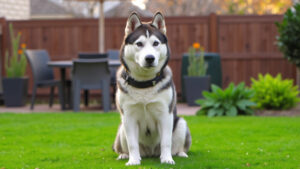
- Independent breeds (Huskies, Shiba Inus, Akitas): These breeds evaluate whether compliance is worthwhile. The recall reward must be consistently high-value, and the training period is longer – 4 to 6 months for reliable outdoor recall versus 6 to 8 weeks for handler-oriented breeds.
- Terriers (Jack Russells, Bull Terriers, Fox Terriers): Prey drive combined with tenacity. A terrier locked onto a target will persist past the point where other breeds give up. Short, high-frequency recall practice sessions (20 to 30 reps per day) build the recall habit faster for these breeds.
The Frustration Cycle That Makes Recall Worse
Most owners with broken recall are trapped in a cycle they cannot see:
- You call the dog. The dog ignores you.
- You repeat the cue, louder. The dog glances, then turns away.
- You repeat again, now frustrated. The dog moves further away.
- You chase the dog. The dog runs faster (it thinks this is a game, or it is fleeing your angry energy).
- You catch the dog (eventually) and scold it for not coming.
- The dog learns: recall cue = angry human = punishment. Next time, the dog avoids coming even harder.
- You repeat step 1, except now with a more poisoned cue and a more avoidant dog.
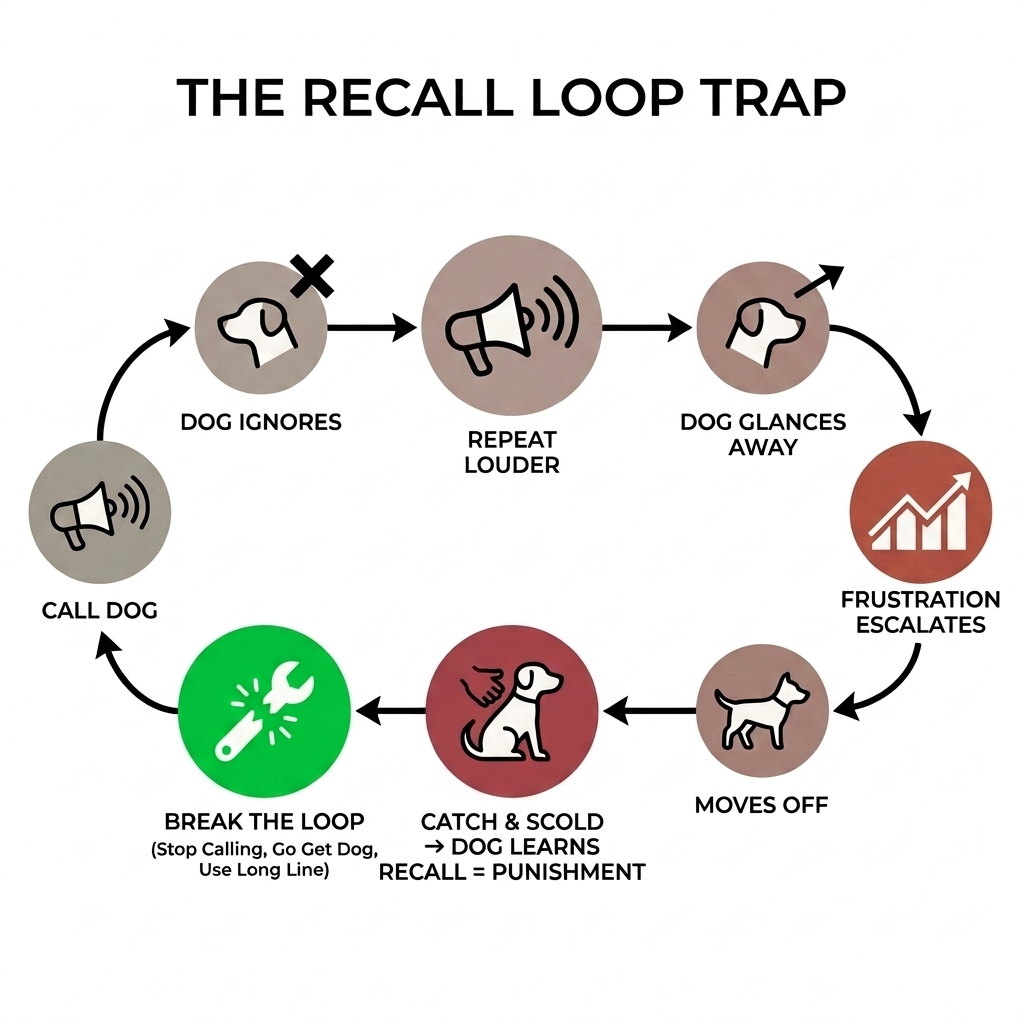
Every cycle through this loop makes recall worse. The fix is to break the loop at step 1: stop calling the dog unless you are confident it will respond. If you are not confident, do not call. Go get the dog. Use the long line. Manage the situation without damaging the cue further. Then rebuild recall in controlled settings where success is guaranteed.
“Many people think a dog that ignores recall is being stubborn or disobedient, but the reality is that dogs make decisions based on what they value most in the moment. Their instincts often prioritize things like wildlife, scents, curiosity, or freedom over returning when called.Effective recall isn’t about repeating commands louder—it’s about building trust, safety, and value in your relationship. Dogs are more likely to come back when they see their owner as a consistent source of guidance and positive experiences.Recall is developed through repeated positive interactions. Every successful recall strengthens your bond, while punishing a dog for returning can weaken it. Ultimately, reliable recall comes from strong communication and connection, making you more meaningful to your dog than the distractions around them.”
– Arianna Melendez Halo Trainer Expert (Dog Psychology & Behavior Modification)
Can a Dog with Bad Recall Ever Be Trusted Off-Leash?
Yes – if the recall is rebuilt correctly and the dog has a safety net for the moments when training alone is not enough.
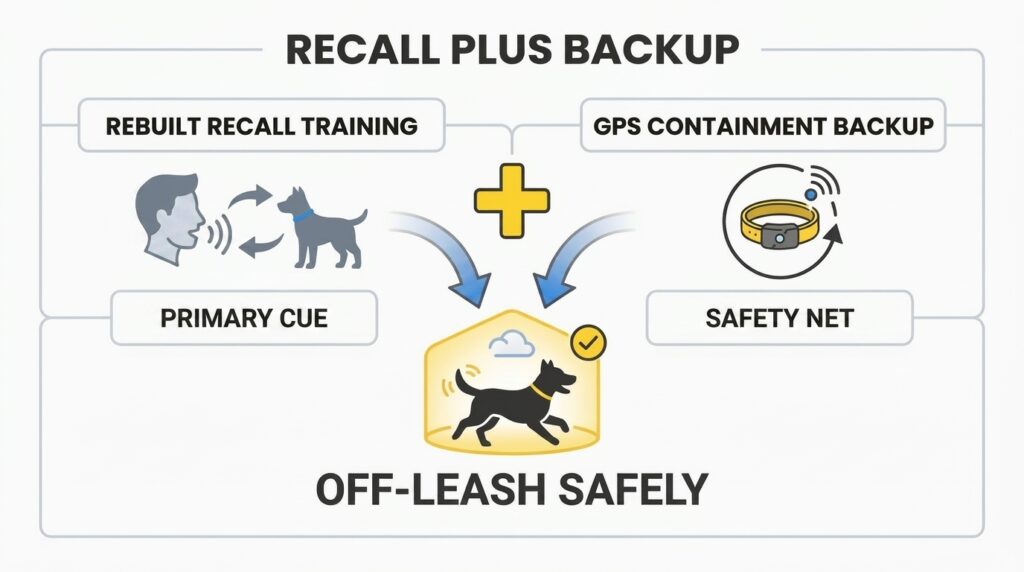
A poisoned cue can be replaced with a clean one in 3 to 6 weeks. A recall that was never properly trained can be built from scratch in 6 to 12 weeks. The key is patience, consistency, and resisting the urge to test the recall before it is ready.
For off-leash freedom with maximum safety, the strongest approach combines rebuilt recall training with a GPS fence collar. The recall handles the vast majority of situations. The collar’s boundary containment catches the moments – extreme prey drive, sudden fear, environmental surprise – when even good recall cannot compete. Together, the two layers provide off-leash reliability that neither can achieve alone. For the complete GPS fence training methodology, see GPS fence training.
Dog Ignores Recall FAQs
Is my dog being stubborn when it ignores recall?
No. Dogs do not ignore recall out of spite, stubbornness, or dominance. A dog that ignores recall is a dog that has not been sufficiently trained for the current environment, has a poisoned cue, or is experiencing a competing drive that exceeds its compliance threshold. The behavior is a training gap, not a character flaw.
Should I use a shock collar to fix recall?
Using aversive correction to force recall creates a dog that returns out of avoidance, not out of positive association. Research shows that dogs trained with reward-based methods come faster, respond more reliably on the first cue, and show fewer stress behaviors than dogs trained with aversive methods. Build recall through positive reinforcement first. If you need a safety net while recall is being rebuilt, a GPS fence collar provides automated boundary containment that does not depend on the recall cue at all – it works through the collar’s own graduated feedback system, not through voice commands.
How long does it take to rebuild a broken recall?
A poisoned cue reset takes 3 to 6 weeks to reach moderate-distraction reliability with a new word. A recall that was never properly trained takes 6 to 12 weeks to build from scratch. High-distraction reliability (other dogs, wildlife, busy environments) adds another 4 to 8 weeks of distraction proofing. The timeline depends on daily consistency more than anything else.
What if treats don’t motivate my dog?
Some dogs are not strongly food-motivated, especially outdoors where environmental stimulation competes with food. For these dogs, identify the dog’s highest-value reinforcer – often a tug toy, a ball, or access to a specific activity (swimming, running, playing with another dog). Reserve that reinforcer exclusively for recall. If the dog gets its favorite tug toy only when it comes when called, the recall cue becomes the gateway to the dog’s most valued experience. The Halo Collar’s encouragement feedback adds a secondary reinforcement layer: the collar delivers a positive tone when the dog moves toward the safe zone, providing a reward signal even when the handler is not present to deliver a treat or toy.