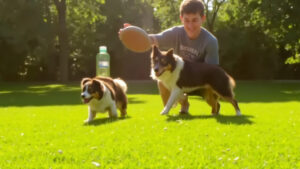
Most GPS fence collars are appropriate for puppies starting at 5 to 6 months of age, once the puppy meets three readiness criteria: minimum age, minimum weight, and basic behavioral maturity. Starting before the puppy is ready creates confusion and anxiety. Starting after the right preparation window means the puppy learns faster, responds better, and builds a positive relationship with the collar from day one.
The months between bringing a puppy home (8 weeks) and starting GPS fence training (5 to 6 months) are not wasted time. They are the preparation window where you teach the puppy the foundational skills that make GPS fence training fast and effective: name recognition, sit, stay, come, collar comfort, and basic boundary awareness. A puppy that arrives at GPS fence training with these skills already in place can be reliably contained within 2 to 3 weeks. A puppy without this preparation takes longer and struggles more.
This guide covers when your puppy is ready for a GPS fence, what to train during the waiting period, how to introduce the collar and boundaries gently, and what mistakes to avoid so your puppy builds confidence rather than fear around the system.
How Old Does a Puppy Need to Be for a GPS Fence?
A puppy is ready for GPS fence training when it meets all three of the following criteria:
- Age: 5 months minimum. At this age, most puppies have developed the cognitive maturity to understand cause-and-effect associations – the foundation of all GPS fence learning. Before 5 months, puppies are still in the socialization and habituation stage, and adding electronic feedback too early can create lasting anxiety.
- Weight: 10 pounds minimum for the Halo Collar (other brands vary: SpotOn requires 15 lbs). The collar weighs 130 grams (4.6 ounces), which is appropriate for dogs over 10 pounds but too heavy relative to body weight for very small puppies.
- Behavioral maturity: The puppy responds to its name, sits on command, and comes when called in a low-distraction environment. These skills are not just nice to have – they are the cognitive prerequisites that allow the puppy to process and respond to the collar’s feedback cues.
“The first few months are when she’s deciding what’s frightening and what isn’t, and those early conclusions are sticky. Everything she meets gets filed one way or the other, and the filing at that age tends to hold. So a puppy who gets an electronic cue at twelve weeks isn’t learning about a boundary. She’s learning that something odd happens at her neck for reasons she can’t work out, and I’ve had that come back to me at two years old with a dog who won’t have a collar near her. Wait a few months and the same tone is just information. Nothing changes about the collar. What changes is how much of the world she’s had time to get used to first.”
– Charlie Angel Chun Expert Trainer & Consultant (Behavioral Rehabilitation & Society Acclimation)
If your puppy meets the age and weight requirements but does not yet know sit, stay, and come, delay GPS fence training until these basics are in place. The collar’s feedback is a communication tool, not a teaching tool – the puppy must already understand the concept of responding to cues before the collar’s cues will make sense.
What Should Your Puppy Know Before GPS Fence Training?
GPS fence training builds on foundational obedience. A puppy that starts GPS fence training without these prerequisites will take longer to learn and may develop anxiety around the collar.
- Name recognition. The puppy turns to look at you within 2 seconds of hearing its name in a low-distraction environment. This is the attention gateway – every redirect, recall, and boundary cue depends on getting the puppy’s attention first.
- Sit on command. A reliable sit teaches impulse control and gives you a “default behavior” to redirect the puppy to when it approaches a boundary.
- Come when called (basic recall). The puppy comes to you from 10 to 15 feet away with a treat reward. Full distraction-proof recall is not required – that will develop during and after GPS fence training.
- Stay (short duration). The puppy holds position for 5 to 10 seconds before being released. This teaches the puppy that not moving is a choice, not a punishment.
- Collar comfort. The puppy wears a flat collar without scratching, biting, or freezing. If the puppy resists a regular collar, it is not ready for a GPS collar. Collar conditioning must come first.
For the complete recall training protocol, see reliable recall.
How Do You Prepare a Puppy for a GPS Fence? (8 Weeks to 5 Months)
The preparation period between 8 weeks and 5 months is not downtime. It is structured training that makes the GPS fence introduction smooth, fast, and stress-free when the puppy reaches the right age.
Weeks 8–12: Foundation Training
- Teach name recognition using the name game (say name → puppy looks → treat). Practice 10 to 15 reps per session, 3 sessions per day.
- Introduce the flat collar. Let the puppy wear a lightweight collar during meals, play, and affection. Remove it for naps and overnight. The goal: the puppy ignores the collar completely within 1 to 2 weeks.
- Begin sit and down using luring. Hold a treat above the puppy’s nose and move it backward – the puppy’s rear drops into a sit. Mark and reward. Keep sessions under 3 to 5 minutes.
- Start basic recall indoors. Call the puppy’s name + recall cue (“come”), reward with a jackpot treat and enthusiastic praise when it arrives.
Months 3–4: Boundary Awareness
- Introduce visual boundary markers. Place small flags or cones along a line in the yard. Walk the puppy on a 15-foot leash along the flag line. When the puppy approaches a flag, redirect it away with a gentle cue and treat. The puppy learns: flags = turn around = reward.
- Practice stay at increasing durations. Build from 5 seconds to 30 seconds over several weeks. This impulse control is the cognitive muscle the puppy will use to stop at the GPS boundary rather than running through it.
- Expand recall to outdoor environments. Practice come-when-called in the yard on a long line. Reward every successful recall with a jackpot.
“The introductions that go smoothly are nearly always the ones where somebody did exactly this for a couple of months first—flags, a long line, a pocket of chicken, and no electronics anywhere near it. By the time the collar goes on, she already knows what an edge is. She knows that walking up to one and turning round gets her something. So the collar isn’t teaching her a new idea; it’s an extension of something she already understands, putting a sound on a behaviour she’s been practicing for weeks. If that foundation isn’t there, adding a collar won’t magically make the dog understand what you’re asking of her. That’s the whole reason these puppies come along quicker, and none of it needs a collar to set up.“
– Charlie Angel Chun Expert Trainer & Consultant (Behavioral Rehabilitation & Society Acclimation)
Month 5: Collar Conditioning
Before activating the GPS fence, condition the puppy to the GPS collar itself. This is Phase 1 of the adult GPS fence training protocol, adapted for a puppy’s sensitivity:
- Put the GPS collar on the puppy 30 to 60 minutes before outdoor time. Do not activate the fence system.
- Leave the collar on during meals, play, walks, and affection – only positive activities.
- Remove the collar well after outdoor time ends, not immediately when the puppy comes inside.
- Vary the timing so the puppy does not associate the collar with a predictable event.
- Continue for 5 to 7 days until the puppy shows zero reaction to the collar going on or coming off.
How Do You Introduce a Puppy to a GPS Fence Collar?
The puppy introduction protocol follows the same three-phase structure as the adult GPS fence training methodology, with three adaptations: shorter sessions, lighter feedback levels, and more patience between phases.
Phase 1 – Collar Conditioning (Days 1–7)
If you completed the Month 5 preparation above, this phase may already be done. Verify that the puppy wears the GPS collar without any stress response: no scratching, no freezing, no behavior change. If the puppy is not comfortable, continue conditioning for another week before activating the fence.
Phase 2 – Guided Boundary Introduction (Days 8–14)
Activate the GPS fence system. Set the collar to the lowest feedback level – tone only for the first 3 to 5 days. The puppy should hear the warning tone as it approaches the boundary, turn toward you (because you have trained this response during the preparation period), and receive a treat.
Walk the boundary with the puppy on a 15-foot long line. Approach the boundary from different directions. Each time the puppy hears the tone and turns away, mark the moment and deliver a high-value reward. Practice 2 to 3 sessions per day, each lasting 5 to 10 minutes (shorter than the adult protocol’s 10–15 minutes, because puppies fatigue faster).
After 3 to 5 days of tone-only, add vibration as a secondary cue if the puppy does not respond to the tone. The Halo Collar’s Direction-Based Feedback detects the puppy’s trajectory, so the feedback is proportional to the approach speed – gentle for a slow walk, more immediate for a fast trot.
Move to Phase 3 when: The puppy turns away from the boundary at the warning tone in 8 out of 10 approaches without leash guidance, across 3 consecutive days.
Phase 3 – Light Distraction and Supervised Freedom (Days 15–21+)
Introduce mild distractions: a family member walking past the boundary, a toy tossed toward (not past) the boundary line, a calm dog visible at a distance. The puppy should respond to the collar’s tone and turn back despite the distraction.
Transition from the long line to a 6-foot drag line for 3 to 5 days. If the puppy self-corrects reliably, remove the drag line and begin supervised off-leash time.
Puppies require more supervised off-leash time than adult dogs before they can be left unsupervised. Plan on 2 to 4 weeks of supervised yard time after removing the drag line before the puppy is ready for unsupervised outdoor access with the GPS fence active. Stay in the yard, watch from a window, and check the collar’s app for boundary approach alerts.
What Are the Biggest Mistakes When GPS Fence Training a Puppy?
Five mistakes account for most puppy GPS fence training failures:
- Starting too early. A puppy under 5 months does not have the cognitive maturity to understand the collar’s feedback. The result is confusion and anxiety, not learning. Wait for all three readiness criteria (age, weight, behavioral maturity) to be met.
- Setting feedback too high. Puppies are more sensitive than adult dogs. Start with tone-only for the first 3 to 5 days and add vibration only if the puppy does not respond to tone. Static correction should be the absolute last resort and at the lowest available level.
- Sessions too long. Puppy GPS fence sessions should be 5 to 10 minutes, not the 10 to 15 minutes used for adult dogs. Puppies fatigue cognitively faster and will disengage or become stressed if sessions are too long.
- Skipping pre-collar preparation. A puppy that has never worn a collar, does not know its name, and has no recall foundation is not ready for GPS fence training regardless of age. The preparation period (8 weeks to 5 months) builds the skills the GPS fence depends on.
- Expecting adult-speed results. Puppies learn GPS fence boundaries reliably within 3 to 4 weeks with consistent daily practice – slightly longer than the 2 to 3 weeks typical for adult dogs. The extra time is normal and necessary for a puppy’s developing brain.
Does Breed Affect When a Puppy Is Ready for a GPS Fence?
Breed affects both physical readiness (when the puppy reaches the minimum weight) and cognitive readiness (when the puppy develops the focus and impulse control for training).
- Large and giant breeds (Labs, Goldens, German Shepherds, Great Danes): Typically reach the 10-pound weight minimum by 3 to 4 months but may not develop the cognitive maturity for GPS fence training until 5 to 6 months. Large-breed puppies are physically big enough early but mentally ready later.
- Medium breeds (Beagles, Border Collies, Cocker Spaniels): Usually meet all three criteria by 5 to 6 months. These breeds balance physical size and cognitive development well.
- Small breeds (Cavaliers, Miniature Schnauzers, Dachshunds): May not reach the 10-pound weight minimum until 6 to 8 months or later. For very small breeds that never reach 10 pounds (Chihuahuas, Yorkies, Toy Poodles), GPS fence collars may not be appropriate – a physical fence or supervised boundary training is a better fit.
- Independent breeds (Huskies, Shiba Inus, Akitas): Reach physical readiness at normal timelines but may need an extended preparation period to build the recall and impulse control foundation. Allow 6 to 7 months before starting GPS fence training with these breeds.
Can a Puppy Use an Underground Fence Instead?
Underground wire fences have different puppy age requirements than GPS fences because the technology is different.
Underground fence receiver collars are typically lighter (~1 to 2 ounces) because they contain only a radio receiver and a battery – no GPS hardware, no cellular module, no accelerometer. This lower weight means some underground fence manufacturers allow training as early as 8 to 12 weeks. The training is also simpler: one tone, one correction level, one buried wire.
GPS fence collars are heavier (4 to 5 ounces) because they contain GPS receivers, cellular radios, Bluetooth, accelerometers, and gyroscopes. The feedback system is more complex (graduated cues across multiple levels). This additional complexity requires the puppy to be cognitively mature enough to process multiple cue types – which is why GPS fence manufacturers recommend 5 to 6 months minimum.
The trade-off: underground fences can start earlier, but they are permanent, not portable, and require installation. GPS fences start later, but they are portable, require no installation, and offer a richer training system with virtual GPS fencing, activity monitoring, and structured training programs. For most puppy owners, the 3-to-4-month wait for GPS fence readiness is a small trade-off for a system that will serve the dog for its entire life across any location.
GPS Fence for Puppies FAQs
Can a 3-month-old puppy use a GPS fence?
No. A 3-month-old puppy does not have the cognitive maturity to understand the collar’s graduated feedback system, and most puppies at this age do not meet the minimum weight requirement. Use the period between 8 weeks and 5 months to teach foundational skills (name recognition, sit, stay, come, collar comfort) and positive boundary awareness with visual markers and a long line. The puppy will be ready for the GPS fence by 5 to 6 months with this preparation complete.
What is the minimum weight for a GPS fence collar?
The Halo Collar requires a minimum weight of 10 pounds and a neck size of at least 8 inches. SpotOn requires ~15 pounds. The weight minimum exists because the collar weighs 130 grams (4.6 ounces), and a collar that exceeds 5% of the dog’s body weight can cause neck strain and discomfort during extended wear. For puppies that will grow past the minimum but have not reached it yet, wait until the weight threshold is met before starting.
How long does puppy GPS fence training take?
Puppies with completed pre-collar preparation typically learn GPS fence boundaries within 3 to 4 weeks of consistent daily practice, slightly longer than the 2 to 3 weeks typical for adult dogs. Add 2 to 4 weeks of supervised off-leash time before the puppy is ready for unsupervised outdoor access. Total timeline from GPS fence activation to unsupervised reliability: approximately 5 to 8 weeks. For detailed training timelines, see how long train dog.
What if my puppy is afraid of the collar?
Fear of the collar means conditioning was rushed or the puppy received feedback before it understood the rules. The fix: turn off the GPS fence system entirely, remove the collar for 2 to 3 days, then restart collar conditioning from scratch. Reintroduce the collar during only positive activities (meals, play, walks) for a full 7 to 10 days before reactivating the fence. When you restart boundary training, begin at the lowest feedback level (tone only) and advance more slowly than the standard protocol. The Halo Collar’s feedback is fully adjustable, so you can find the lightest cue that your puppy responds to without distress.