You can start leash training a puppy the moment they come home, usually around 8 weeks old. Early, gentle sessions get a puppy comfortable with a collar and leash long before serious walks begin, turning the gear into a normal, happy part of life. Leash training is less about strength and more about patience: short, positive sessions teach your puppy that walking beside you is rewarding. This guide covers exactly when to start, how to do it step by step, what to do when your puppy will not budge, and how the leash skills you build now become the foundation for off-leash freedom later.
When Should You Start Leash Training a Puppy?
Most puppies can start leash training at around 8 weeks old, as soon as they settle into their new home. At this age a puppy cannot focus for long, so keep sessions short and positive – begin by simply introducing the collar and leash indoors, and build from there as your puppy’s attention and confidence grow.
Is Your Puppy Ready? Behavior and Readiness
A puppy is ready to begin leash training as soon as they are home, typically between 8 and 12 weeks old. At this stage your puppy recognizes praise for good behavior but does not yet have full self-control, which is exactly why short, frequent, upbeat sessions work best. These early weeks are formative, so it is an ideal time to pair leash introduction with basic obedience and gentle socialization.
A Word on Vaccinations and Where You Practice
Until your puppy’s vaccination course is complete – usually around 16 weeks – keep the practice off public ground. Parvovirus and other diseases survive in soil and on pavement where unknown dogs have been, and a young puppy has only partial protection. Your own yard, your home, and the homes of friends whose dogs are vaccinated are all fine. Public sidewalks, parks, and dog parks can wait.
That does not mean keeping your puppy in a bubble, because the socialization window is closing during exactly these weeks. Carry them to see traffic, crowds, and new surfaces from your arms, invite vaccinated adult dogs over, and let them experience the world without walking through the risky parts of it. Your vet knows your local disease picture and can tell you when your puppy is clear. Once your vet gives the all-clear, keep those first outings small.
“The first outings aren’t walks and it helps enormously to stop thinking of them that way. People set off meaning to get round the block, and she stops dead at the end of the drive with her nose in a hedge for four minutes – so they chivvy her along, because the block is the plan. But the hedge was the point. At that age she’s out there collecting information about the world, and standing still taking in a bin lorry from thirty feet is a full session’s work. Judge it by what she’s had a look at, not by how far you got. There’s plenty of time later for a dog who walks properly. There isn’t plenty of time for this bit.”
— Charlie Angel Chun Expert Trainer & Consultant (Behavioral Rehabilitation & Society Acclimation)
How to Get a Puppy Used to a Collar and Leash
Before any walking, your puppy needs to feel completely comfortable wearing a collar and leash. Take it gradually, indoors and distraction-free:
- Let your puppy sniff the collar and leash while you offer treats and praise, so the gear feels positive.
- Put the collar on, reward, and remove it after a moment; repeat until your puppy is happy wearing it.
- Build up to longer collar-wearing during play and meals, so it fades into the background.
- Attach the leash indoors and let your puppy move around wearing it, rewarding calm.
IIf your puppy seems stressed, slow down – pushing too fast can create negative associations, the opposite of what you want. This patient, one-step-at-a-time conditioning is the same approach used much later in the first 14 days of GPS fence training, so the habit you build now pays off twice.
Two safety points matter more with a puppy than with an adult dog. Never leave a puppy alone while a leash is attached, even indoors and even briefly: a trailing leash catches on furniture and crate bars, and a panicking puppy can strangle in seconds. And check the collar fit every week, because puppies outgrow gear faster than anyone expects. A collar that is not loosened as your puppy grows will start to dig in, and in bad cases the skin grows over it – a weekly two-finger check takes seconds and prevents it entirely.
How to Leash Train a Puppy, Step by Step

Once your puppy is comfortable in their gear, teach loose-leash walking gradually, from indoors out. Work through these stages:
Practice indoors first – reward your puppy for taking even a few steps beside you on a loose leash.
Add gentle distractions gradually – your own yard first, and busier places only once your vet has cleared public walks.
Pair walking with simple cues – ask for a sit to keep your puppy focused and give them something to do besides pull.
Reward the position you want – mark and treat your puppy whenever the leash is slack and they are near you.
Stay calm and patient throughout; a relaxed handler makes for a relaxed puppy, and progress comes faster when sessions stay short and positive.
Troubleshooting: When Your Puppy Will Not Walk or Pulls
If your puppy plants themselves and will not walk, or pulls hard on the leash, the fix is patience and the right response, not force. Match the problem to its solution:
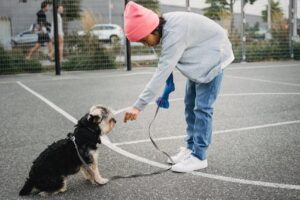
- Will not walk or freezes: do not drag your puppy – crouch, encourage with a happy voice and a treat, and reward any step toward you; let them build confidence at their own pace.
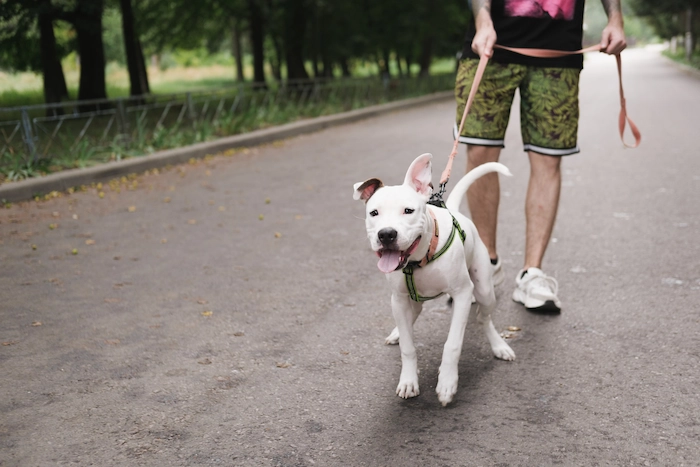
- Pulls on the leash: stop moving completely until the leash goes slack, then continue; your puppy learns that pulling stops the walk and a loose leash keeps it going.
- Bites the leash: stop, redirect with a simple cue like sit, then reward – turning the focus from the leash back to you.
- Gets overwhelmed: return to an easier, quieter setting and rebuild; too much distraction too soon is the most common setback.
“Stopping every time the lead goes tight is the right method and it fails for a reason nobody mentions: you’ve got somewhere to be. It only works if you’re genuinely prepared to stand outside next door’s gate for six minutes, and at half past seven on a Tuesday you’re not – so you give in, she gets there anyway, and now she’s learned that pulling works about a third of the time, which is the hardest lesson of the lot to undo. So decide before you open the door which one this is. If it’s a training session, bring nothing but time and don’t plan a route. If it’s a trip to the postbox, take the lead short and get on with it. Nobody teaches loose-lead walking and gets somewhere on the same outing.”
— Charlie Angel Chun Expert Trainer & Consultant (Behavioral Rehabilitation & Society Acclimation)
How Long Does Leash Training Take?
Most puppies learn the basics of loose-leash walking within a few weeks of short daily sessions, with reliable walking taking a few months. The timeline depends on your consistency and your puppy’s age and temperament, so focus on steady progress rather than speed. A few minutes of happy practice each day beats occasional long, frustrating sessions.
From Leash to Freedom: The Off-Leash Transition
The loose-leash skills your puppy learns now are the foundation for safe off-leash freedom later. A puppy who walks attentively beside you, responds to cues, and checks in is well on the way to being trusted with more freedom as they mature. That transition is not a single leap – it moves from leash, to long line, to off-leash in a safe, contained space, and only later to open areas. Our guide to off-leash training covers how to judge each step.
Readiness comes down to two things: a recall that holds under distraction, and a puppy who checks in with you without being asked. Build a reliable recall alongside leash training and you are working on both at once.
Choosing the Right Leash and Collar
The right gear makes leash training easier, and the most important factor is a proper fit. A collar should be snug but comfortable – you should be able to slip two fingers underneath; too tight is uncomfortable, too loose risks your puppy backing out of it. For training, a standard fixed-length leash gives you more control than a retractable one, which is better saved for later, once your dog walks reliably. Many trainers and vets suggest clipping the leash to a well-fitted harness rather than the collar while your puppy is still learning, since a small dog throwing their weight against a neck collar puts that force straight onto the windpipe.
A GPS collar is a later chapter, not a puppy purchase. Halo recommends waiting until a dog is at least 5 months old before starting fence training, and that recommendation is about development rather than size: boundary training asks a dog to understand a rule about space they cannot see, which is beyond an 8-week-old. When your dog reaches that stage, our guide to GPS fences for puppies covers how to introduce one. For now, simple, well-fitted gear and patient training are all you need – and when the time comes, the Halo Collar 5 fits neck sizes from 8 to 30.5 inches on one adjustable strap, so it grows with your dog rather than being outgrown.
Frequently Asked Questions
At what age should you start leash training a puppy?
You can start leash training a puppy at around 8 weeks old, as soon as they come home, using short and gentle sessions to introduce the collar and leash positively.
How long does it take to leash train a puppy?
Most puppies grasp the basics within a few weeks of short daily practice, with reliable loose-leash walking developing over a few months, depending on consistency and temperament.
How do I leash train a puppy that will not walk?
Never drag a puppy who will not walk; instead crouch down, encourage them toward you with a happy voice and treats, and reward every step until their confidence grows.
Can I walk my puppy before their vaccinations are finished?
Not on public ground. Practice at home and in your own yard until the course is complete, usually around 16 weeks, and ask your vet when it is safe to walk on sidewalks and in parks where unknown dogs have been.
When can a dog start off-leash training?
Off-leash training usually begins once a dog reliably walks on leash and responds to recall, often as they mature past puppyhood, starting in safe, enclosed spaces first.